

More news on this day
Thousands of travelers across China are facing severe disruption today as airports in Shanghai, Beijing, Guangzhou, Shenzhen, Chengdu, Xi’an, Nanjing, Changsha, Wuxi and other major cities report 316 flight cancellations and 2,211 delays, causing extensive knock-on impacts for Air China, China Eastern, China Southern, Shenzhen Airlines and other carriers.
Get the latest news straight to your inbox!
Major Chinese Hubs Buckle Under Heavy Disruption
Publicly available flight tracking dashboards indicate that the disruption is concentrated at China’s largest domestic hubs, including Shanghai’s Pudong and Hongqiao airports, Beijing Capital and Beijing Daxing, Guangzhou Baiyun and Shenzhen Bao’an. Secondary but still significant congestion is being reported at Chengdu, Xi’an, Nanjing, Changsha, Wuxi and a string of other regional gateways feeding the country’s dense internal network.
The combined total of 316 cancellations and 2,211 delays represents a sizeable shock to the country’s tightly timed aviation system. Even a relatively modest percentage of daily flights being cancelled or running late can quickly escalate into missed connections, aircraft and crew out of position, and extended ground holds as airlines attempt to rebuild schedules.
Operational data for recent days show that these airports have already been running under pressure, with several hubs recording hundreds of delayed movements in a single 24 hour period. Today’s figures add another layer of strain, with disruption no longer restricted to one or two weather affected regions but rippling along the east coast and deep into central and western China.
With so many of the affected airports also serving as key bases for China’s largest airlines, irregular operations on this scale are translating into widespread inconvenience for passengers on both trunk and regional routes.
Air China, China Eastern and China Southern Among Hardest Hit
China’s three big state controlled carriers, Air China, China Eastern Airlines and China Southern Airlines, appear to be among the most exposed to the current wave of cancellations and delays. Public statistics on recent performance show each airline operating high volumes of daily flights linking Beijing, Shanghai, Guangzhou and Shenzhen with dozens of domestic cities, meaning schedule shocks at any of the main hubs quickly cascade through their networks.
China Eastern, headquartered in Shanghai, relies heavily on its dual hub system at Pudong and Hongqiao. When outbound flights from these airports are delayed or cancelled, services to destinations such as Xi’an, Chengdu, Changsha and Wuxi can be affected within hours. Similarly, Air China’s strong presence in Beijing and China Southern’s base in Guangzhou tie their performance closely to conditions at those airports, especially on heavily trafficked north south corridors.
Shenzhen Airlines, which uses Shenzhen Bao’an as a primary base, is also experiencing disruption as late running arrivals constrain aircraft availability for subsequent departures. Industry summaries of recent operations have highlighted Shenzhen as one of the airports with particularly dense clusters of delays and cancellations in early April, leaving little slack in schedules when additional disruptions occur.
Published flight status information for individual services in and out of Beijing, Shanghai and Shenzhen today shows multiple cancellations alongside prolonged departure and arrival delays, underlining how a relatively small number of problem flights per hour can reverberate across large fleets and complex route maps.
Qingming Holiday Demand Amplifies Passenger Impact
The timing of the disruption is particularly challenging for travelers because it overlaps with China’s Qingming Festival holiday period, which in 2026 runs from April 4 to April 6. This long weekend typically brings a sharp rise in domestic and short haul regional trips as families travel to visit relatives or take short seasonal breaks.
Recent commentary from travel analysts and frequent flyer communities has already noted higher fares and fuller flights across the first week of April, especially on routes linking major cities such as Beijing, Shanghai, Guangzhou and Chengdu. When flights are operating near capacity in a holiday window, even a single cancellation can leave hundreds of passengers competing for a limited number of remaining seats.
With 316 cancellations reported today, many on popular trunk routes, the knock on effect for rebooking options is significant. Later services in the day are often already heavily sold, and some travelers face the prospect of overnight stays or longer rerouting journeys via secondary hubs if direct seats are unavailable.
For passengers with fixed plans, such as tour departures, family gatherings or connecting international flights, the combination of peak season demand and network wide disruption greatly reduces flexibility compared with off peak travel periods.
Operational Pressures Range from Weather to Congested Airspace
While a single clear cause has not been identified for today’s precise tally of 316 cancellations and 2,211 delays, recent days of data and regional reporting point to a combination of factors. Strong storm systems affecting parts of southern and eastern China have periodically reduced airport capacity, particularly at coastal hubs including Guangzhou, Shenzhen and Shanghai.
At the same time, reports indicate that constraints in en route airspace can force airlines and air traffic managers to meter departures or impose holding patterns, extending flight times and triggering late arrivals at already busy terminals. When conditions require diversions or go arounds, aircraft and crews can be left out of position, amplifying the disruption beyond the initial weather window.
China’s airlines have also recently transitioned into the 2026 summer and autumn timetable period, adding new frequencies on a range of domestic routes. While increased capacity supports demand growth, it can also tighten margins for operational recovery when unexpected constraints arise, as schedules run with less built in slack for disruptions.
Industry observers suggest that the confluence of seasonal storms, airspace bottlenecks and aggressive schedules has created a fragile operating environment in which relatively modest shocks lead quickly to visible delays and cancellations at multiple airports concurrently.
Travelers Face Missed Connections and Crowded Service Counters
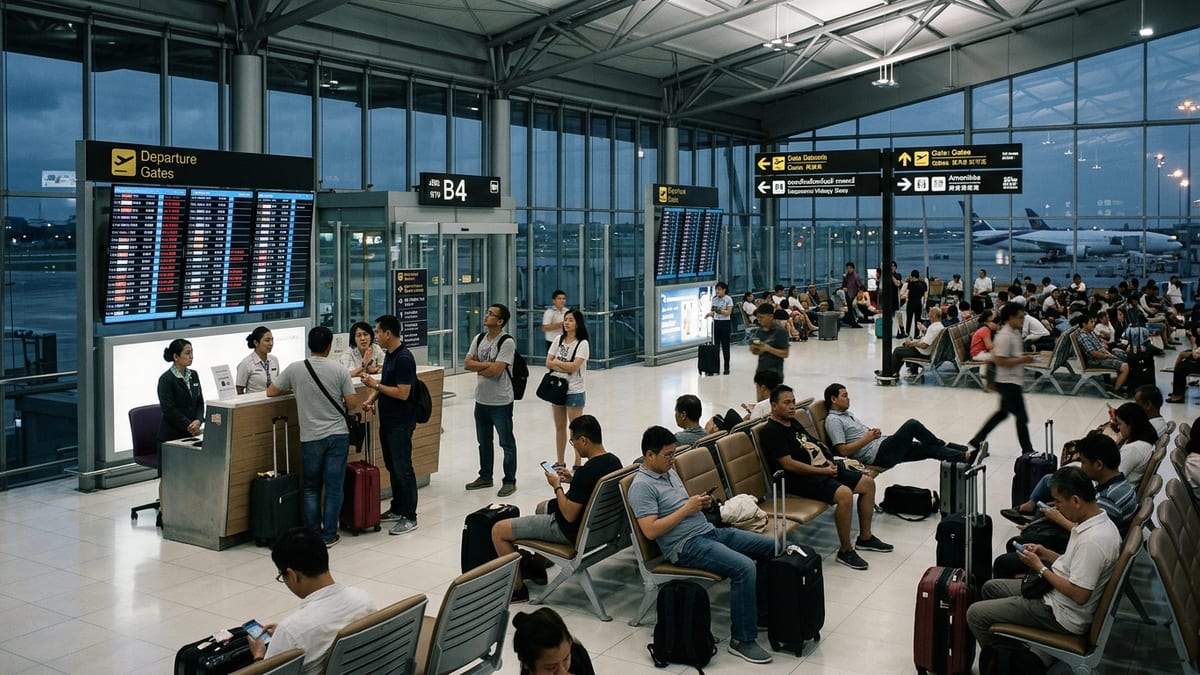
For passengers on the ground, today’s statistics translate into long waits at departure gates and crowded airline counters across many of China’s busiest terminals. Missed onward flights are a particular concern for travelers relying on tight domestic connections to reach smaller cities from major hubs such as Beijing, Shanghai, Guangzhou, Chengdu and Xi’an.
When an early leg into a hub is cancelled or significantly delayed, the same aircraft cannot operate its subsequent sectors, and passengers booked on those later flights can find themselves suddenly without a seat. This dynamic is especially pronounced during the Qingming holiday period, when alternative departures later in the day may already be close to full.
Publicly available guidance from airlines and consumer advocates typically encourages passengers to monitor flight status closely through official digital channels, arrive early at airports during peak periods, and build in longer connection windows where possible during seasons prone to disruption. Travel forums and recent discussion threads also highlight a growing interest in flexible hotel reservations and travel insurance products that cover delays and missed connections within China.
As operations gradually stabilize, airlines are expected to work through rebookings and reposition aircraft to restore normal schedules. However, with disruption spread across multiple hubs today, residual delays are likely to persist into subsequent days as carriers clear backlogs and attempt to realign aircraft and crews with published timetables.