

More news on this day
Thousands of air travellers across mainland China were left in limbo today as a fresh wave of cancellations and delays affected services operated by China Eastern, Air China, China Southern, XiamenAir and several other carriers at major hubs including Shanghai, Beijing, Xi’an, Guangzhou and Chengdu.
Get the latest news straight to your inbox!
New Wave of Cancellations and Delays Hits Key Chinese Airports
Publicly available aviation data for today indicates that flight operations at several of China’s busiest airports have come under renewed strain, with dozens of services cancelled and many more running late. The latest figures point to at least 87 cancellations and around 100 recorded delays concentrated at hubs such as Shanghai Pudong, Shanghai Hongqiao, Beijing Capital, Beijing Daxing, Guangzhou Baiyun, Chengdu Tianfu and Xi’an Xianyang.
The disruption follows several days of irregular operations across the country, during which earlier tallies already showed triple-digit cancellation and delay numbers at many of the same airports. Today’s update suggests that while the scale is somewhat lower than previous peaks, the impact on travellers remains severe, particularly for those relying on tight domestic connections.
Travel-industry roundups and airport status boards show that Shanghai and Beijing corridors have again acted as pressure points in the national network. Services linking the capital region with key commercial centres in the Yangtze River Delta and Pearl River Delta appear to make up a substantial share of the flights affected, compounding disruption for business and leisure passengers alike.
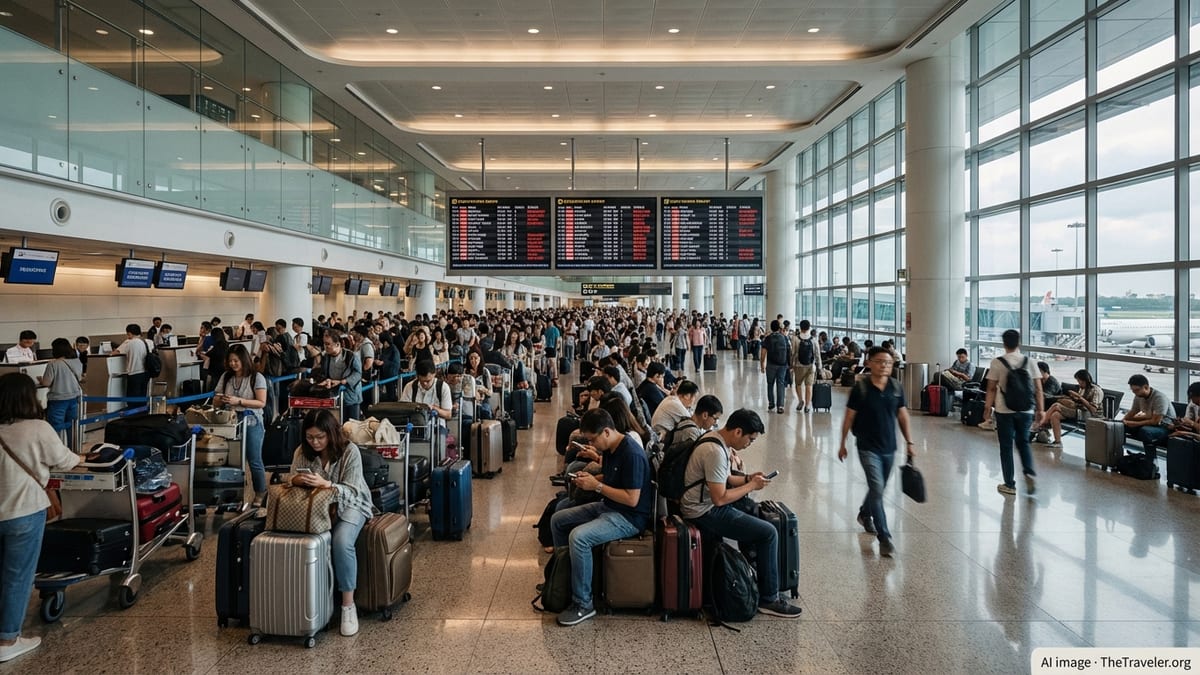
Although operations have not ground to a complete halt, the combination of cancellations and extended delays has left departure halls crowded through much of the day, with many passengers searching for rebooking options or last-minute alternatives by rail.
Major Carriers Among the Most Affected
According to aggregated flight-tracking boards and aviation analytics platforms, the latest bout of disruption has once again fallen heavily on China’s largest full-service airlines. China Eastern, Air China and China Southern feature prominently in today’s cancellation and delay lists, reflecting their dominant presence at hubs in Shanghai, Beijing and Guangzhou.
China Eastern, headquartered in Shanghai and operating a dense domestic network through both Pudong and Hongqiao, appears particularly exposed on trunk routes between Shanghai, Beijing and inland centres such as Xi’an and Chengdu. Publicly available performance statistics already indicate a pattern of tight scheduling on these corridors, and today’s irregular operations add further stress to aircraft and crew rotations.
Air China and China Southern, the main flag carriers at Beijing and Guangzhou respectively, also show significant numbers of affected flights in today’s data. Their extensive networks mean that disruption at one or two major hubs can rapidly cascade to secondary cities, including Changsha, Nanjing, Kunming and other important regional gateways.
Several other operators, including XiamenAir, Shenzhen Airlines, Sichuan Airlines and Hainan Airlines, also appear in today’s disruption summaries. While their absolute numbers are smaller than those of the three largest carriers, their role in connecting coastal hubs to regional centres has meant that passengers on these airlines are experiencing similar waits and last-minute schedule changes.
Network Under Pressure After Days of Weather and Congestion Issues
Today’s events come on the heels of a turbulent period for China’s aviation network. In the past few days, travel-focused coverage and flight-tracking snapshots have documented multiple waves of disruption driven by a mix of adverse weather, chronic congestion at busy hubs and knock-on operational challenges.
Earlier this week, reports highlighted more than a thousand delays and over a hundred cancellations in a single day across key airports such as Beijing, Chengdu, Guangzhou, Shenzhen, Hangzhou and Kunming. Separate updates pointed to additional cancellations and delay clusters tied to weather systems moving across Guangdong, Sichuan, Xinjiang and Zhejiang, again affecting many of the same carriers now prominent in today’s figures.
This repeated pattern means that today’s cancellations and delays are hitting a network that was already stretched. Aircraft and crew that were out of position after previous rounds of disruption have had limited time to return to normal rotation, increasing the likelihood that relatively small schedule revisions or air-traffic control constraints can trigger further cancellations on short notice.
For travellers, this has translated into longer-than-usual queues at check-in and transfer desks, crowded waiting areas and heightened competition for the remaining available seats on alternative flights, especially on popular evening departures.
Airports and Passengers Grapple With Ongoing Disruption
At Shanghai’s dual-airport system and Beijing’s two major gateways, today’s statistics show disruption cutting across both domestic and limited international services. Flight boards at Shanghai Pudong, in particular, list clusters of late departures on routes to Guangzhou, Chengdu, Xi’an and inland provincial capitals, while Shanghai Hongqiao sees a mix of delays and cancellations on high-frequency shuttle services to Beijing and other eastern business centres.
In Beijing, publicly visible status screens indicate that both Capital and Daxing airports have been handling a combination of delayed arrivals and cancelled outbound departures. Routes to southern and western cities such as Guangzhou, Chengdu and Xi’an feature strongly among the affected flights, reflecting their status as core business and transit corridors.
Further south, Guangzhou and Chengdu continue to act as focal points for delay-heavy operations. Available imagery and reports from recent days show departure halls at these airports filling quickly whenever batches of flights are rescheduled, with queues forming at ticket counters and service desks as passengers attempt to secure updated itineraries.
For many travellers, especially those connecting from smaller regional airports through Shanghai, Beijing or Guangzhou to other domestic destinations, today’s irregular operations have meant missed onward flights and, in some cases, overnight stays near airports while waiting for rebooked services.
What Travellers Can Do if Their Flight Is Affected
With cancellations and delays continuing to ripple across China’s aviation network, travel advisers and passenger-rights advocates generally recommend that affected travellers take a proactive approach to managing their itineraries. The most consistent guidance is to monitor flight status closely through official airline apps or airport information channels, which often update more quickly than physical departure boards.
For those who have not yet left for the airport, checking real-time status and gate information before departure can help avoid unnecessary waiting in crowded terminals. Where cancellations have already been confirmed, many airlines enable rebooking or refund processing through digital platforms, reducing the need to queue at service counters during peak disruption.
Passengers who are already at the airport and facing long delays or cancellations are often advised to document their situation carefully. Keeping boarding passes, booking confirmations and any written delay or cancellation notices can be important if travellers later need to pursue expense reimbursement or make insurance claims, depending on the terms of their policies.
Given the recent pattern of repeated disruption, some travel planners suggest building in longer connection times at China’s busiest hubs, avoiding the last flight of the day on critical routes where possible and considering rail alternatives on corridors with strong high-speed train coverage, such as those linking Shanghai, Beijing, Nanjing and other eastern cities.