

More news on this day
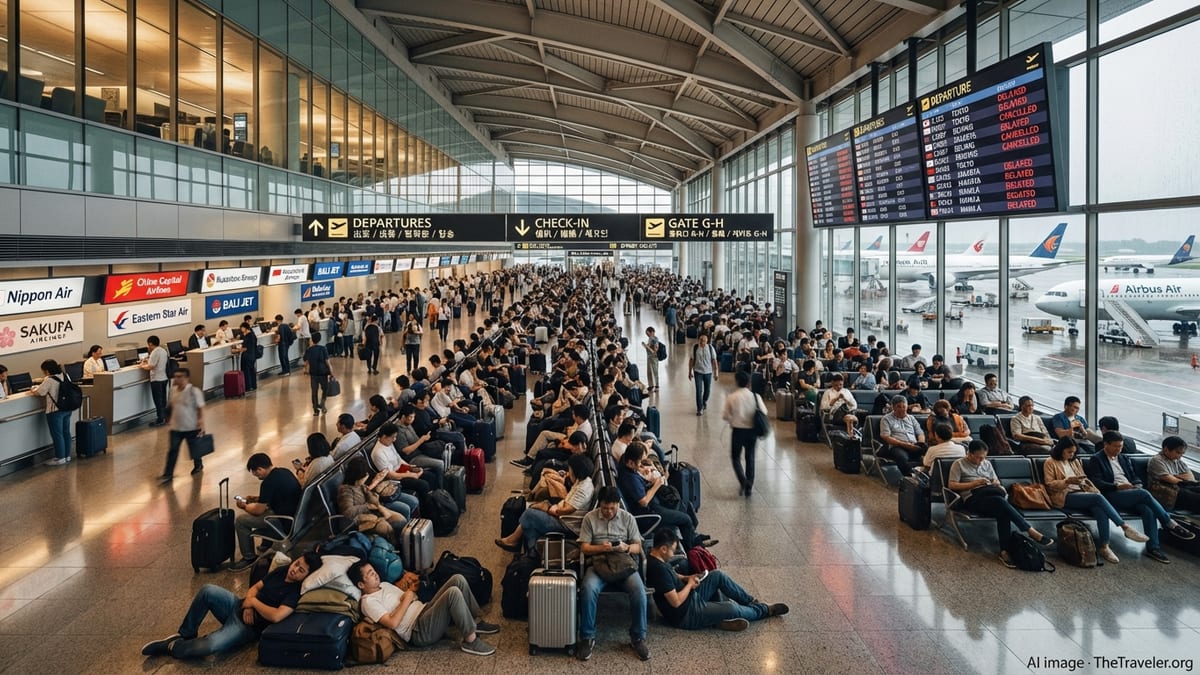
Hundreds of travelers across China and Southeast Asia have been caught in fresh aviation turmoil, as publicly available tracking data and regional reports indicate that 449 flights operated by China Eastern and Lao Airlines have suffered delays amid a wider bout of Asia-Pacific disruption.
Get the latest news straight to your inbox!
Data Points to Concentrated Disruption for Two Regional Carriers
Operational data compiled by independent aviation trackers and regional travel advisories suggest that China Eastern and Lao Airlines have been disproportionately affected in the latest wave of flight disruption across the Asia-Pacific region. Within a single operating window, the two carriers together accounted for 449 delayed services, a figure that stands out even against a backdrop of elevated delays across major hubs.
Reports indicate that China Eastern, one of China’s largest state-backed carriers with a significant presence at Shanghai Pudong and other coastal hubs, accounted for the majority of those delays. Lao Airlines, the flag carrier of Laos and an important connector between Vientiane and secondary Chinese cities, contributed a smaller but still notable share, particularly on cross-border routes linking mainland China with Indochina.
Industry-facing summaries published in recent days describe a pattern in which regional carriers with dense intra-Asia schedules have been more vulnerable to knock-on effects once the first wave of delays sets in. For China Eastern and Lao Airlines, this has meant that a relatively small number of early operational issues have propagated across the day, affecting flights well beyond the initial problem airports.
Although precise passenger counts have not been disclosed, aviation analysts note that wide-body and high-frequency narrow-body routes common in the networks of both airlines mean that tens of thousands of travelers are likely to have been touched by the disruptions in some form, whether through late departures, missed connections, or extended time on the ground waiting for aircraft and crew.
Weather, Airspace Bottlenecks and Network Complexity
According to recent Asia-Pacific disruption summaries, the latest wave of delays has arisen from a mix of adverse weather, airspace constraints, and operational strain at several busy regional hubs. Poor visibility and seasonal weather patterns have periodically slowed arrivals and departures at airports from Shanghai to Kunming, putting pressure on airlines that rely on tight turnarounds and high aircraft utilization.
Publicly available information indicates that congestion in certain air corridors has compounded the problem. When air traffic control introduces spacing measures or rerouting around congested sectors, aircraft can accumulate holding time en route, arriving late and leaving insufficient ground time for crews and ground handlers to reset for the next departure. This is particularly acute for carriers such as China Eastern, which operates dense banks of flights around peak morning and evening waves.
For Lao Airlines, the impact often appears in the final stages of multi-leg itineraries that connect Laos with Chinese cities via regional hubs. Travel advisories describe instances where incoming flights already running late from Chinese airports leave crews and aircraft out of position for onward departures, amplifying delays on subsequent sectors even when weather conditions have improved.
Network complexity also plays a role. Both airlines serve a mix of domestic, regional, and in China Eastern’s case, long-haul international routes. Analysts highlight that once a delay ripples into wide-body aircraft used on trunk or international sectors, it becomes more difficult to recover the schedule, especially when spare aircraft and crews are limited under current cost-control strategies.
China’s Major Hubs Under Pressure
Recent coverage of operations at major Chinese airports points to an overall deterioration in punctuality as travel demand has rebounded. Reports focused on days of acute disruption at hubs such as Shanghai Pudong, Beijing Daxing, Guangzhou Baiyun, and Chengdu indicate that hundreds of flights across multiple carriers can experience delays during a single day when weather or airspace restrictions align unfavorably.
China Eastern, with its primary base in Shanghai and substantial slots at other primary hubs, is frequently cited in these reports as carrying a significant share of delayed operations whenever large-scale disruption occurs. Even on days when cancellations remain comparatively low, the number of delayed flights has been high, reflecting a preference by airlines to hold flights rather than cancel outright in order to preserve connectivity and reduce the risk of compensation claims on routes governed by international passenger rights regimes.
Regional observers note that secondary Chinese airports feeding into these hubs also contribute to the problem. When provincial airports experience localized weather or airport-capacity constraints, departure delays can cascade into late-arriving aircraft at the main hubs, placing further strain on departure banks and creating gridlock during peak hours.
For passengers traveling with Lao Airlines into or out of China, this dynamic can be particularly challenging. Flights linking Vientiane and Luang Prabang with Chinese cities often rely on coordinated schedules and short connection times at partner or codeshare airports. When arrival slots in China shift due to congestion, the viability of onward connections narrows quickly, sometimes forcing rebooking or overnight stays.
Passenger Experience and Travel Planning Impact
The immediate effect of 449 delays concentrated across two airlines is measured not just in hours lost, but in missed business meetings, disrupted holiday plans, and increased costs borne by travelers. Social media posts and traveler discussion forums show an uptick in complaints regarding extended ground delays, rebooking challenges, and confusion over entitlement to care and compensation on international sectors involving Chinese carriers.
Public-facing information from the airlines emphasizes standard industry practices such as rebooking on the next available service when delays result in missed connections, but travelers often report difficulty in securing clear guidance during peak disruption periods. Language barriers, high call-center volumes, and airport staff stretched across multiple delayed flights contribute to longer resolution times at check-in counters and transfer desks.
Consumer advocates in the region encourage travelers affected by long delays to keep detailed records of boarding passes, delay notifications, and any additional expenses, noting that insurance policies and, in some jurisdictions, passenger-protection regulations may offer partial relief. However, they also acknowledge that the regulatory framework for compensation on routes involving non-domestic carriers can be complex and varies significantly between departure and arrival countries.
In practical terms, travel-planning services are advising passengers flying with China Eastern or Lao Airlines on regional routes to build in longer connection buffers where possible, particularly when moving through Shanghai and other high-traffic hubs. Flexible itineraries, early-morning departures, and avoiding tight same-day onward connections are among the strategies being suggested to reduce the risk of being stranded if another major disruption spike occurs.
What the Turmoil Signals for Asia-Pacific Aviation
Aviation analysts view the concentrated delays at China Eastern and Lao Airlines as part of a broader stress test for Asia-Pacific aviation as the region continues to scale back up toward pre-pandemic traffic levels. Airlines have added capacity and reopened routes faster than some infrastructure and staffing levels have been able to accommodate, leaving little margin to absorb shocks from weather or geopolitical events.
Recent regional data snapshots showing thousands of delays and hundreds of cancellations across Asia-Pacific on peak disruption days underscore how interconnected the system has become. When key hubs in China, Southeast Asia, or the Middle East experience operational challenges, their effects can ripple quickly into seemingly unrelated routes, including those operated by mid-sized carriers such as Lao Airlines.
For China Eastern, the latest turmoil highlights the challenge of maintaining reliability while operating one of the region’s most complex networks. For Lao Airlines, it underlines the vulnerability of smaller flag carriers that depend heavily on timely operations at foreign hubs to keep their schedules intact.
Observers suggest that unless capacity, staffing, and airspace management keep pace with rising demand, travelers across the region should expect further episodes of large-scale delay clusters. For now, the 449 delays affecting China Eastern and Lao Airlines stand as a vivid illustration of how quickly turbulence in the aviation system can translate into real-world disruption for passengers on the ground and in the air.