

More news on this day
China’s railway system has recorded its strongest Spring Festival travel rush on record in 2026, with unprecedented passenger volumes, heavier cargo flows and new efficiency gains that are reshaping how people and goods move across the world’s second-largest economy.
Get the latest news straight to your inbox!
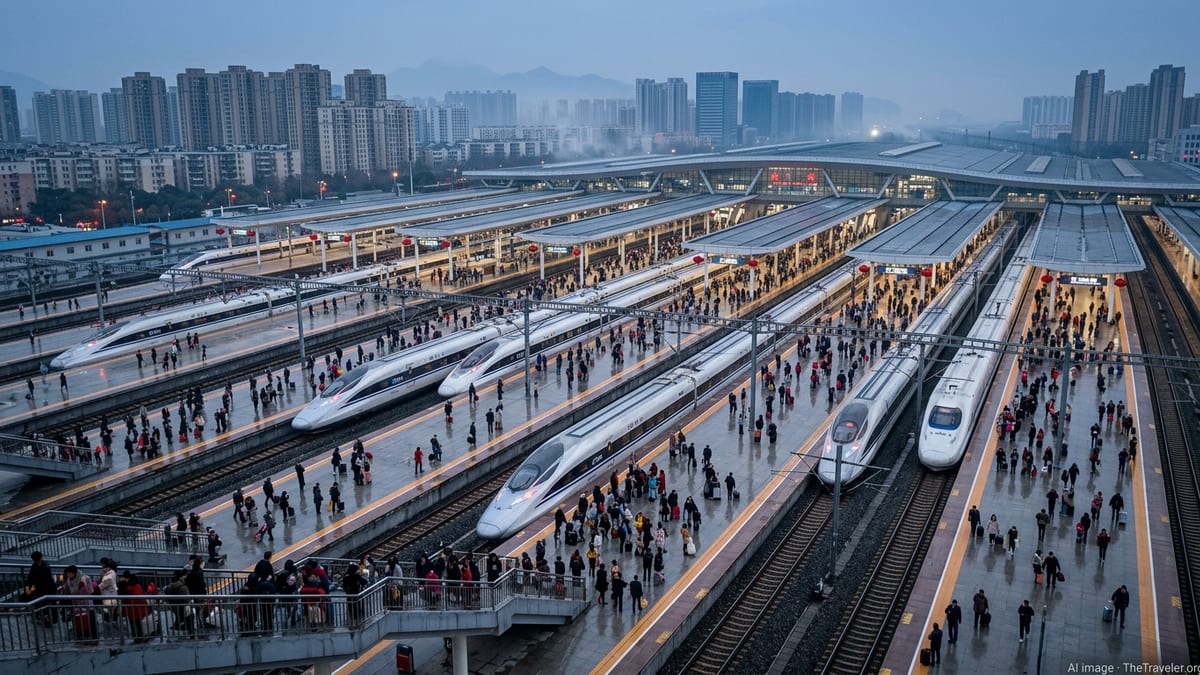
Record Passenger Volumes Redefine Holiday Travel
The 40-day 2026 Spring Festival travel rush, known in China as chunyun, has emerged as a landmark season for the country’s railways, with passenger figures surpassing even the ambitious forecasts set before the holiday period began. Publicly available planning data from China Railway had projected around 540 million rail passenger trips for the season, a 5 percent increase on 2025 and a new all-time high. As the period drew to a close in mid-March, indications from aggregated transport reports suggested that actual rail usage not only met but exceeded those targets, cementing rail’s role as the backbone of the world’s largest annual human migration.
Daily peaks during the rush underlined the scale of demand. On several days around the start and end of the official Lunar New Year holiday, national rail passenger volumes were reported in excess of 18 million trips in a single day, setting fresh records for Spring Festival traffic. These peaks occurred despite a more staggered pattern of departures and returns, as workers, students and tourists spread their journeys over a wider window to avoid crowding and secure better fares.
The record-setting performance comes against a backdrop of broader mobility growth. Overall inter-regional passenger movements across all modes during the 2026 rush were estimated at around 9.5 billion trips, according to economic planning figures cited by multiple news outlets. Within that wider surge, the rail network held its position as the most heavily used long-distance option, thanks to its extensive coverage, range of price points and improving reliability.
For domestic travelers and visitors alike, these numbers translated into fuller trains but also more options. Extra services on popular corridors such as Beijing–Shanghai, Beijing–Guangzhou and routes into major migrant-sending provinces allowed many passengers to secure tickets that in past years would have been out of reach.
Freight Capacity Keeps Factories and Ports Supplied
While passengers dominate public attention during chunyun, the 2026 season has also highlighted how China’s railways are carrying unprecedented amounts of cargo through the holiday period. Logistics industry tracking and port-side reports indicate that railway freight volumes remained robust or even rose in some regions, supported by strong container traffic to and from major coastal ports and inland logistics hubs.
Several large ports reported double-digit growth in container throughput during the Lunar New Year window compared with the previous year, pointing to resilient export demand and more efficient hinterland connections. Rail has been a key link in those flows, moving containers and bulk cargo between manufacturing clusters in the interior and terminals on the eastern seaboard, even as passenger operations ramped up.
Maintaining freight performance during the busiest passenger season required careful capacity management. Schedules were adjusted to prioritize time-sensitive goods, with more night-time freight paths and tighter coordination between marshalling yards, intermodal terminals and shipping lines. According to publicly available logistics commentary, this helped keep supply chains stable for industries such as electronics, automotive components and e-commerce, which increasingly rely on rail to avoid highway congestion.
The result is a dual-track success story: passenger trips surged to record highs without displacing critical freight, and cargo volumes stayed strong despite the annual holiday disruption. For manufacturers and retailers, this translated into fewer delays, more predictable inventory flows and greater confidence in rail as a year-round logistics backbone.
High-Speed Network and Digital Tools Boost Efficiency
Underlying the 2026 performance is a high-speed rail and conventional network that has grown denser, faster and more technologically sophisticated over the past decade. China has continued to extend its high-speed rail mileage, linking more second- and third-tier cities into the national grid, and upgrading existing lines to handle higher frequencies and speeds during peak demand.
During the 2026 rush, rail operators leaned heavily on digital platforms and big data tools to refine timetables and match rolling stock to demand in near real time. Ticketing platforms were used to monitor booking patterns and adjust train formations, adding carriages on heavily booked services and scheduling extra trains on the busiest days. Artificial intelligence and predictive analytics supported crowd-flow management in major stations, helping smooth passenger movements through ticket halls, security checks and boarding gates.
On flagship high-speed corridors, extra overnight services were introduced to maximize track capacity without significantly impacting daytime reliability. Reports on railway operations noted increases in overnight high-speed trains on routes such as Beijing–Guangzhou and Beijing–Shanghai, providing additional options for long-distance travelers and easing pressure on daylight schedules.
These changes contributed to shorter queues, fewer last-minute cancellations and improved punctuality compared with earlier years, according to accounts compiled from domestic media coverage and travel platforms. For millions of passengers, the experience of chunyun, long associated with packed waiting rooms and anxious ticket searches, is gradually shifting toward a more predictable form of mass mobility.
Regional Hubs and Cross-Border Links Gain Prominence
The 2026 rush also underscored the growing importance of regional hubs and cross-border routes within China’s rail system. Cities such as Chongqing, Chengdu, Wuhan and Nanning played increasingly central roles as transfer points and destinations, reflecting broader trends in population movement and tourism. Local authorities and railway bureaus in several of these hubs announced plans or preliminary figures pointing to record passenger volumes, in some cases outpacing traditional coastal centers.
New and upgraded stations, including large integrated transport hubs, enabled smoother transfers between high-speed rail, conventional trains, metro systems and buses. These nodes have become critical to handling flow surges during key days of the rush, channeling travelers from smaller cities and rural areas onto mainline corridors and then on to their final destinations.
Cross-border passenger and freight links also featured in the 2026 season, particularly on lines connecting southern China with Southeast Asia. Reports on services between China and neighboring countries described strong occupancy on international trains as migrant workers, students and tourists took advantage of improved timetables and simplified transfer arrangements. At the same time, freight operators continued to run China–Europe and regional intermodal services through the holiday period, though often on adjusted schedules.
These developments highlight how China’s domestic railway network is increasingly integrated into a wider regional transport web, with Spring Festival travel patterns offering an annual stress test for new routes and partnerships.
Economic Signals and Future Challenges
The record-breaking 2026 Spring Festival rail numbers carry significant economic implications. Heavy passenger traffic is widely viewed as a barometer of household confidence, suggesting that millions of people still have both the means and motivation to undertake long journeys for family reunions and leisure, even amid lingering concerns about growth and employment in some sectors. Strong freight volumes, particularly in export-related corridors, add to the picture of continued industrial and trade activity.
For policymakers and planners, the season’s data provide insights into shifting travel patterns. Demand growth has been especially noticeable on routes serving inland provincial capitals and emerging tourist destinations, indicating that consumption and mobility are spreading beyond the traditional coastal strongholds. At the same time, the surge has highlighted bottlenecks that persist in certain corridors, especially where conventional lines must juggle dense mixes of passenger and freight traffic.
Looking ahead, published commentary from transport analysts points to several priorities. These include further expansion of high-speed and intercity links in densely populated regions, continued modernization of signaling and scheduling systems, and additional investment in station and depot capacity to cope with peak-season surges. There is also rising interest in greener operations, from wider electrification of freight routes to more energy-efficient rolling stock and station design.
Even as the 2026 rush sets new benchmarks, the challenge for China’s railway system will be to convert seasonal successes into sustainable, year-round gains. The latest figures suggest that the network is moving in that direction, with a combination of infrastructure, technology and operational reforms enabling record numbers of passengers and cargo to move more efficiently than ever during the country’s most important holiday period.