

More news on this day
Hundreds of China Southern Airlines passengers have been left stranded at airports across Asia, Europe and North America after cascading cancellations linked to Middle East airspace closures deepened what aviation analysts are calling the worst global travel disruption since the Covid era.
Airspace Lockdowns Ripple Across Global Routes
The latest wave of disruption follows sweeping airspace restrictions across the Middle East in the wake of US and Israeli strikes on Iran, which prompted Iran and several Gulf states to shut or severely restrict their skies. Airlines that normally rely on these corridors to connect Asia with Europe and North America have been forced to reroute or ground services, leaving aircraft and crews out of position worldwide.
While the initial impact was concentrated around major hubs such as Dubai, Abu Dhabi and Doha, aviation data now shows the shock spreading deep into wider networks. Carriers are cancelling or heavily delaying long haul services that would usually cross airspace over Iran, Iraq and neighbouring states, with knock on effects reaching airports as far apart as London, Amsterdam, Seoul, Tokyo, Vancouver and Auckland.
For China Southern, which operates extensive connections between Chinese hubs and cities in Europe, the United Kingdom, Southeast Asia and Oceania, the sudden loss of key overflight corridors has disrupted carefully calibrated schedules. Aircraft that should be cycling through Guangzhou, Beijing and Shanghai are stuck on the ground abroad, while crews are timing out under duty rules, forcing further cancellations.
Aviation analysts say that although airlines are attempting to route some services along longer paths avoiding restricted zones, these flights are slower, more fuel intensive and often constrained by crew and aircraft availability. As a result, many departures are being withdrawn from schedules at short notice, catching passengers off guard at departure gates around the world.
Stranded Passengers From China To Canada
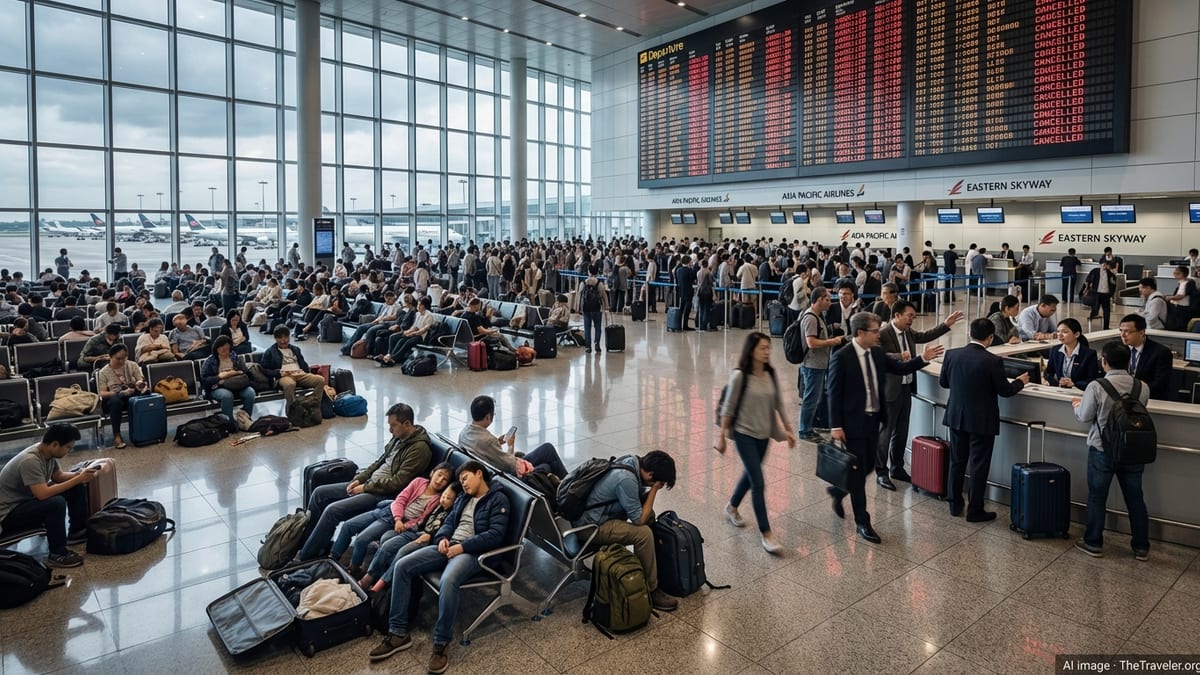
The impact on travellers has been immediate and highly visible. At major Chinese gateways including Beijing Capital, Shanghai Pudong and Guangzhou Baiyun, departure boards on Monday showed a mix of delayed and cancelled China Southern services, with clusters of stranded transfer passengers congregating near airline service desks after missing onward connections.
In Thailand and Indonesia, two of China Southern’s busiest Southeast Asian markets, travellers reported being told to expect waits of 24 hours or more for rebooking. Crowded scenes were reported at Bangkok Suvarnabhumi and Phuket in Thailand, as well as Bali’s Ngurah Rai Airport, where holidaymakers bound for China or onward to Europe via Chinese hubs have found their itineraries abruptly cut short.
Further afield, disruptions have extended into New Zealand and South Korea. At Auckland and Christchurch, China Southern passengers heading to Guangzhou for connections to Europe faced cancellations or significant delays as the carrier recalibrated schedules. In Seoul and Busan, travellers destined for Chinese hubs encountered similar uncertainty, with some services retimed and others pulled entirely.
Airports in the Netherlands, Kazakhstan, Japan, the United Kingdom and Canada have all reported scattered China Southern cancellations among a wider field of disrupted services by carriers from Europe, the Middle East and Asia. At Amsterdam Schiphol, London Heathrow, Tokyo Narita and Vancouver, passengers bound for China and onward destinations have been caught up in the unfolding network shock, with long lines forming at customer service counters as travellers seek rerouting or refunds.
China Southern Adjusts Network Amid Mounting Cancellations
China Southern has not issued a detailed public tally of affected routes, but operational data from Chinese and international flight tracking services indicates that scores of its flights have either been cancelled outright or are operating with extended delays. Industry reports out of China suggest that the carrier is focusing limited aircraft and crew resources on maintaining core trunk routes between major hubs, while trimming or suspending more marginal connections that rely heavily on now restricted airspace.
On routes linking China with Europe, the United Kingdom and Canada, the airline is understood to be examining alternative routings that skirt Middle Eastern conflict zones, potentially tracking further north through Central Asia or along more southerly arcs via South Asia where permitted. These reroutings can add hours to flight times, increase fuel burn and reduce the number of rotations an aircraft can complete in a given day, further tightening capacity.
Domestic aviation in China is also feeling indirect strain. With long haul operations constrained, some widebody aircraft are being redeployed onto high demand internal routes and regional links, shifting the disruption rather than eliminating it. That in turn is complicating schedules at secondary hubs such as Chengdu and Zhengzhou, where passengers connecting from domestic flights to international services have seen their onward options suddenly disappear.
Executives across the Chinese airline sector are closely watching how long Middle Eastern airspace restrictions remain in place. Any protracted closure could force a more fundamental reset of long haul networks, including potential service suspensions on some intercontinental routes if operational and financial pressures mount.
European And Asian Hubs Struggle With Knock On Effects
In Europe and Northeast Asia, where China Southern connects into dense networks of partner and codeshare flights, airport operators are contending with cascading disruption. Slot constrained hubs such as Heathrow and Schiphol have little spare capacity to absorb irregular operations, meaning cancelled inbound flights from China can easily trigger missed onward connections for passengers booked on other carriers.
At Japanese gateways including Tokyo Narita, Haneda and Osaka Kansai, China Southern cancellations have joined a swelling list of schedule changes from other Asian and European airlines. Travellers bound for destinations in China, Southeast Asia and Australasia via Chinese hubs are being encouraged by local airport staff to contact airlines before heading to the airport and to build in additional margin for any rebooked journey.
In South Korea and the Netherlands, airline ground teams have reported challenges in sourcing accommodation and meal vouchers for stranded passengers as hotels near major airports quickly fill. Images from Seoul Incheon and Amsterdam Schiphol show long queues at ticket counters, with some passengers attempting to secure seats on rival airlines that still have limited capacity on surviving routes.
Canadian airports are also experiencing turbulence, particularly on routes to and from East Asia. Airspace closures and diversions have led to altered schedules for multiple transpacific carriers, including China Southern. Vancouver and Toronto, key entry points for travellers connecting onward to China, have seen rising numbers of delayed departures, as well as cancellations when aircraft are unable to position on time from disrupted Asian hubs.
Uncertain Timeline As Airlines Urge Passengers To Monitor Bookings
With airspace closures tied to an evolving geopolitical crisis and airlines still scrambling to redesign flight paths, there is little clarity on when China Southern’s network will stabilise. Aviation planners caution that even if some Middle Eastern skies reopen in the coming days, aircraft and crew will remain out of position, meaning irregular operations could extend well beyond the initial security shock.
Airports and airlines across the affected regions are urging passengers to monitor their bookings closely, use official apps and contact centres for real time updates, and avoid heading to airports until their flight is confirmed as operating. Many carriers, including China Southern, have introduced flexible change and refund policies for tickets touching affected dates or routes, though the specifics vary by fare type and point of purchase.
Travel agents in markets such as the United Kingdom, Thailand, Indonesia and New Zealand report heavy demand from customers seeking alternative routings that bypass the most severely affected hubs. However, with capacity constrained and many airlines facing their own operational challenges, seats on remaining viable itineraries are limited and often significantly more expensive.
Industry observers say the episode underlines how dependent global travel has become on a handful of strategic air corridors. With hundreds of China Southern and other airline passengers still waiting for a way home from airports across China, the United Kingdom, Thailand, Indonesia, New Zealand, South Korea, the Netherlands, Kazakhstan, Japan and Canada, it may take days before the scale of the disruption and the path to recovery become clear.