

More news on this day
China Southern Airlines is set to relaunch nonstop flights between Beijing Daxing International Airport and Helsinki Airport on 29 March 2026, deploying Boeing 787-9 aircraft on a route that will become Beijing Daxing’s first direct connection to Northern Europe and a new bridge in the evolving air corridor between China and Europe.
Get the latest news straight to your inbox!
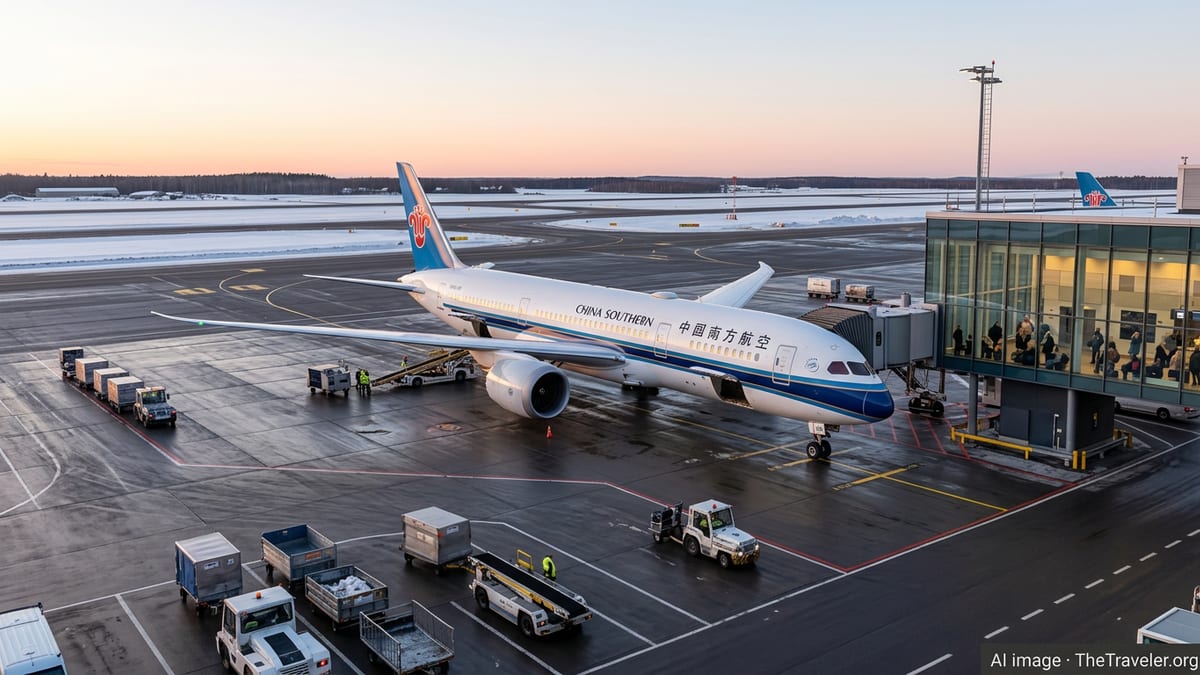
First Nordic Gateway from Beijing Daxing
Publicly available information from Finland’s airport operator and industry outlets indicates that the Beijing Daxing–Helsinki service will initially operate three times a week from late March 2026 before ramping up to daily flights from 20 June 2026. The route will be flown by China Southern’s Boeing 787-9 aircraft, adding both passenger capacity and belly-hold cargo space on the 6,400-kilometre sector between the Chinese and Finnish capitals.
Finavia, the company that manages Helsinki Airport, notes that Helsinki will be the first nonstop destination in Northern Europe served from Beijing Daxing. Reports also describe it as the airport’s inaugural direct link to any European city, underscoring how strategically significant the Finland connection is within Daxing’s still-maturing long-haul network.
Coverage in Nordic and aviation media further points out that this will be China Southern’s first scheduled service to Finland and the wider Nordic region. For Helsinki, which has sought to consolidate its role as a transfer hub between Europe and Asia, the restoration of a direct Beijing link is regarded as a key step in rebuilding its pre-pandemic long-haul footprint.
Reshaping Europe–China Travel Patterns
The new route arrives at a time when traditional Europe–China travel flows are still adjusting to post-pandemic demand and constraints created by airspace restrictions over parts of Russia. Published analyses highlight that several European carriers, including Finnair, have reduced or reshaped their networks to China, leaving gaps on some long-haul corridors that Asian airlines are now moving to fill.
By operating nonstop from Beijing Daxing to Helsinki, China Southern is positioning Helsinki as a convenient transfer point for passengers heading to and from Northern and Central Europe. Helsinki Airport’s compact layout and established banked connections to cities across Scandinavia, the Baltics, and parts of Central Europe mean that travellers from northern China can often reach secondary European destinations with a single transfer.
Travel industry reports suggest that the timing of the flight schedule is designed to connect efficiently with China Southern’s domestic and regional network from Daxing. Early-morning arrivals into Helsinki and daytime departures back to Beijing are expected to support same-day onward connections in both directions, making the route competitive against itineraries that require changes in hubs such as Frankfurt, Istanbul, Doha or Dubai.
Analysts also note that the additional premium economy and business-class seating on China Southern’s Boeing 787-9s could appeal to corporate and high-yield leisure travellers. As business links between China and Northern Europe in sectors like technology, clean energy and forestry continue to recover, convenient point-to-point and one-stop options are likely to be a key factor in route performance.
Cargo, Tourism and Trade Benefits
Helsinki’s role as an export gateway means that the restoration of direct capacity to Beijing is not only about passenger travel. Airport and trade-focused coverage underline the importance of additional belly cargo space on long-haul flights for Finnish exporters of machinery, paper products, timber, pharmaceuticals and high-value technology components destined for northern China.
Industry estimates cited in recent reports point to around a dozen tonnes of cargo capacity per Boeing 787-9 flight, adding up to hundreds of tonnes per month once the service becomes daily. This additional lift is seen as particularly valuable for time-sensitive goods and e-commerce parcels that benefit from the relatively short flight time between Finland and China compared with routings via more southerly hubs.
On the tourism side, the direct route gives Chinese leisure travellers a straightforward way to reach Finland and onward Nordic destinations, including Lapland’s winter resorts and aurora-viewing areas. Conversely, Finnish and other Nordic travellers gain an additional nonstop option into Beijing, with easy same-day connections from Daxing to China Southern’s domestic network, including cities such as Guangzhou, Shenzhen and Chengdu.
Published commentary from regional tourism boards and aviation analysts suggests that the renewed connectivity may help diversify visitor flows on both sides. Finland and the broader Nordics are expected to benefit from increasing numbers of independent Chinese travellers seeking nature, design-focused city breaks and cooler summer climates, while Chinese cities may see more Nordic visitors returning for business, study and cultural tourism.
Helsinki’s Hub Strategy in a New Geography
Before the pandemic, Helsinki Airport built its long-haul strategy around its geographic location on the “short northern route” between Europe and Northeast Asia. Route planners frequently highlighted that flights from many European cities to destinations such as Beijing, Shanghai, Tokyo and Seoul were shorter via Helsinki than through central or southern European hubs.
With Russian airspace closures complicating some of those routing advantages, Helsinki’s recovery has relied more heavily on targeted partnerships and selective long-haul additions. The return of a Beijing service operated by a major Chinese carrier fits into this shift, where carefully chosen routes are expected to rebuild transfer traffic without relying solely on pre-2020 patterns.
Aviation industry coverage notes that the Daxing–Helsinki service is part of a broader move by Chinese airlines to deepen their presence in Europe under evolving bilateral traffic rights and capacity caps. For China Southern, the Helsinki route complements other Daxing-based long-haul launches and reinforces the airport’s role as a key international hub for the carrier.
Observers also point out that Helsinki’s modern terminal infrastructure, emphasis on punctuality and streamlined transfer processes may become a selling point for travellers comparing options between multiple one-stop routings. If the Beijing Daxing–Helsinki flights maintain reliable on-time performance and competitive pricing, the route could help solidify Helsinki’s role as a niche but influential bridge between Northern Europe and China.
Competitive Landscape and Future Growth Prospects
China Southern’s return to the Beijing–Helsinki market comes after a break of roughly five years, during which overall Europe–China capacity was heavily reduced. Since long-haul networks began to rebuild, competition has intensified among major European, Gulf and Asian carriers offering one-stop itineraries between secondary cities in Europe and China via their respective hubs.
Analysts quoted in recent aviation commentary suggest that the combination of a modern aircraft type, direct routing and a first-mover position at Beijing Daxing for Northern Europe gives China Southern a distinct competitive edge. The airline’s presence at Daxing, where it is a core hub operator, allows for coordinated banked connections that can feed both the Helsinki route and other long-haul services.
At the same time, observers caution that long-haul performance will depend on broader factors such as visa facilitation, corporate travel policies and macroeconomic trends in both regions. Any future easing of travel formalities or expansion of leisure-focused promotions in the Nordic markets could strengthen demand, while shifts in global trade flows might further boost cargo volumes.
Industry reporting indicates that, if the route performs well, additional capacity or seasonal adjustments are possible in future northern summer schedules. For now, the launch of Boeing 787-9 services between Beijing Daxing and Helsinki stands out as a symbolic and practical milestone, reconnecting two airports with ambitions far larger than their local catchment areas and redrawing part of the map of Europe–China travel.