

More news on this day
China Southern Airlines is accelerating its post-pandemic expansion with a wave of new routes and extra flights running into 2026, signaling a bolder global strategy that puts more European, Central Asian and Australian destinations within easy reach of international travelers.
Get the latest news straight to your inbox!
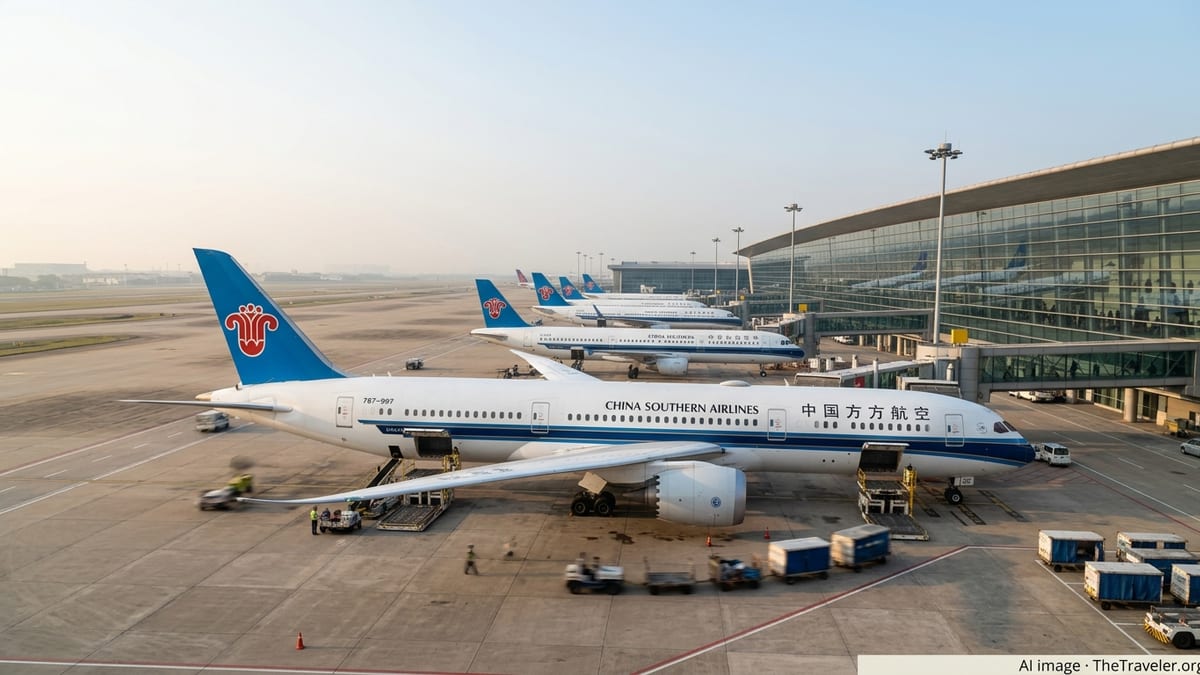
New 2026 Flight Program Targets Europe and Central Asia
Publicly available information on China Southern’s latest schedules indicates that the carrier is using its Beijing Daxing and Guangzhou hubs to anchor a new phase of long-haul growth. As part of its 2026 summer–autumn season, the airline is preparing new links from the Chinese capital to northern Europe and fresh connections deeper into Central Asia, widening options for both inbound and outbound passengers.
Reports from Guangzhou’s official information channels highlight plans for a new Beijing Daxing to Helsinki service from March 29, 2026, creating a direct bridge between northern China and Finland’s capital. The route is expected to complement the airline’s existing European network from southern China by offering shorter itineraries for travelers starting or ending their journeys in the Beijing region.
China Southern has also been progressively expanding its presence in Central Asia, most recently with a direct Beijing Daxing to Dushanbe link that marked the first such connection between the two capitals by a Chinese carrier. The 2026 schedule builds on that momentum with additional frequencies and broader scheduling designed to feed one-stop itineraries between Central Asia and long-haul destinations across Asia-Pacific.
Industry observers note that these network moves continue a trend that began in 2024 and 2025, when China Southern added new international routes from Guangzhou to cities such as Budapest, Belgrade and Istanbul, as well as further into the Middle East. Together, these launches are steadily transforming the airline from a primarily Asia-Pacific operator into a broader intercontinental player.
Australia Becomes a Centerpiece of Capacity Growth
Australia stands out as one of the biggest winners from China Southern’s latest expansion, with published schedules and airport announcements pointing to a sharp increase in capacity through early 2026. The carrier has been steadily rebuilding and then surpassing its pre-pandemic presence across multiple Australian gateways, using Guangzhou as a primary connecting hub.
For the southern hemisphere’s 2025–2026 peak summer season, flight data and local aviation reports show that China Southern has significantly boosted frequencies between Guangzhou and key Australian cities including Sydney, Brisbane and Adelaide. On the flagship Guangzhou–Sydney route, the airline is operating up to four daily round trips during the core peak, adding tens of thousands of extra seats over the season.
Brisbane has also seen a substantial uplift, with schedules indicating a move to double-digit weekly frequencies during the busiest holiday weeks. Aviation coverage notes that this reflects strong two-way demand between southern China and Queensland, as leisure travelers return and business ties resume at scale.
In South Australia, Adelaide Airport has confirmed that China Southern’s Guangzhou–Adelaide route will transition from a seasonal service to a year-round operation from March 2026, supported by extra flights compared with previous seasons. Extending these flights beyond the traditional December–March window effectively secures Adelaide’s direct link to a major Asian hub throughout the year, enabling one-stop journeys from the state to destinations in Asia, Europe, the Middle East and Africa.
New Global Gateways from Guangzhou and Beijing
China Southern’s broader international push is not confined to Australia and Central Asia. Over the past two years the airline has opened a string of new long-haul routes from Guangzhou, including services to Madrid and Darwin that have drawn attention from aviation analysts for their strategic significance.
The direct Guangzhou–Madrid route, launched in late 2025, provided the first nonstop connection between a southern Chinese city and the Iberian Peninsula. This link has quickly become a key bridge for traffic flows between China, Spain and Latin America, especially for travelers who prefer to avoid crowding through more traditional northern European hubs.
On the same day, China Southern inaugurated a direct Guangzhou–Darwin service, its shortest route to Australia. With a flight time of about six hours, the Darwin link offers an additional gateway into Australia’s north and creates new options for combining Top End tourism with multi-stop itineraries via Guangzhou to Europe and the rest of Asia.
Corporate filings and network summaries further reveal that Guangzhou has been connected in recent seasons to Budapest, Belgrade, Doha and Islamabad, among other cities, creating a dense arc of destinations stretching across Europe, the Middle East and South Asia. When combined with new flights and increased activity at Beijing Daxing, these developments position China Southern’s dual-hub system as an increasingly competitive alternative for global travelers seeking flexible routings.
What the 2026 Changes Mean for International Travelers
For travelers planning trips in 2026, the cumulative effect of China Southern’s new routes and extra flights is a wider selection of one-stop options, often with improved connection times and more choice of departure days. Expanded capacity from Guangzhou to Australia and onward to Europe, along with fresh links via Beijing Daxing, gives passengers more flexibility to mix and match hubs based on price, schedule and visa preferences.
More frequencies on trunk routes such as Guangzhou–Sydney and Guangzhou–Brisbane can also help relieve pressure on peak-season fares, although ticket prices will continue to be shaped by broader factors including fuel costs, competition and regulatory constraints on airspace. Additional flights are likely to appeal not only to tourists but also to students, visiting friends and relatives travelers and small business passengers seeking reliable access between secondary cities and global markets.
At the same time, international travelers are watching regulatory and geopolitical developments that may affect routings, particularly on services over Russia and across the Pacific. Chinese airlines, including China Southern, have raised concerns about potential restrictions on use of Russian airspace for flights to and from the United States, noting that longer detours could push up journey times and costs. While these discussions continue, the bulk of the new 2026 capacity announced so far is focused on markets where routing remains relatively straightforward, such as Europe via the Middle East and northern routes, Central Asia and the Asia–Pacific region.
For many would-be visitors, the most immediate impact of China Southern’s expansion is practical rather than political: more departure options from key gateways, greater year-round connectivity for cities like Adelaide and Darwin, and new combinations for multi-country trips that tie Europe, Central Asia, China and Australia into a single itinerary. As 2026 approaches, those changes are turning what once felt like aspirational “dream destinations” into realistic plans sitting just a single connection away.