

More news on this day
China has carried out the first full ground test of a hydrogen-fueled AEP100 turboprop engine variant, a development that signals Beijing’s growing focus on low-carbon propulsion technologies for future regional and short-haul aircraft.
Get the latest news straight to your inbox!
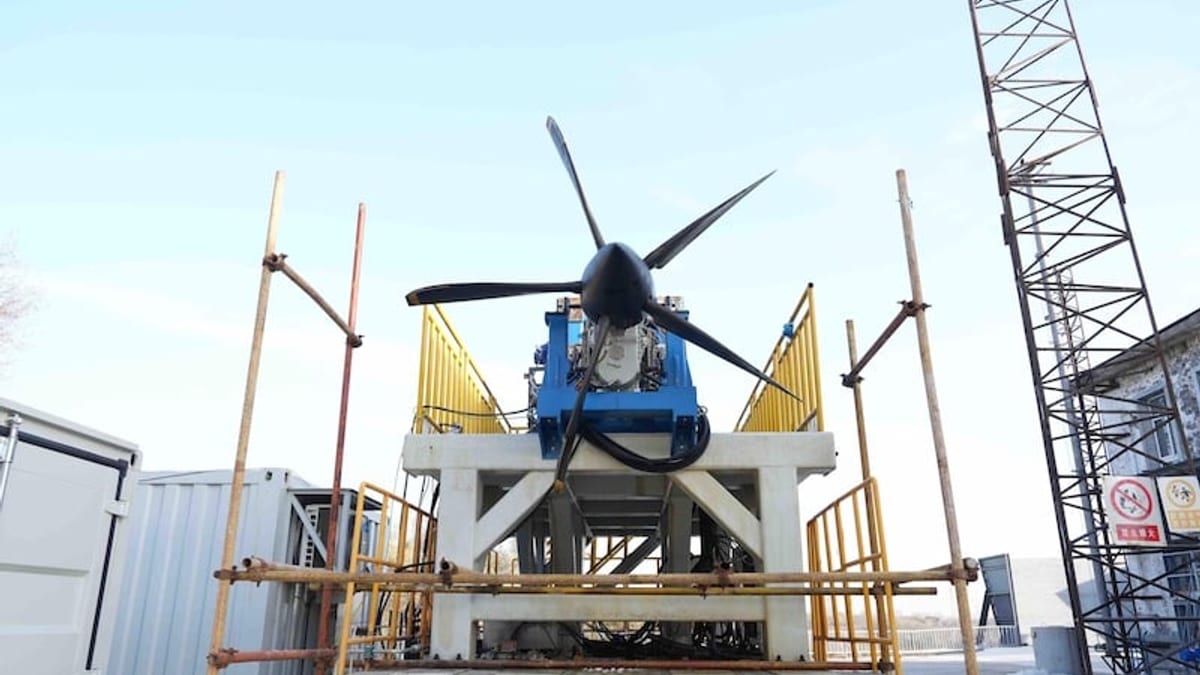
Image by AWN RSS by content source
Milestone Ground Test for Hydrogen-Fueled AEP100
Publicly available information from Chinese state-linked science and technology outlets indicates that the hydrogen-capable AEP100 variant recently completed a full series of ground tests at a dedicated facility in Zhuzhou, in central Hunan province. The engine, developed by a research institute under Aero Engine Corporation of China, reportedly met predefined performance targets while operating on liquid hydrogen, marking a first for this class of aviation powerplant within the country.
Reports describe the AEP100 as a megawatt-class turboprop platform intended for regional aviation applications. In its hydrogen-fueled configuration, the variant is designed to use liquid hydrogen supplied through a dedicated feed and control system integrated with the engine’s combustion section. During the latest test campaign, that system was evaluated under multiple power settings, with data suggesting stable operation across the expected performance envelope.
According to coverage in Chinese technical media, the test sequence included ignition trials, performance adjustment runs and extended operation at higher power levels. Engineers monitored turbine temperatures, vibration levels, pressure stability and the behavior of the cryogenic hydrogen supply infrastructure. The published results indicate that key indicators remained within acceptable margins, allowing the program to declare a full performance ground-test milestone.
The AEP100 effort follows several years of parallel work in China on sustainable aviation technologies, including hydrogen-fueled drones, hybrid-electric demonstrator aircraft and ground-based gas turbine trials using hydrogen-rich fuels. The hydrogen AEP100 variant is emerging as one of the first megawatt-class aviation engines in the country to validate hydrogen combustion at a system level.
How the Hydrogen Variant Differs from Conventional AEP100 Designs
While the baseline AEP100 has been described in open sources as a conventional turboprop optimized for regional aircraft, the hydrogen-fueled variant incorporates a number of adaptations to manage the low temperature and high diffusivity characteristics of liquid hydrogen. The most visible change is the integration of a cryogenic storage and feed system that delivers hydrogen to the engine under tightly controlled pressure and temperature conditions.
Hydrogen’s high energy content by mass but low density by volume requires different design priorities than kerosene-based aviation fuels. For the AEP100 hydrogen variant, this means reworked fuel lines, insulation, valves and safety systems to prevent leaks and to manage boil-off gas. Combustion hardware also needs specific tuning to handle hydrogen’s fast flame speed and wide flammability range while maintaining stable operation and acceptable emissions of nitrogen oxides.
Technical commentary in Chinese engineering publications notes that the test campaign placed particular emphasis on matching the behavior of the liquid hydrogen delivery system with the dynamic load changes in the turboprop. Transient maneuvers such as rapid throttle movements are critical for regional aircraft, especially in demanding conditions like short runways or mountainous terrain. Demonstrating that the engine can handle these transients on hydrogen without flameout or unstable combustion is seen as a key outcome of the ground test.
Another important distinction is the integration challenge between the engine and the future airframe. Because hydrogen requires larger onboard tanks than kerosene for a given range, the AEP100 hydrogen variant will likely be paired with aircraft designs that incorporate novel fuselage or wing tank layouts. The current ground tests, however, are focused on validating the propulsion system itself before moving toward flight demonstration phases.
Implications for Global Sustainable Aviation Efforts
The AEP100 hydrogen variant test places China in a more visible position within the emerging global competition to develop hydrogen-capable aircraft propulsion. In recent years, European and US aerospace firms have publicized their own hydrogen engine test programs, including conversions of existing turbofan and turboprop models running on gaseous or liquid hydrogen blends. The Chinese program adds another major market to this effort and could accelerate technology maturation through parallel experimentation.
Hydrogen propulsion is being explored as a pathway to reduce lifecycle greenhouse gas emissions for short and medium-range flights, particularly when the hydrogen is produced from low-carbon electricity. Aviation experts typically highlight regional and turboprop segments as early candidates for hydrogen adoption, due to their shorter routes and lower power requirements compared with long-haul jets. The AEP100, as a megawatt-class turboprop, fits directly into this category.
Analysts following China’s industrial policy note that hydrogen aviation trials dovetail with broader national plans to scale up green hydrogen production and associated infrastructure. Government strategies on energy transition define hydrogen as a strategic industry, with applications ranging from heavy industry and long-distance trucking to power generation. Aviation is now emerging as a visible proving ground for these ambitions.
Within the global travel sector, airlines and airports are monitoring such engine milestones as they chart decarbonization roadmaps. While sustainable aviation fuels remain the most immediate lever for cutting emissions in existing fleets, hydrogen technologies are increasingly viewed as a potential second wave of change that could reshape aircraft design and route planning later in the 2030s and 2040s.
What the Test Means for Future Regional Air Travel
For travelers, the hydrogen ground test does not result in near-term schedule changes or new route offerings, but it does point to how short-haul flying might evolve over the next two decades. If the AEP100 hydrogen variant progresses from ground testing to flight demonstrations and eventual commercial certification, it could power future regional aircraft connecting medium-sized cities across China and potentially neighboring markets.
Hydrogen-fueled turboprops would likely be targeted at flights of a few hundred to perhaps around one thousand kilometers, linking secondary airports that currently rely on conventional regional jets or turboprops burning kerosene. In such a scenario, passengers might not notice major differences in cabin experience, but operators would emphasize lower carbon footprints per seat and potentially quieter operations, depending on the final engine and propeller configuration.
Airport infrastructure would need to adapt to accommodate hydrogen, particularly in its liquid form. That would mean cryogenic storage tanks, new fuel handling procedures and updated safety protocols. China’s experience building hydrogen supply chains for industrial and transport uses could inform how regional hubs prepare for future hydrogen-powered aircraft using engines like the AEP100 variant.
Industry watchers caution that significant hurdles remain, including regulatory frameworks, ground infrastructure investment, hydrogen production costs and competition from other low-carbon technologies. Nevertheless, the completion of a full ground test at megawatt scale suggests that hydrogen-powered regional aircraft are moving from concept studies toward tangible hardware.
Next Steps in China’s Hydrogen Aviation Roadmap
The hydrogen-fueled AEP100 variant’s recent ground test is described in Chinese media as a full-performance milestone rather than the conclusion of the development program. Further work is expected to focus on extended endurance runs, detailed reliability assessments and refinement of the engine’s control software to handle a wider range of operational scenarios. Only after these stages are complete would a transition to flight testing be considered.
Observers of China’s aviation sector point out that the AEP100 sits alongside other indigenous engine programs aimed at reducing reliance on imported propulsion technology. Hydrogen capability adds a further strategic dimension, aligning engine research with longer-term environmental and industrial objectives. As a result, follow-on funding and policy support for hydrogen aviation projects are likely to remain strong.
Beyond the AEP100, Chinese aerospace institutes are studying configurations that combine hydrogen with hybrid-electric powertrains, fuel cells and advanced aerodynamics. These concepts are intended to cover a wide spectrum of missions, from unmanned aircraft and air taxis to larger regional airliners. The recent ground test provides a data-rich reference point for these design studies and may influence choices on whether to prioritize hydrogen combustion, fuel cells, or a blend of both.
For the global travel industry, developments around the AEP100 hydrogen variant will be watched alongside similar programs in Europe and North America. Each milestone helps clarify the technical and economic feasibility of hydrogen in commercial aviation. While commercial hydrogen flights remain a long-term prospect, the successful ground test in China represents a concrete technical step that could ultimately reshape how regional air travel is powered.