

More news on this day
China’s domestic air network is facing fresh disruption as 58 flight cancellations and 223 delays ripple across key northern gateways, including Xilinhot, Hohhot, Chifeng and Harbin, with regional carriers such as China Express, Tianjin Airlines and Chengdu Airlines among those cutting and deferring services.
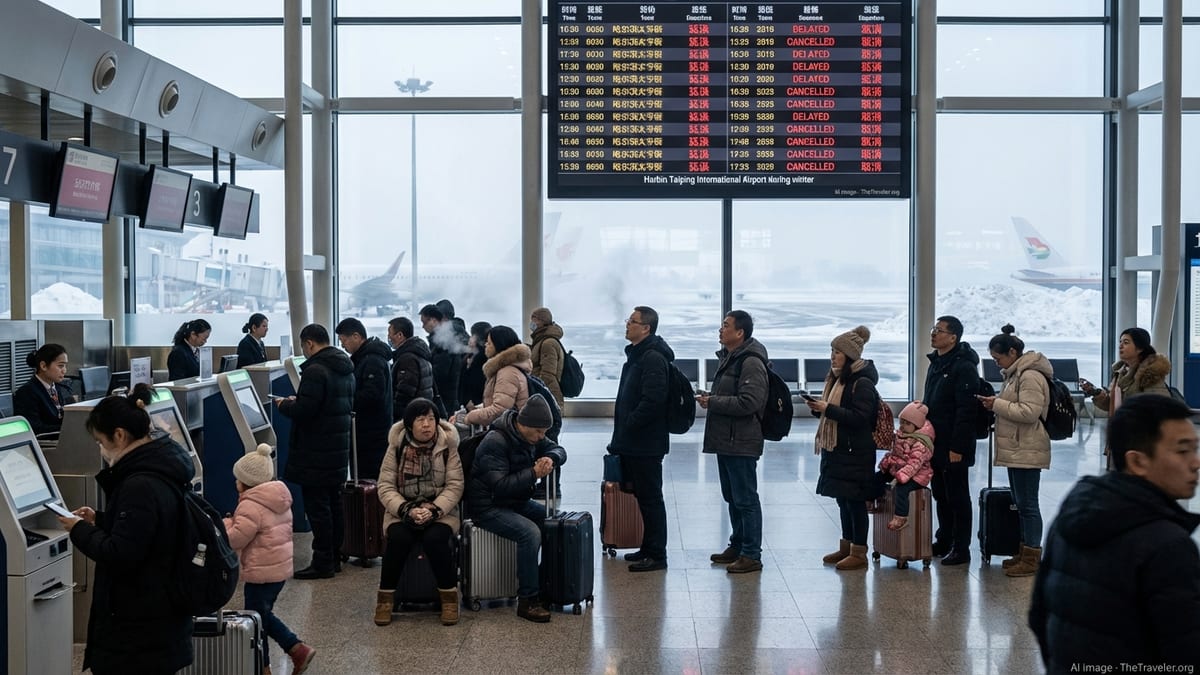
Severe Weather and Regional Hubs at the Center of Latest Turmoil
The latest wave of disruption is concentrated across Inner Mongolia and the country’s northeast, where a volatile mix of snow, low cloud and shifting wind patterns has pushed airport operations to the limit. Xilinhot, Hohhot and Chifeng in Inner Mongolia, together with Harbin in Heilongjiang, have reported cascading schedule changes as airlines struggle to maintain safe operating conditions on already congested winter corridors.
Aviation data and civil aviation advisories indicate that the cancellations and delays span both trunk and feeder routes, affecting passengers traveling between major provincial capitals and smaller regional cities. While China’s coastal megahubs have learned to absorb frequent weather shocks, the impact on inland hubs with more limited infrastructure can be more acute, especially when runway visibility and de-icing capacity are strained at the same time.
The 58 cancellations and 223 delays recorded in this latest update build on a pattern of weather-related upheaval that has defined the winter travel season in northern China. In recent weeks, similar systems have triggered dozens of cancellations and hundreds of delays across Hohhot, Harbin and other regional centers, underscoring how vulnerable these corridors remain during prolonged cold snaps.
For travelers, the practical result is a patchwork of last-minute schedule changes. Passengers connecting through Inner Mongolia and Heilongjiang report extended waits in terminals, multiple rebookings and in some cases overnight stays, as carriers recalibrate operations in real time to shifting conditions.
Airlines Under Pressure: China Express, Tianjin and Chengdu Airlines
Regional operators are bearing much of the brunt, with China Express Airlines, Tianjin Airlines and Chengdu Airlines among those most exposed to the storm-affected corridors. These carriers play a critical role in linking provincial capitals with smaller outposts across Inner Mongolia, Xinjiang and the northeast, meaning that any disruption to their schedules can rapidly isolate remote communities.
China Express in particular has built its network around secondary and tertiary airports, including routes connecting Hohhot with smaller centers such as Xilinhot and Erenhot. When snow and freezing fog reduce runway visibility or complicate de-icing procedures, these thinner routes are often the first to be cut, as airlines prioritize aircraft and crew for trunk services into larger hubs with better ground infrastructure.
Chengdu Airlines has also faced repeated weather and operational challenges this winter on routes into Harbin and other northern destinations. Previous disruptions in Heilongjiang saw more than a dozen flights grounded and dozens more delayed, leaving hundreds of passengers facing extended waits and rebookings. The latest cancellations and deferrals reinforce how sensitive these regional networks remain to sharp swings in weather conditions.
Tianjin Airlines, which operates a mix of regional jets and narrowbody aircraft across northern and western China, has had to juggle aircraft rotations and crew duty times as conditions fluctuate across multiple airports on the same day. With several airports simultaneously operating under low-visibility procedures, the margin for on-time performance has narrowed considerably.
Inner Mongolia and the Northeast: A Difficult Winter for Connectivity
Inner Mongolia’s airports, including Hohhot, Xilinhot and Chifeng, sit on some of China’s most weather-exposed plateaus and grassland basins, where winter storms can move in quickly and linger for days. Low cloud ceilings, drifting snow and rapid temperature drops can make it difficult to maintain normal operations for extended periods, especially during peak travel weekends.
Hohhot, a regional hub that connects Inner Mongolia to Beijing, Harbin and cities in western China, has been a particular pinch point. When departures from Hohhot are delayed or canceled, aircraft and crews are left out of position for onward legs to smaller cities such as Xilinhot and Chifeng, compounding the impact well beyond the immediate storm zone. Even a relatively short suspension of operations can ripple through the network, resulting in knock-on delays hours later at distant airports.
Further northeast, Harbin Taiping International Airport has continued to see a higher incidence of disrupted flights compared with milder southern hubs. The combination of heavy snow, icy runways and persistent low temperatures has kept airport authorities on permanent alert, even between major storm systems. When weather thresholds for safe operations are breached, flights are delayed or held on the ground, leaving passengers facing uncertain departure times.
The reliance on a limited number of daily services between some of these cities and the national trunk network exacerbates the disruption. Travelers who miss a single connection from Xilinhot or Chifeng to Hohhot or Harbin can find themselves without a same-day alternative, especially if aircraft are already committed elsewhere in the network.
Growing Strain on China’s Domestic Aviation Network
The current wave of cancellations and delays is part of a broader pattern of strain on China’s domestic aviation network as travel demand remains high and winter weather tests the resilience of regional infrastructure. Data from recent weeks show repeated spikes in cancellations and heavy delay totals across multiple provinces, reflecting both meteorological volatility and the constraints of airport and airline capacity.
According to flight statistics monitored by industry data platforms, some Chinese carriers have seen average delay durations stretch beyond an hour during recent weather events. On certain northern routes, fewer than three-quarters of flights have arrived on time, with disruption peaking during periods of snow and fog. While major hubs such as Beijing and Shanghai can reroute or absorb traffic, smaller airports have fewer fallback options when operations slow or pause.
Industry analysts note that the rise in disruptions coincides with sustained growth in domestic travel demand. Since the lifting of most pandemic-related restrictions, Chinese carriers have increased frequencies on popular domestic routes and opened new services into secondary and tertiary cities. This expansion has improved connectivity but also leaves networks more complex and more vulnerable when storms or air traffic control constraints hit multiple regions at once.
The cumulative effect of repeated weather-related disruptions is a growing sense of uncertainty for travelers who rely on domestic flights to move between inland provinces. For business travelers and migrant workers in particular, missed connections and last-minute cancellations can carry financial and personal costs that extend well beyond a single delayed flight.
Passenger Experience: Long Queues, Confusion and Limited Options
At terminals in Hohhot, Harbin and other affected cities, passengers have reported long queues at check-in and customer service counters as airlines race to rebook stranded travelers. With 58 flights canceled outright and more than 200 delayed in the latest update, the pressure on ground staff has been intense, particularly during peak departure windows.
Many travelers have found themselves repeatedly checking departure boards as estimated times of departure shift in line with evolving weather advisories. Announcements about runway inspections, aircraft de-icing and changes in arrival slots are common, but real-time information is not always complete, especially at smaller airports where systems are less sophisticated than at the country’s premier hubs.
Accommodation and meal arrangements have also become a point of frustration for some passengers. When cancellations are attributed to severe weather rather than technical or staffing issues, compensation policies can be limited, leaving travelers to shoulder part or all of the cost of unexpected overnight stays. Families with children and elderly passengers are among those most affected when last flights of the day are removed from the schedule.
Despite the frustration, there have been reports of airport staff improvising to help vulnerable passengers, from arranging priority rebookings to coordinating ground transport to nearby cities with more robust rail or bus connections. However, such measures remain patchwork and heavily dependent on local capacity.
Operational Responses from Airlines and Regulators
Airlines have responded to the unfolding situation with a mix of tactical cancellations, schedule consolidation and flexible rebooking policies. Carriers operating into the worst-affected airports have concentrated resources on maintaining a core set of flights during periods of low visibility, often combining lightly booked services and rerouting aircraft to airports with better weather windows.
Some airlines are offering free or low-fee changes for tickets on disrupted routes within a limited time frame, allowing passengers to shift to alternative dates or destinations where capacity is available. While such measures can ease individual travel problems, they also require complex coordination across networks that are already operating close to their winter limits.
On the regulatory side, the Civil Aviation Administration of China has continued to emphasize safety first, reiterating that flights must not depart if weather conditions fall below prescribed thresholds. Local airport authorities in Inner Mongolia, Heilongjiang and neighboring regions have implemented additional ground inspections and runway clearing operations to accelerate the resumption of normal traffic once conditions improve.
Technical upgrades, including improved runway lighting, enhanced de-icing facilities and more robust meteorological monitoring, are part of a broader modernization drive at regional airports. However, these investments will take time to fully translate into greater resilience when faced with back-to-back winter storms.
What Travelers Should Do if Flying Through Affected Cities
For travelers planning itineraries that pass through Xilinhot, Hohhot, Chifeng, Harbin or other northern hubs in the coming days, preparation and flexibility are essential. Aviation experts recommend monitoring flight status closely via airline channels on the day of departure, as schedules may continue to shift in response to changing forecasts.
Where possible, passengers are advised to allow extra connection time when routing through weather-prone airports, particularly when traveling onward to remote destinations with only one or two daily services. Booking earlier departures in the day can also provide more buffer if rebooking becomes necessary, as later flights may already be fully committed or vulnerable to airport curfews.
Travelers with non-refundable tickets should review their carrier’s disruption policies before departure, including rules around voluntary changes, same-day standby and accommodation support in the event of extended delays. Purchasing travel insurance that covers weather-related interruptions can provide an additional layer of protection, especially for longer itineraries that involve multiple flights.
Finally, passengers are encouraged to keep essential items such as medication, chargers and basic toiletries in their carry-on luggage in case of overnight delays. With winter weather still in play across northern China, the possibility of being unexpectedly grounded remains significant, and being prepared can help soften the impact of an already stressful situation.
Looking Ahead: Winter Risks and Network Resilience
As winter continues across northern China, aviation planners expect intermittent turbulence in the domestic schedule to persist. While the current tally of 58 cancellations and 223 delays may ease as conditions stabilize, the underlying vulnerabilities that produced this episode remain, particularly in regions where infrastructure and backup options are more limited than in the country’s coastal mega-hubs.
Airlines are likely to review their winter operations playbooks, including crew rostering, maintenance scheduling and aircraft deployment on weather-sensitive routes. Some carriers may also adjust capacity on marginal services during peak storm periods, reducing frequencies in order to build more resilience into their timetables.
For airport authorities in Inner Mongolia, Heilongjiang and neighboring provinces, the latest disruptions underline the need for continued investment in snow and ice control, advanced forecasting tools and passenger information systems. Incremental improvements in these areas can make a significant difference when multiple weather fronts converge on the same day.
In the meantime, passengers flying into and out of Xilinhot, Hohhot, Chifeng, Harbin and other affected cities can expect a more cautious operational posture from airlines. While that may mean further delays and selective cancellations, it also reflects a system that is prioritizing safety in challenging conditions, even as demand for domestic travel remains robust.