

More news on this day
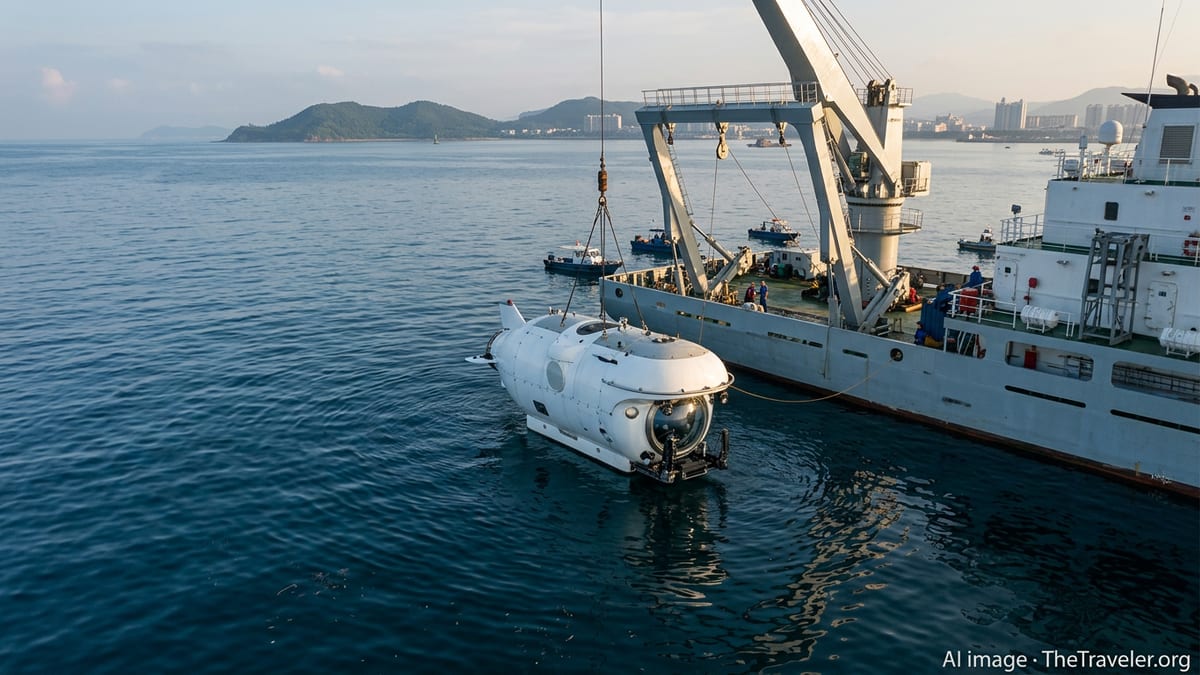
China is moving to turn its deep-sea engineering edge into a new tourism draw, advancing construction plans for a high-tech vessel intended to carry paying passengers into the deep ocean and inject fresh momentum into the country’s coastal travel economies.
Get the latest news straight to your inbox!
From Research Platforms to Tourist-Ready Deep-Sea Craft
China has spent more than a decade building a fleet of sophisticated deep-sea research vessels and manned submersibles, including the Jiaolong, Shenhai Yongshi (Deep Sea Warrior) and Fendouzhe (Striver). Publicly available information shows these craft have supported hundreds of scientific dives in the Western Pacific and South China Sea, helping to refine hull materials, life-support systems and navigation technologies needed for long-duration, crewed operations at extreme depths.
Over the past two years, Chinese shipyards and research institutes have introduced a new generation of platforms such as the comprehensive research ship Tansuo 3, which is designed to carry multiple manned submersibles on global expeditions. Reports indicate that these vessels incorporate advanced moon pool systems, dynamic positioning and enhanced endurance, allowing crews and pilots to work safely in rough seas and polar environments while deploying high-value deep-diving assets.
Industry analysts note that this research-focused fleet is now serving as a technological springboard for a commercial pivot. Design concepts and early-stage engineering work described in Chinese-language technical briefings outline deep-sea tourist submersibles that borrow pressure-hull designs, buoyancy materials and digital control systems from existing research craft, but reconfigure them with panoramic viewing windows, upgraded cabin ergonomics and redundant safety systems tailored to civilian passengers.
Planned tourist models, according to these materials, are expected to operate at depths far greater than typical sightseeing submarines used in tropical reef destinations, aiming at several thousand meters rather than a few hundred. That target would position China among a small number of countries trying to bring full-ocean-depth or near full-ocean-depth experiences into the high-end tourism market.
High-Tech Features Aim to Reassure a Safety-Conscious Market
The prospect of commercial trips into the deep ocean comes at a time when public awareness of submersible risks has grown, following well-publicized incidents involving tourist craft in other parts of the world. Chinese engineers and maritime specialists have responded by emphasizing incremental design paths from proven research platforms and by highlighting internationally recognizable safety benchmarks in open technical discussions.
Specifications released for recent Chinese deep-sea vehicles stress the use of thick-walled titanium or high-strength steel pressure spheres, multi-layered acoustic positioning systems, and highly fault-tolerant electrical architectures. Applied to a tourist vessel, these same approaches are being paired with simplified pilot interfaces, automated emergency ascent protocols and real-time health monitoring of critical components to reduce the likelihood of human error.
Reports on newer test platforms also describe the use of fiber-optic data links and high-capacity batteries, which allow continuous communication with surface support ships and provide reserve power for controlled returns to the surface. For passenger operations, such features translate into more predictable mission timelines and clearer contingency plans, both of which are important for tour operators and insurers assessing commercial viability.
Industry observers say that the engineering effort is unfolding in parallel with tighter regulatory attention worldwide on submersible tourism. While the emerging Chinese tourist vessel will be subject to national standards, companies involved in concept development are also referencing classification society guidelines and lessons drawn from international accident investigations to frame marketing narratives around robust design and conservative operating envelopes.
New Underwater Itineraries for China’s Coastal Destinations
Chinese coastal provinces have been positioning themselves as hubs for “blue economy” growth, combining research activity, shipping, fisheries and marine tourism. Hainan, Guangdong and Shandong in particular have promoted cruise terminals, island resorts and maritime museums, and have hosted open days where the public can see research submersibles on deck and learn about deep-sea exploration.
With a tourist-ready deep-sea vessel, regional planners see scope to add premium underwater excursions to existing destination portfolios. Potential embarkation points include established science ports such as Sanya in Hainan and Qingdao in Shandong, where support ships, maintenance facilities and trained crews are already in place to service research expeditions and could be adapted to manage commercial operations.
Concept itineraries described in domestic coverage range from short descents over continental slopes in the South China Sea to longer journeys combined with liveaboard-style surface cruises. These packages would target affluent domestic travelers and international visitors seeking rare experiences, positioning deep-sea dives alongside polar cruises and space-adjacent flights as part of a growing market for extreme yet curated adventure travel.
Local officials and tourism researchers quoted in Chinese media have linked such experiences to broader destination branding strategies. Underwater voyages could be paired with onshore science centers, aquariums and cultural attractions to create multi-day routes, encouraging visitors to spend more time in coastal cities and spreading tourism revenue more evenly through surrounding communities.
Economic Ripple Effects Across the Maritime Supply Chain
The push to commercialize deep-sea operations is expected to generate demand for a range of specialized services. Chinese manufacturers of subsea optics, pressure-resistant alloys, battery systems and navigation equipment are already part of global supply chains for research and offshore energy markets. Deep-sea tourism adds a consumer-facing dimension that amplifies branding opportunities for domestic suppliers and service companies.
Shipyards capable of building and maintaining complex research vessels stand to benefit from new orders for support ships and for the tourist submersibles themselves. Training academies and maritime universities may expand pilot, technician and safety-officer programs, while coastal cities invest in port upgrades, visitor terminals and emergency-response infrastructure calibrated to higher passenger throughputs.
Economists following the sector point out that high-end marine tourism typically has a strong multiplier effect, generating jobs not only in vessel operations but also in hospitality, transport and cultural industries. A successful deep-sea tourism offering could therefore help diversify local economies that currently rely heavily on seasonal beach tourism or traditional fisheries, making them more resilient to climate-related disruptions and shifting travel patterns.
At the same time, observers caution that deep-sea tourism ventures require substantial upfront capital and careful risk management. Insurance premiums, certification costs and ongoing maintenance for high-specification submersibles can be significant, and operators will need consistent visitor demand at premium price points to reach profitability.
Balancing Exploration, Conservation and Visitor Experience
As China accelerates construction of a high-tech deep-sea tourist vessel, marine scientists and conservation advocates are drawing attention to the need for strict environmental safeguards. Deep-sea ecosystems are slow-growing and sensitive to disturbance, and expanded human presence raises questions about noise, light pollution and the potential for accidental damage to fragile habitats.
Existing Chinese research expeditions have already generated extensive bathymetric maps, species inventories and environmental data, providing a scientific baseline that can be used to identify zones suitable for limited tourism and areas that should remain off-limits. By aligning tourist routes with these datasets, operators can reduce ecological impact while still offering visually compelling experiences centered on geological formations, mid-water life and shipwrecks that are robust enough to handle occasional visits.
Educational content is expected to play a central role in differentiating China’s deep-sea tourism from more conventional sightseeing tours. Cabin displays, pre-dive briefings and post-dive exhibits on shore can highlight the scientific value of deep-ocean research and the importance of conservation, encouraging visitors to see themselves as temporary guests in an environment that remains largely unknown.
Analysts note that if carefully managed, deep-sea tourism could help build public support for broader marine protection measures, including marine protected areas and stricter oversight of seabed resource extraction. The emerging Chinese tourist vessel project is therefore being watched not only as a test of new technical capabilities, but also as an indicator of how exploration, commerce and stewardship might be balanced in the next phase of global ocean use.