

More news on this day
China is accelerating a far-reaching expansion of visa-free entry for foreign visitors, positioning relaxed border rules as a central tool to revive international tourism, attract business travelers and support a slowing domestic economy.
Get the latest news straight to your inbox!
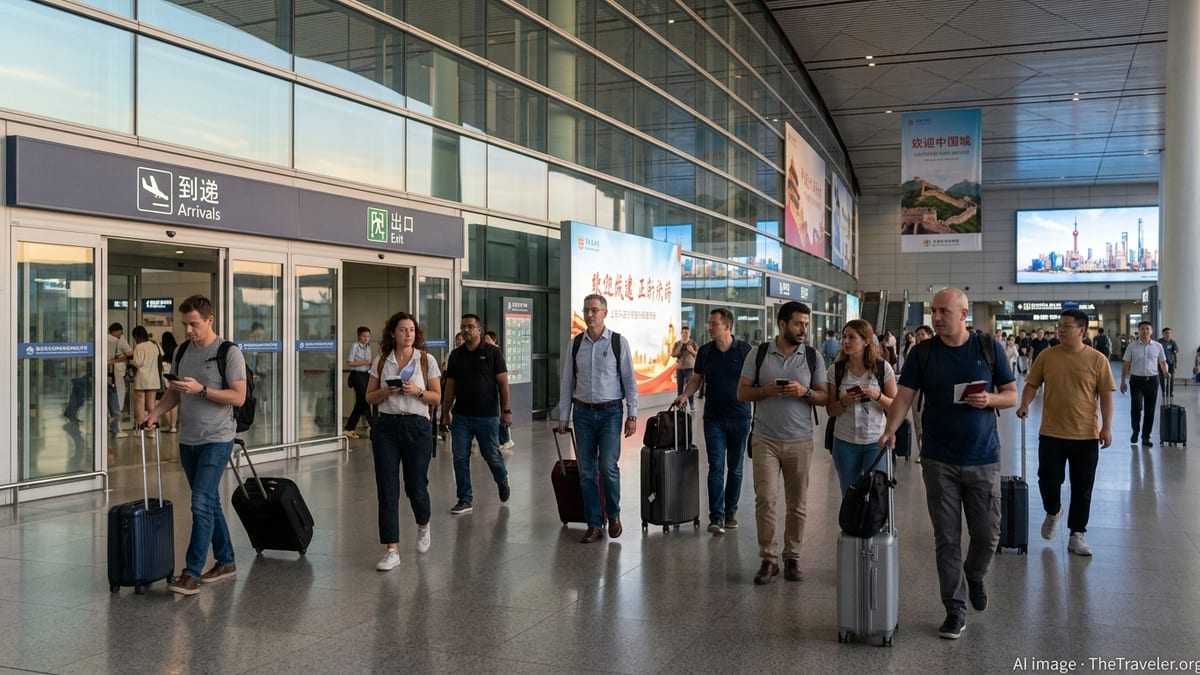
From Pandemic Isolation to an Open-Door Strategy
After nearly three years of some of the world’s strictest pandemic-era controls, China is now pursuing what publicly available information describes as its most open inbound travel regime in decades. Since borders fully reopened in 2023, the authorities have incrementally rolled out unilateral visa-free entry, mutual exemption agreements and broader transit waivers, transforming what was once a complex, paperwork-heavy process into a simpler proposition for many travelers.
According to published coverage, citizens from roughly 79 countries can now enter China without a full tourist visa, though conditions and permitted length of stay vary by nationality and purpose of visit. Many of these visitors are allowed to remain in the country for up to 30 days for tourism, business, family visits or exchanges, while others benefit from shorter transit-focused schemes that still remove the need to apply in advance.
This pivot is part of a broader effort to rebuild international arrivals, which fell from more than 140 million in 2019 to just a fraction of that level during the pandemic years. Officials have publicly emphasized openness and convenience as new watchwords for the border regime, in contrast to the health-security focus that dominated travel rules from 2020 to early 2023.
Inbound tourism has started to rebound, but remains below pre-pandemic highs, prompting Beijing to continue widening the list of eligible countries and extending temporary waivers that were initially launched as time-limited pilots.
Expanding List of Visa-Free Countries and Regions
Recent updates show that China has significantly broadened the pool of nationalities eligible for short-term visa-free stays. Reports indicate that most European Union member states now enjoy some form of exemption, often allowing 15 to 30 days of travel for tourism or business. Over the last two years, the lineup has grown to include multiple waves of European countries, as well as partners in Asia, the Gulf, Latin America and Oceania.
Media coverage in early 2026 highlighted the addition of the United Kingdom and Canada to the program, lifting the total number of destinations whose citizens can enter without a visa to 79. Many of these visitors may stay for up to 30 days under unilateral Chinese measures, while others benefit from mutual visa exemption agreements negotiated on a bilateral basis.
Earlier stages of the rollout saw trial schemes for countries such as France, Germany, Italy, the Netherlands and Spain, followed by expansions to Switzerland, Ireland, Hungary, Austria, Belgium and Luxembourg. Separate announcements extended visa-free entry to Australia, New Zealand and Poland, as well as to several states in the Gulf region. In 2025, Latin American nations including Brazil, Argentina, Chile, Peru and Uruguay were added for one-year or multi-year trial periods allowing 30-day visits.
Publicly available policy documents and analytical reports describe these exemptions as overlapping layers: a core group of countries benefit from 30-day visa-free entry, a wider set has mutual short-stay arrangements, and a further cohort can access China through generous transit waivers without obtaining a traditional visa.
Transit Visa-Free Rules: Longer Stays and Wider Movement
Alongside unilateral visa-free entry, China has also overhauled its transit visa-free system, a crucial channel for travelers who are passing through the country on their way to a third destination. As of late 2024, the long-standing 72-hour and 144-hour schemes were unified and extended to 240 hours, effectively giving eligible travelers up to 10 days on the ground when transiting through designated cities.
Official explanatory notes and business travel advisories report that the revamped policy now covers a wider set of ports of entry and offers “cross-regional” flexibility. Under the updated rules, many visitors using transit visa-free privileges can arrive in one metropolitan region and depart from another, moving within a network of 24 provincial-level areas rather than being confined to a single city cluster.
The 240-hour policy has been gradually extended to more nationalities, including travelers from parts of Europe and Asia who are not yet included in the full 30-day visa-free cohort. Some countries whose citizens still require a regular visa for direct entry can nonetheless access China visa-free when they hold confirmed onward tickets to a different country and remain within the permitted stay period.
Travel industry guides emphasize that eligibility criteria, permitted routes and documentation checks remain technical, and they encourage passengers to verify current rules with airlines and consular sources before departure. Even so, the longer transit window and expanded geography are widely viewed as important steps in making China more attractive as a stopover hub and short-stay destination.
Tourism Rebound and Economic Aims
The rapid loosening of visa requirements is closely linked to China’s efforts to reinvigorate its tourism and services sectors, which lagged the recovery seen in manufacturing and exports after the lifting of pandemic controls. Data cited in international news reports show a sharp rise in visa-free arrivals: more than 20 million foreign visitors reportedly entered under visa-free arrangements in 2024, more than double the figure a year earlier but still below pre-2019 levels.
Travel platforms and airlines have reported a surge in searches and bookings to Chinese destinations following each new round of visa-free announcements. Cities such as Beijing, Shanghai, Guangzhou and Shenzhen are once again prominent on global travel itineraries, while regional centers like Chengdu, Xi’an and Kunming are seeing stronger interest from first-time visitors drawn by easier entry rules.
Policy analysts argue that the expansion is about more than leisure tourism. Short-stay visa-free entry for business travelers is intended to facilitate trade fairs, supply-chain visits and investment scouting trips at a time when foreign direct investment flows into China have slowed. University exchanges, cultural events and sports tournaments are also viewed as beneficiaries of simplified procedures that reduce the friction and uncertainty associated with traditional visa applications.
For local governments, the hope is that international visitor spending will help support hotels, restaurants, transportation providers and retail sectors facing subdued domestic demand. Inbound tourism is also seen as a channel for promoting Chinese brands and cultural products to overseas consumers.
Practical Considerations for Prospective Visitors
Despite the broad trend toward liberalization, China’s visa landscape remains complex, and conditions vary widely by nationality. Publicly available information stresses that not all visitors can benefit from the 30-day visa-free stays, and some programs are officially labeled as temporary pilots that currently run through dates such as the end of 2025 or 2026. Extensions have been common, but they are not guaranteed.
Prospective travelers are advised in industry guidance to distinguish between unilateral visa-free entry, mutual visa exemption and transit visa-free options, each of which has different requirements. Some schemes apply only to ordinary passport holders, exclude work or journalism activities, or limit the types of permissible business engagements. Others mandate specific entry points, onward tickets and regional travel boundaries.
Several major economies, including the United States, are not yet included in the full short-stay visa-free programs, although their citizens may qualify for the 240-hour transit regime under defined conditions. For these travelers, the traditional visa application process, with supporting documents and in-person appointments or mail-in submissions, remains necessary for most types of visits.
Even with these caveats, analysts say the direction of policy is unmistakably toward greater openness. If current pilots are renewed or expanded, China’s visa-free architecture is likely to play a growing role in shaping global travel flows, business itineraries and tourism patterns across Asia and beyond.