

More news on this day
China’s Adora Cruises has placed orders for two new large cruise ships from domestic shipyards, a move that publicly available information indicates is designed to solidify the country’s position in the global luxury cruise segment and meet rapidly rising demand from Asian travelers.
Get the latest news straight to your inbox!
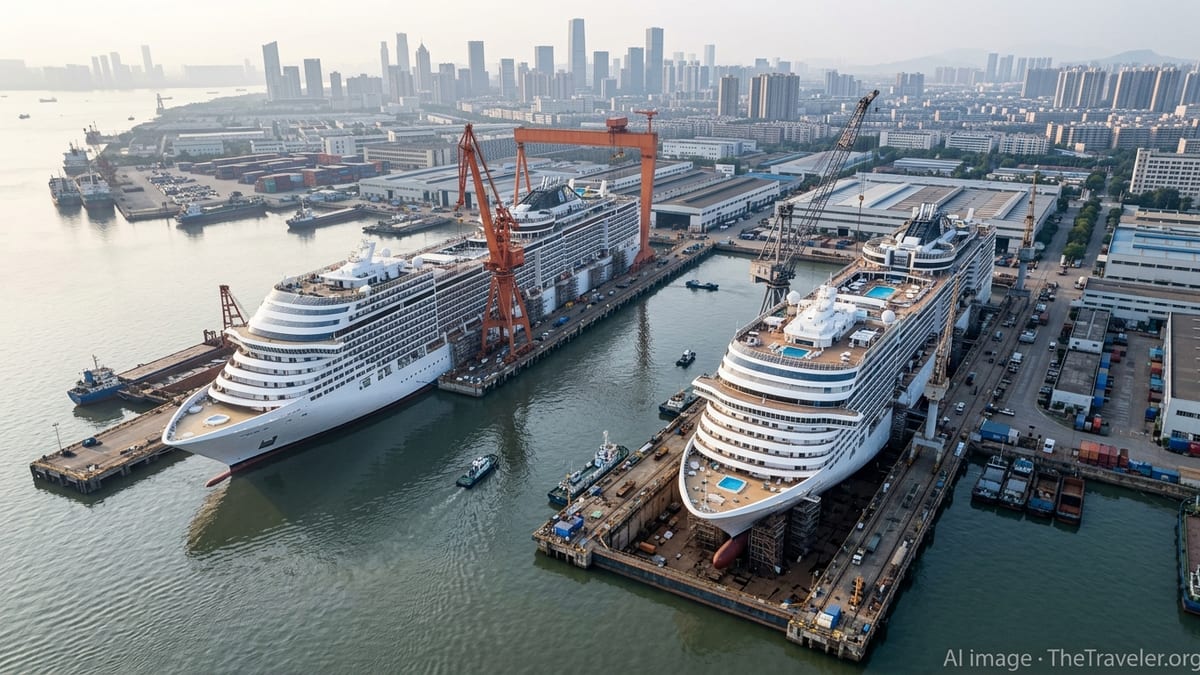
New Orders Underscore China’s Cruise Ambitions
Industry reports and shipbuilding orderbooks show that Adora Cruises has contracted two additional large vessels of around 140,000 gross tons each from Shanghai Waigaoqiao Shipbuilding, a major yard under China State Shipbuilding Corporation. Sector analyses describe the order as part of a broader multi-ship program that follows the delivery of Adora Magic City, China’s first domestically built large cruise ship, and the ongoing construction of sister vessel Adora Flora City.
Publicly available data from cruise newbuild trackers indicate that the two new Adora ships are scheduled for delivery later this decade, adding thousands of lower berths to the brand’s capacity. The enlarged fleet is expected to operate primarily from Chinese and other Asian homeports, placing Adora firmly among the region’s largest players by available cabins once all units are in service.
The decision to proceed with fresh tonnage comes despite lingering uncertainties in parts of the global travel market. Analysts note that demand for cruise holidays within Asia has rebounded strongly, supported by a growing middle class and improving regional connectivity, creating conditions that large shipowners consider favorable for long-term investments.
Building a Chinese-Led Luxury Cruise Brand
Adora Cruises, the rebranded China-focused joint venture between Carnival Corporation and Chinese partners, has been positioned as a flagship Chinese-led cruise company. Its first domestically built vessel, Adora Magic City, entered service in 2023 and has been used as a showcase for integrating Chinese design preferences, local cuisine, and Mandarin-language services into a contemporary large-ship platform more commonly associated with Western brands.
The new orders appear to extend that strategy. Industry commentary suggests the upcoming ships will continue to prioritize features popular with Chinese and broader Asian guests, including extensive family accommodations, retail offerings tailored to regional tastes, and expanded group dining spaces. At the same time, the ships are expected to maintain amenities such as water parks, theaters, and multi-restaurant promenades that align with international luxury standards.
Shipbuilding documentation reviewed by market observers indicates that the vessels will be equipped with modern energy-efficiency technologies, digital connectivity solutions, and upgraded hotel systems. These investments are intended to position Adora’s fleet as competitive with the newest ships entering service for established global cruise brands, while still reflecting a distinctly Chinese identity on board.
Rising Asian Demand Reshapes Cruise Capacity
Market research on global cruise deployment shows that Asia, and China in particular, are once again attracting capacity allocations after several years of pandemic-related disruption. With outbound travel from China recovering and regional tourism corridors reopening, cruise lines are gradually redeploying tonnage to East Asian homeports, often with itineraries focused on short to medium-length voyages appealing to first-time cruisers.
Analysts note that the middle-class population across Asia is expanding, with higher disposable incomes and a greater appetite for experiential travel, including cruises. This demographic shift is reflected in the orderbooks of major shipyards, where several large vessels are now earmarked for Asian-focused brands or itineraries. Adora’s decision to commit to two additional large ships fits within this trend and signals expectations of sustained regional growth through the 2030s.
Industry assessments also suggest that Asian passengers are increasingly sophisticated in their expectations, seeking higher service levels, more diverse dining, and premium accommodation categories. By investing in new-build hardware rather than relying solely on older vessels transferred from Western fleets, Adora is positioning itself to meet those expectations with purpose-designed ships tailored to local preferences.
Boost for China’s Domestic Shipbuilding and Supply Chain
The new Adora contracts provide a further boost to China’s nascent cruise shipbuilding ecosystem. The delivery of Adora Magic City and the construction of Adora Flora City have already been cited in sector reviews as milestones that demonstrate China’s ability to design, engineer, and integrate the highly complex systems required for large cruise vessels, from hotel operations to advanced safety and propulsion technologies.
By ordering more large cruise ships domestically, Adora and its parent entities are reinforcing a national push to climb the value chain in shipbuilding, moving beyond bulk carriers and container ships into technologically demanding segments traditionally dominated by European yards. This supports a growing network of local suppliers in areas such as interiors, outfitting, and specialized marine equipment, as well as high-value design and project management services.
Observers also point out that additional cruise projects help Chinese yards build a track record needed to win export contracts in the future. Successful delivery and operation of a fleet of Chinese-built cruise ships could encourage other brands, including non-Chinese operators, to consider placing orders with Chinese shipbuilders, potentially reshaping the competitive landscape of the global cruise newbuild market over the longer term.
Competition Intensifies in the Global Luxury Segment
The Adora orders come at a time when leading global cruise companies are also expanding their fleets with larger, more elaborate vessels aimed at the premium and contemporary mass-market segments. Orderbooks for European and American brands include multiple mega ships above 200,000 gross tons, with features such as neighborhood concepts, expansive water parks, and immersive entertainment designed to attract travelers worldwide.
Against this backdrop, China’s move to develop its own large-ship capacity is seen by analysts as both a commercial and strategic response. Rather than relying solely on foreign brands to meet domestic demand, China is cultivating a homegrown operator with ships built in local yards, giving it more control over deployment, pricing, and product design in a market that is expected to represent a growing share of global cruise passengers.
Travel and tourism observers suggest that the entrance of more Chinese-built, Chinese-operated large cruise ships will intensify competition in the wider luxury and upper-mainstream segments. As Adora’s expanded fleet comes online, travelers within Asia could see more itinerary options from nearby ports, as well as new approaches to onboard experiences that blend Chinese cultural elements with international luxury standards.