

More news on this day
China’s fast-rising cruise brand Adora Cruises has placed an order for two next-generation mega-ships, deepening the country’s push to build and operate its own large cruise fleet and signaling a new phase in its high-seas ambitions.
Get the latest news straight to your inbox!
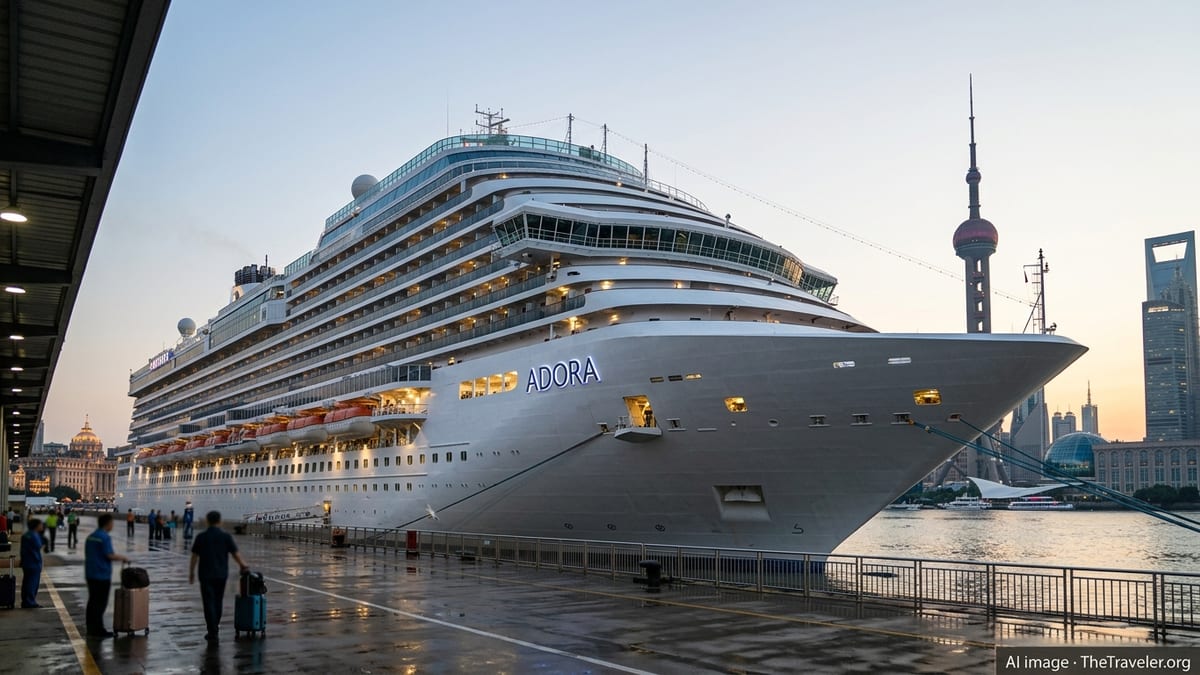
New Orders Build on Adora’s First Homegrown Flagship
Publicly available information indicates that the latest order will add two large vessels to the Adora Cruises pipeline, following China’s first domestically built cruise ship, Adora Magic City, and its larger sister ship Adora Flora City. Industry coverage describes the fresh order as part of a long-planned series that positions Adora as the core platform for China’s homegrown cruise development.
Adora Magic City, built at Shanghai Waigaoqiao Shipbuilding, has been widely reported as a milestone vessel for China’s shipbuilding sector. Entering commercial service in early 2024, the ship has already completed dozens of sailings from Shanghai and introduced many first-time Chinese travelers to the modern cruise experience. The ship’s performance has given Chinese yards and designers crucial operational data and real-world feedback.
The second China-built ship, Adora Flora City, is under construction with delivery targeted around the end of 2026, according to Chinese media and cruise-industry reports. Flora City is described as larger and more advanced than Adora Magic City, featuring higher gross tonnage, more cabins, and expanded public spaces designed to handle greater passenger volumes and longer itineraries.
Reports on the new two-ship order indicate that these coming vessels will again be built in China, in cooperation with established cruise-ship designers. That structure mirrors the earlier collaboration between China State Shipbuilding Corporation and experienced European partners, while gradually shifting more design and systems integration work into Chinese hands.
Next-Generation Design Aimed at Global Standards
While detailed specifications have not yet been made public, industry analyses suggest that Adora’s next-generation mega-ships will be similar in scale to the world’s larger contemporary cruise vessels, with capacities in the several-thousand-passenger range. The new ships are expected to incorporate more efficient propulsion, upgraded hotel systems, and enhanced environmental technology to meet tightening international standards.
Reports on Adora Flora City already highlight improvements such as optimized hull design, upgraded emissions-control systems, and more efficient energy management compared with the first ship. Observers expect the additional two vessels to push that evolution further, with incremental gains in fuel efficiency and digitalization, from smart-cabin energy controls to more advanced navigation and safety systems.
Publicly available coverage of the Chinese cruise program notes that each successive build is intended to reduce construction time, increase local content, and refine the onboard product for Chinese travelers. The two new ships are likely to feature layouts tailored for multigenerational family travel, extensive retail and entertainment zones, and culinary offerings reflecting both Chinese regional cuisines and international tastes.
If the projected timelines hold, Adora’s enlarged fleet would give China a series of increasingly sophisticated ships broadly aligned with global mainstream brands, but with hardware and onboard concepts designed primarily in and for the Chinese market.
China’s Bid to Become a Cruise-Building Powerhouse
The decision to add two more large ships underscores Beijing’s broader objective of mastering the full life cycle of modern cruise vessels, from concept and construction to operation and maintenance. Large cruise ships are often described in Chinese media and industry materials as among the most complex civilian products to engineer and build, involving thousands of suppliers and highly integrated hotel, safety, and marine systems.
China’s first two large cruise builds for Adora have already showcased rapid learning in areas such as modular construction, interior outfitting, and systems integration. Reports indicate that build times and productivity have improved from the first to the second ship, and the expectation is that the newly ordered mega-ships will benefit from further standardization and accumulated expertise.
Analysts view the multi-ship program as a strategic hedge in the wider maritime sector. Chinese yards already hold strong positions in container ships and bulk carriers, and are vying for more advanced segments such as liquefied natural gas carriers. Cruise vessels, which demand tight tolerances and premium interior quality, offer a high-profile proving ground for capabilities that can spill over into other complex ship types.
For Adora Cruises, anchoring its growth in domestically built hardware also aligns with policy goals favoring local manufacturing and technology. It helps create a full cruise-industry ecosystem in China, supporting specialized suppliers for everything from cabin components and galley equipment to digital booking systems and port logistics.
Implications for Asia’s Cruise Routes and Port Cities
As Adora’s fleet expands, the deployment of these ships is expected to focus primarily on Asia, with Chinese port cities as homeport hubs. Existing reports already point to Shanghai and Guangzhou’s Nansha cruise terminal as key bases for the first two homegrown ships, and industry watchers anticipate that additional Chinese ports along the Bohai Rim, the Yangtze River Delta, and the southern coast will compete for future deployments.
Larger, more advanced ships give Adora the flexibility to broaden itineraries beyond domestic coastal runs to regional routes across Northeast and Southeast Asia. Potential patterns include loops to Japan and South Korea, as well as tropical cruises to destinations in Vietnam, Thailand, and other Southeast Asian nations, depending on port infrastructure and regulatory arrangements.
For destination ports, the rise of a sizable China-based fleet could alter passenger flows and seasonal patterns. Asian ports that can accommodate mega-ships may see larger, more concentrated arrivals, driving demand for shore excursions, local transportation, and hospitality services. Ports that cannot yet handle very large vessels may feel pressure to upgrade berths, terminals, and access roads if they wish to tap into the growing China-sourced cruise market.
Travel planners and regional tourism boards are watching China’s cruise trajectory closely, as more hardware based in East Asia could shift some capacity away from traditional hubs in Europe and North America during certain seasons. The eventual deployment strategy for Adora’s next two mega-ships will be a key indicator of how aggressively the brand intends to expand beyond Chinese home waters.
Competitive Pressures in the Global Cruise Market
Adora’s fleet expansion arrives at a time when major global cruise groups are also introducing their own latest-generation mega-ships, many of them targeted at North American and European travelers. However, relatively few of those vessels are dedicated to the Asian market, leaving room for a China-focused brand with purpose-built hardware and distribution networks.
According to international orderbook summaries, the cruise sector continues to invest in larger and more efficient ships, even as it works through debt burdens accumulated during the pandemic. In this context, China’s decision to double down on cruise construction through Adora stands out as a bet that domestic demand and regional tourism flows will justify a sizable, locally based fleet over the coming decade.
For global competitors, an expanded Adora fleet could introduce new dynamics in areas such as charter partnerships, port access, and seasonal redeployments in Asia. Some analysts suggest that foreign brands may eventually seek deeper cooperation with Chinese ports or cross-marketing arrangements to maintain visibility among Chinese travelers who are increasingly choosing home-based lines.
Much will depend on how quickly Chinese consumers embrace longer and more diverse itineraries, and on how effectively Adora’s next-generation ships deliver on expectations for service, entertainment, and value. The order for two additional mega-ships signals confidence that demand will continue to grow, and that China intends not only to sail the world’s seas, but to build more of the ships that traverse them.