

More news on this day
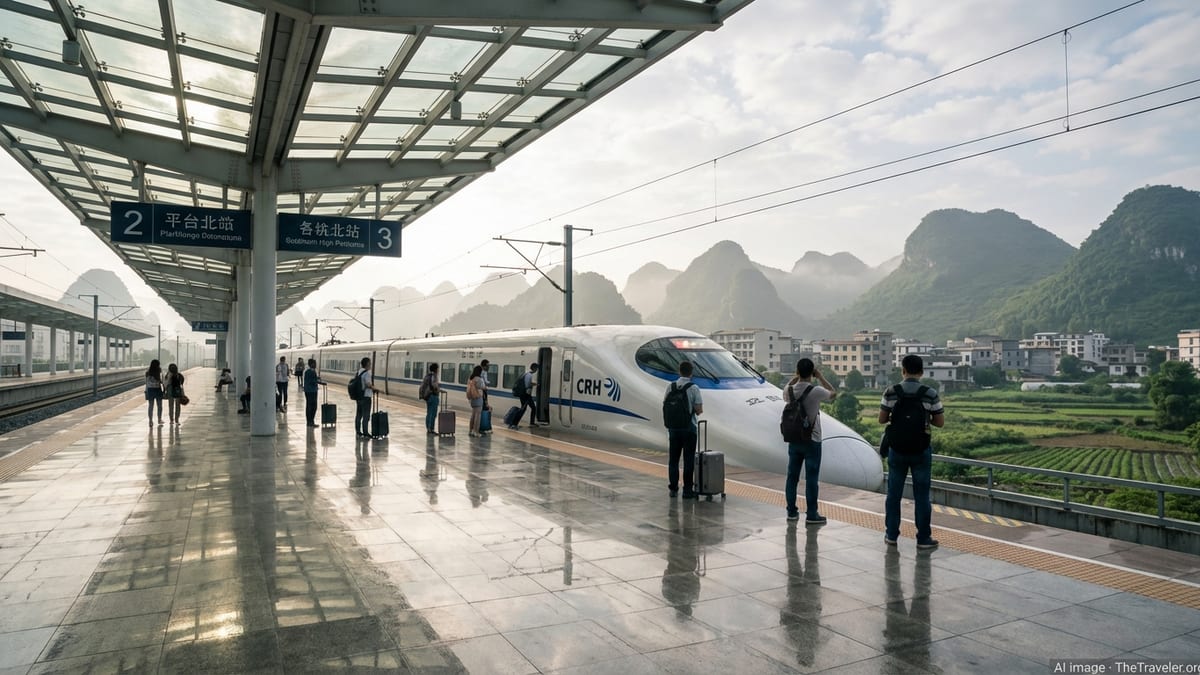
As high-speed trains slice through karst mountains, river valleys and ancient market towns at up to 350 kilometers per hour, China’s travelers are quietly reshaping the country’s tourism map, trading overnight sleeper berths and budget flights for fast, frequent rail services that now reach deep into once-remote regions.
A Network That Now Reaches Almost Every Major City
China’s high-speed rail network has grown from a handful of showcase routes in the late 2000s into the backbone of domestic travel, carrying nearly three out of every four rail passengers nationwide in 2024. Official figures show high-speed services handled about 3.3 billion trips last year, accounting for just under 76 percent of all rail journeys, as the country opened more than 3,000 kilometers of new track and pushed total high-speed mileage to roughly 48,000 kilometers, by far the largest such network in the world.
That expansion is increasingly about density rather than simple length. Railway planners say high-speed lines now connect 96 percent of Chinese cities with populations above half a million, and the overall rail network serves 99 percent of cities with more than 200,000 residents. For would-be tourists, that means destinations which once required circuitous bus rides or multi-leg flights can now be reached on a single train booked through the 12306 online platform, often with departures every 30 minutes at peak times.
The effect is visible during major holiday periods, when railways have repeatedly set new records. During the National Day “Golden Week” in early October 2024, daily passenger volumes peaked at around 21.5 million trips as families headed to coastal resorts, historic inland cities and emerging rural getaways. Earlier in the year, the Qingming festival travel rush saw a single-day peak of over 20 million rail journeys, driven in part by a surge in leisure trips booked around family visits.
China State Railway Group has responded by layering dense intercity services on top of the trunk high-speed grid in mega-regions such as Beijing–Tianjin–Hebei, the Yangtze River Delta and the Guangdong–Hong Kong–Macao Greater Bay Area, turning rail into the default mode for trips of a few hundred kilometers and undercutting both air travel and long-distance coaches on price and time.
New Lines Aim Directly at Tourism Hotspots
Where early high-speed lines largely linked political and economic hubs such as Beijing, Shanghai, Guangzhou and Wuhan, the latest wave of construction is explicitly aimed at tourism corridors. The Guiyang–Nanning high-speed railway in the southwest, which fully opened in late August 2023, cut travel time between the two provincial capitals from around 10 hours to less than three. The route passes through Libo and other areas known for dramatic karst landscapes and ethnic minority villages, making same-day visits from major cities feasible for the first time.
In eastern Anhui province, the Chizhou–Huangshan high-speed railway, inaugurated in April 2024, has stitched together a trio of scenic assets long separated by winding provincial roads: Jiuhua Mountain, one of Chinese Buddhism’s four sacred peaks; the famed granite ridges of Huangshan, or Yellow Mountain; and traditional Huizhou villages such as those in Yixian County. The 125-kilometer line, which operates at up to 350 kilometers per hour, allows travelers from Nanjing, Shanghai or Hangzhou to step off a morning bullet train and be on a mountain trail or village lane before lunch.
Coastal and cultural tourism are also being targeted. In Zhejiang province, the Hangzhou–Wenzhou high-speed railway opened in September 2024, connecting the provincial capital and its West Lake scenery with the port city of Wenzhou and a string of inland towns best known until now to domestic tour groups. The route serves Hengdian, home to Hengdian World Studios, one of the world’s largest film and television production bases, which is aggressively promoting itself as a theme-park-like experience for visitors interested in walking through period sets and replica palaces.
In the densely populated Yangtze River Delta, the Shanghai–Suzhou–Huzhou line, which began operations in December 2024, is tightening links between the financial hub of Shanghai and the canal towns and lakefront resorts of southern Jiangsu and northern Zhejiang. Travel times from Shanghai Hongqiao to Huzhou, near the shores of Lake Tai, have been cut to well under an hour, reinforcing the region’s shift toward short-stay, high-frequency leisure trips rather than infrequent long holidays.
Previously Remote “Hidden Gems” Move Into the Mainstream
For smaller cities and counties long overshadowed by nearby provincial capitals, high-speed rail has become a lifeline to the domestic tourism market. Academic research on the Sichuan–Chongqing economic circle and the Beijing–Tianjin–Hebei region has found that the arrival of high-speed service significantly boosts tourism flows, particularly for secondary and end-of-line cities that can market themselves as weekend getaways from megacities.
In mountainous southwestern provinces such as Guizhou and Guangxi, stations along the Guiyang–Nanning corridor are rebranding themselves around outdoor activities and ethnic culture, emphasizing hiking, river rafting and village homestays. Travel agencies in Guiyang report that itineraries once marketed as three- or four-day road trips can now be compressed into flexible one- or two-day rail-based packages that appeal to younger urban professionals with limited vacation time.
Similarly, the Chizhou–Huangshan line has catapulted towns like Yixian and the area around Jiuhua Mountain onto the radar of independent travelers, not just tour groups. Local guesthouse owners say bookings have climbed as visitors from Shanghai and Hangzhou opt to skip crowded flagship spots and instead spend nights in traditional courtyard inns or farmstays a short shuttle ride from the new high-speed stations.
Along newly opened coastal routes, smaller ports and beach towns between major nodes are positioning themselves as quieter alternatives to well-known resort cities. Some local governments have rolled out discounted rail-and-hotel bundles and destination passes that can be loaded onto passengers’ digital wallets, reducing friction for first-time visitors who might once have dismissed these areas as too difficult to reach.
Holiday Travel Surges Reveal Shifting Traveler Behavior
China’s big holiday periods provide a window into how high-speed rail is changing domestic tourism behavior. During the 10-day National Day and Mid-Autumn festival period in autumn 2024, railway authorities projected 175 million passenger trips, with tourism, family reunions and student travel all contributing to the surge. Instead of choosing a single far-flung destination, many travelers are now stringing together multi-stop itineraries made possible by frequent bullet trains.
Railway data around the Qingming festival in April 2024 showed especially heavy traffic on routes such as Nanning–Guangzhou, Shenzhen–Hong Kong and Changsha–Wuhan, corridors that combine family-visit flows with a growing share of leisure travel. Popular departure and arrival cities were not only Beijing, Shanghai and Guangzhou but also regional hubs like Chengdu and Wuhan, underscoring how high-speed rail is diffusing tourism demand across the country.
Travel agencies say the typical domestic tourist is also becoming more spontaneous. With advance ticket sales handled via apps and dynamic capacity adjustments adding extra trains during peaks, many urban residents now book short-haul high-speed rail trips a few days in advance or even on the morning of departure, particularly within mega-regions where journey times can be under two hours. That flexibility is encouraging more frequent, shorter leisure breaks in nearby cities and countryside areas rather than rare, once-a-year long-distance tours.
The shift is visible onboard. Where long-distance trains were once dominated by large family groups and retired travelers, high-speed carriages during off-peak weekdays now host a mix of students, remote workers with laptops, and small groups of friends on quick getaways, blurring the lines between business, commuting and tourism travel.
From Mountains to Theme Parks: New Tourist Products Take Shape
The reach of high-speed trains has prompted local authorities and private operators to redesign their tourism offerings around rail access. In regions famed for natural landscapes, new shuttle bus routes, cableways and visitor centers are being built directly adjacent to high-speed stations, reducing the time and complexity between stepping off a train and entering a scenic area.
Southwestern counties connected to the Guiyang–Nanning line are marketing combined tickets for trains, park entry and village homestays, often distributed through the same apps used to purchase rail seats. In Anhui, Jiuhua Mountain and areas around Huangshan are collaborating across county lines to coordinate visitor flows, encourage longer stays and avoid overcrowding at marquee viewpoints by promoting less-known hiking routes and cultural experiences.
Elsewhere, high-speed rail is linking directly into purpose-built leisure complexes. In Guangdong’s Qingyuan, a new medium-speed maglev tourist line that opened in January 2025 connects the conventional rail network with the sprawling Chimelong Forest Kingdom theme park. Though much shorter and slower than intercity bullet trains, the maglev’s short journey and frequent departures offer a seamless transfer for families who arrive by high-speed rail from Guangzhou or Shenzhen and want a car-free holiday.
Film studios, hot spring resorts and rural homestay clusters in provinces such as Zhejiang, Yunnan and Hainan are similarly tailoring their infrastructure and marketing to highlight rail accessibility, signaling to visitors that a weekend escape can start as soon as they scan a boarding code at the station gate.
Economic Lifeline for Smaller Cities, Balancing Pressures for Big Hubs
For local governments, high-speed rail has become a central plank of regional development strategy. Empirical studies on China’s capital region and the Sichuan–Chongqing corridor suggest that smaller cities often see a disproportionate boost in tourism once connected to the network, as lower land and accommodation costs allow them to position themselves as attractive, lower-density alternatives to megacities. Night markets, riverfront promenades and historic quarters are being refurbished with the explicit goal of capturing weekend visitor spending from larger neighbors.
City planners in provincial capitals, by contrast, are increasingly focused on managing the side effects of success. As travel times shrink and service frequencies grow, popular destinations can face crowding at station hubs, pressure on public transport and congestion at top attractions. Some cities have introduced timed entry systems for particularly sensitive sites and are staggering cultural festivals to avoid unsustainable peaks in visitor numbers.
The broader economic impact is significant. Railway authorities and state media emphasize that high-speed routes not only carry tourists but also support service-sector jobs in hospitality, dining and retail around stations, while enabling talent and investment to circulate more easily. Fixed-asset spending on new lines remains a major component of national infrastructure investment, and tourism-related tax and fee revenues provide an important source of income for many local administrations.
At the same time, analysts caution that some smaller cities risk overreliance on speculative real estate and station-area development if tourism demand does not materialize as quickly as anticipated. The coming years will test which destinations can translate newfound accessibility into distinctive, sustainable tourism products rather than simply building hotel clusters near the tracks.
Greener, Faster and Still Expanding
Environmental advocates and transport experts point to the climate benefits of China’s rail-centered tourism boom. High-speed trains, powered predominantly by electricity, emit far less carbon per passenger kilometer than domestic flights and long-distance buses. Comparative studies suggest that flights on similar routes can emit several times more carbon dioxide than high-speed rail, making bullet trains an important tool as China works toward its long-term emissions goals while still encouraging domestic consumption.
Cost is another driver. In many corridors, high-speed rail fares are roughly half the price of equivalent air tickets, particularly when factoring in airport transfers and check-in time. That cost advantage is particularly attractive to students, young families and retirees, groups that make up a large share of holiday-period travelers and are highly sensitive to ticket prices.
Despite the network’s already impressive scale, China continues to add new sections each year, with both national and regional rail authorities signaling that tourism potential is a key consideration when planning routes. Recent coastal, inland and cross-provincial lines show a growing emphasis on weaving together multiple types of destinations into coherent rail corridors, rather than simply connecting city centers.
For travelers across China, the effect is cumulative. With each new high-speed link, more of the country’s mountains, lakes, temples and historic quarters come within easy reach of a weekend or even a day trip. As operators experiment with themed trains, flexible ticketing and deeper integration with local tourism products, the nation’s vast, still-growing high-speed rail network is set to keep unlocking new hidden gems and subtly reshaping how hundreds of millions of people experience their own country.