

More news on this day
China’s high-speed rail network is entering 2026 with record scale, new lines and upgraded onboard comfort, positioning the country’s trains as a template for how fast, low-carbon travel could look worldwide in the decade ahead.
Get the latest news straight to your inbox!
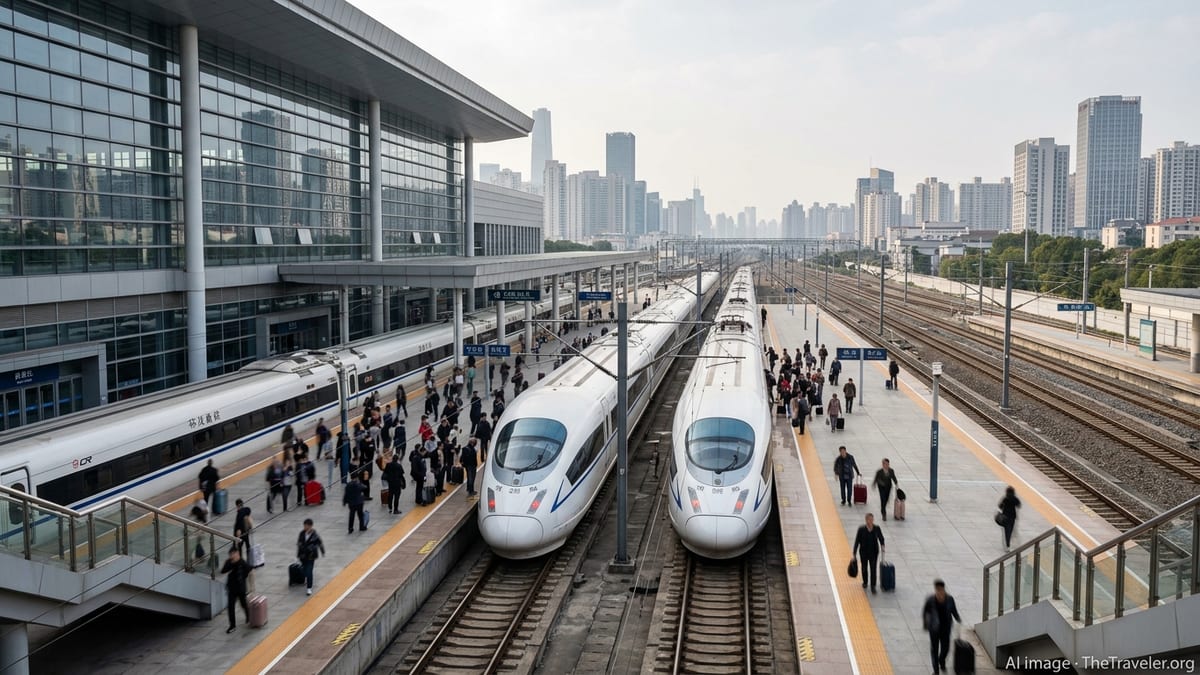
A Network Surpassing 50,000 Kilometers and Still Growing
Publicly available data show that by late 2025 China’s high-speed rail network exceeded 50,000 kilometers of operating lines, accounting for roughly two-thirds of global high-speed track in commercial service. The milestone followed a burst of openings including routes in Shaanxi, Guizhou and along key east–west corridors, underscoring the scale of investment that has continued through the country’s latest five-year planning cycle.
Coverage now extends to 31 of China’s 33 provincial-level regions, according to industry tallies, linking major coastal hubs with inland cities that until recently required long overnight journeys by conventional rail or air. Beijing to Shanghai remains the flagship trunk, but secondary routes such as Xi’an to Yan’an and Panzhou to Xingyi illustrate how high-speed links are reaching smaller urban centers and tourism gateways.
Government planning documents indicate that authorities are targeting a high-speed network of around 60,000 kilometers by 2030, building on the 48,000 kilometers reported at the end of 2024. Recent figures published by Chinese media put the broader national rail system at about 165,000 kilometers of track as of the end of 2025, with high-speed lines representing nearly one-third of the total and continuing to grow faster than conventional rail.
Financial disclosures point to sustained capital spending behind the expansion. Railway fixed-asset investment in 2024 surpassed the equivalent of 850 billion yuan, with additional increases reported for 2025, reflecting both new lines and upgrades to existing corridors that are being pushed to higher speeds and greater capacity.
From Megacities to Scenic Loops: Tourism Built Around High-Speed Tracks
The dense web of routes is reshaping how visitors move inside China. Recent holiday travel coverage from domestic outlets described high-speed stations in Xi’an, Shanghai, Chengdu and Guangzhou operating at or near capacity during peak periods such as the May Day and National Day breaks, when billions of passenger trips are logged across all modes of transport. High-speed trains, running at up to 350 kilometers per hour on core corridors, have become the preferred option for many travelers seeking to avoid airport transfers and congestion.
Travel industry briefings highlight that high-speed links are increasingly central to multi-city itineraries, enabling itineraries that combine historic centers, modern skylines and natural landscapes in a single trip. Popular circuits now pair Beijing with the Great Wall, Xi’an’s terracotta warriors and the karst scenery near Guilin, or link the Yangtze River Delta’s dense network of cultural and culinary destinations in Shanghai, Hangzhou, Nanjing and Suzhou with journey times of under an hour between many city pairs.
The network’s reach is also expanding into less-developed regions that are seeking tourism-driven growth. New high-speed connections in Guizhou, Gansu and along sections of the Chengdu–Lanzhou alignment reduce travel times to mountainous interior provinces, supporting campaigns that promote eco-tourism, canyon landscapes and ethnic minority cultures. Local authorities have highlighted the role of high-speed access in drawing hotel projects and visitor services to smaller cities now only a few hours from major hubs.
At the national level, the push to attract more foreign visitors dovetails with the rail build-out. In 2024 and 2025 China expanded visa-free or visa-on-arrival access to more than 70 countries, according to international news agencies, while inbound tourism surveys point to growing interest in using bullet trains to explore multiple regions in a single trip.
Unmatched Onboard Comfort Sets a New Benchmark
Alongside sheer scale, China’s latest generation of high-speed trains is emphasizing comfort and amenities that compare favorably with short-haul air travel. The homegrown Fuxing series, widely deployed on mainlines, offers business, first and second classes with ergonomically designed seating, generous legroom and seat-back power outlets as standard, according to operator specifications and traveler accounts.
Online reviews and independent travel guides describe quiet, air-conditioned carriages with stable ride quality even at top speeds, wide aisles that make moving luggage easier, and large windows that frame countryside and cityscapes. Many services add hotel-style touches such as dimmable lighting, adjustable headrests and fold-out footrests, especially in premium classes aimed at business travelers.
Digital connectivity has become another differentiator. Reports indicate that free or low-cost Wi-Fi is now common on flagship routes, supported by 5G coverage along major corridors, while onboard portals provide real-time journey information, seat-side food ordering and destination tips. Mobile ticketing and facial-recognition boarding deployed at key stations reduce dwell times and make transfers between connecting trains feel closer to metro travel than airport check-in.
Accessibility and family-friendly design are gaining prominence as the network matures. Many newer stations include level boarding platforms, tactile paving, accessible restrooms and dedicated spaces for wheelchair users, while trains feature stroller storage areas and child-friendly facilities. Together with comparatively low noise levels and minimal turbulence, these features have helped high-speed rail appeal to older travelers and families who might avoid long-distance buses or flights.
Global Impact: A New Standard for High-Speed Rail
China’s build-out is influencing rail projects far beyond its borders. State-owned firms have been involved in the Jakarta–Bandung high-speed line in Indonesia and the China–Laos Railway connecting Kunming to Vientiane, both of which use variants of Chinese technology and operating standards. Regional feasibility studies for future links toward Thailand and other Southeast Asian markets frequently cite China’s model of combining domestic connectivity with cross-border corridors.
Comparative assessments published by transport research bodies show that China’s network now exceeds the combined high-speed mileage of Europe and Japan, with France, Spain and Japan trailing far behind China’s more than 50,000 kilometers of track. While European and Japanese systems remain benchmarks for service quality and punctuality, analysts note that China has effectively set a new scale benchmark, reducing construction costs per kilometer and compressing delivery timelines in ways that other countries are studying closely.
The environmental implications are also significant. Studies by international rail organizations conclude that high-speed trains powered predominantly by electricity can emit a fraction of the carbon per passenger-kilometer of equivalent domestic flights when operating at high load factors. Against a backdrop of climate targets and airline capacity constraints, China’s experience is being watched by policymakers exploring how to shift short and medium-haul travel from air and road to rail.
However, financial and governance debates are likely to shape how far the model can be exported. Commentaries in global business media point to mounting questions about the long-term profitability of certain lines and the debt burdens faced by some localities, echoing similar concerns raised about metro systems. As China prepares its 2026–2030 planning horizon, observers are watching whether the emphasis shifts from building new lines to optimizing usage, upgrading service quality and fostering international cooperation on standards and technology.
2026 and Beyond: What Travelers Can Expect
Looking into 2026 and the rest of the decade, official planning documents and industry forecasts anticipate continued densification of the network, particularly in the Yangtze River Delta, the Greater Bay Area around Hong Kong and Shenzhen, and the Beijing–Tianjin–Hebei region. Several cross-regional routes under construction, including additional east–west links and coastal corridors, are expected to open before 2030, closing remaining gaps between medium-sized cities and major hubs.
Travel analysts expect journey times on select routes to fall further as more segments are uprated to 350 kilometers per hour and bottlenecks at older stations are removed. This could bring same-day, multi-stop itineraries within reach for a wider range of visitors, making it feasible to combine business meetings in one city with cultural or culinary experiences in another before returning to a different base.
Onboard, the next wave of upgrades is likely to center on digital services, personalized seat selection, more advanced noise insulation and expanded quiet-car policies. Rail technology firms are testing smart maintenance systems that monitor track and rolling stock in real time, with the aim of keeping punctuality high even as traffic density increases on busy corridors.
For international travelers, the combination of a more open visa regime, extensive English-language signage at major hubs and the familiarity of app-based booking platforms is gradually lowering barriers to using China’s high-speed rail network independently. If the current expansion trajectory holds, the experience of gliding between megacities and historic towns at near jet speeds, with city-center to city-center convenience, may increasingly define how visitors explore the country, and may offer a preview of how long-distance travel could evolve in other regions over the coming decade.