

More news on this day
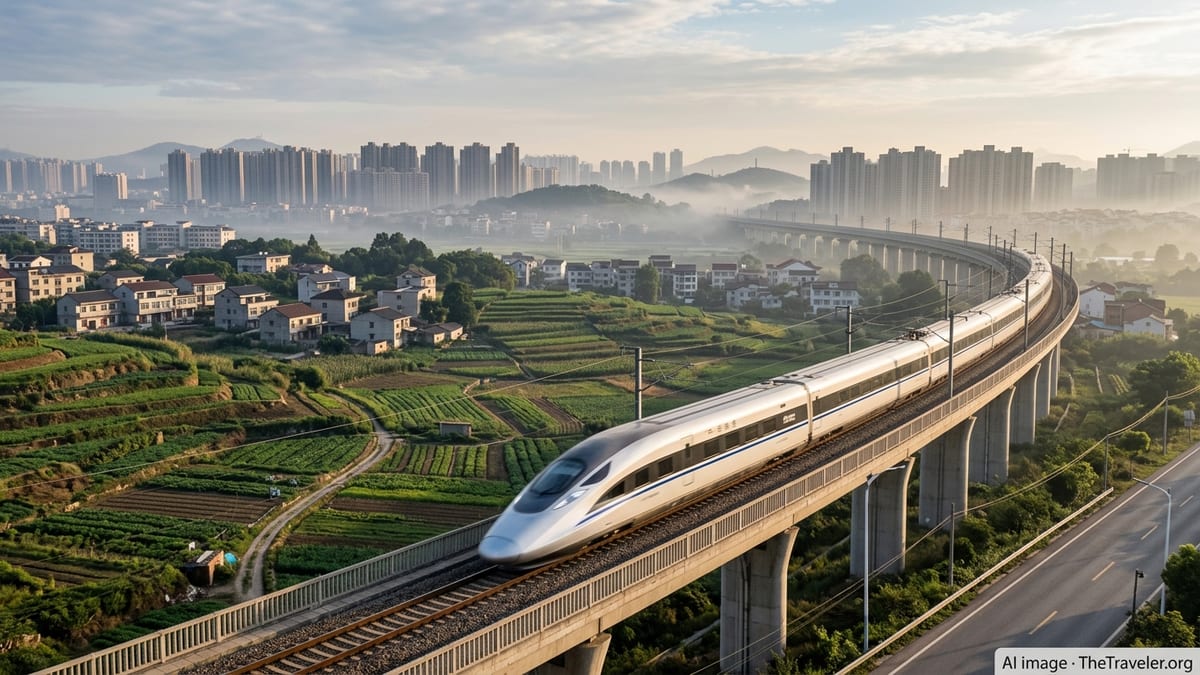
China’s high-speed rail boom is entering a new phase in 2026, as an already world-leading network surpasses 50,000 kilometers of track, adds new premium services and increasingly sets the pace for how long-distance travel is imagined far beyond its borders.
Get the latest news straight to your inbox!
A Network That Now Outruns the Rest of the World Combined
Publicly available data from China’s railway authorities and recent media coverage indicate that by the end of 2025 the country’s national rail network had reached about 165,000 kilometers in length, with roughly 50,000 kilometers classified as high-speed. That milestone means China now operates more high-speed track than the rest of the world combined, a scale unmatched in modern transport.
Analyses of international rail statistics show China accounting for close to two-thirds of global operational high-speed rail. Visual comparisons with other major markets, including Spain, Japan, France and Germany, highlight the contrast: where many countries operate a handful of trunk routes, China has woven a dense web of 250 to 350 kilometer-per-hour corridors linking most provincial capitals and many smaller cities.
Planning documents for the 2026 to 2030 period point to continued, if more measured, expansion. Targets published in official strategy outlines suggest high-speed mileage could approach 60,000 kilometers by 2030, with new investment focused on filling remaining gaps between interior cities, creating alternative routes on busy corridors and improving international connectivity with neighboring countries.
Behind the headline figures is a steady construction tempo that has seen thousands of kilometers of new high-speed lines open each year. Recent examples include routes in central and southwestern provinces that brought high-speed services to cities which previously relied on slower conventional trains, significantly cutting travel times and reshaping domestic tourism and business travel patterns.
From Megacities to Mountain Towns: Travel Times Collapse
The practical impact of this build-out is most visible in journey times between Chinese cities. Published timetables show that high-speed services typically run at 300 to 350 kilometers per hour on core lines, bringing some once-overnight trips down to just a few hours. Travel between mega-regions such as Beijing, Shanghai and the Greater Bay Area has effectively moved into the same-day, multi-trip category, in direct competition with air travel.
Inland regions have seen some of the most dramatic changes. Newly completed links in provinces such as Hubei and Guizhou have turned long, winding journeys through mountains and river valleys into fast, frequent connections. Reports on network coverage note that every prefecture-level city in certain interior provinces is now plugged into the high-speed grid, supporting domestic tourism, student mobility and migration for work.
High-frequency schedules are another hallmark. Industry summaries of the January 2025 timetable show more than ten thousand passenger trains operating daily in China, the vast majority of them high-speed services. On the busiest intercity corridors, frequencies now resemble those of regional metros, with trains departing in minutes rather than hours, especially during peak travel seasons around Lunar New Year and summer holidays.
Forecasts for 2026 suggest further ridership growth from the record levels already reached in 2024 and 2025, helped by digital ticketing, mobile itinerary planning and integrated transfers to urban metro systems at many new high-speed stations. For international travelers entering the country, itineraries that once relied on multiple domestic flights are increasingly being redesigned around rail hubs.
Unmatched Onboard Comfort and the Rise of the “Fuxing” Experience
While China’s first generation of high-speed trains emphasized speed and capacity, recent years have seen a pivot toward comfort and onboard experience. The latest Fuxing intelligent electric multiple unit, highlighted in rail industry briefings, showcases wider seat pitch, upgraded business and first-class cabins and quieter, more stable running at cruising speeds of 350 kilometers per hour.
Descriptions of the premium business-class layout emphasize a one-by-one seating arrangement, transforming each seat into a private pod with lie-flat capability, personal lighting and power, and large windows. First-class sections benefit from adjustable headrests, electronic leg rests and improved ergonomics, narrowing the gap with international long-haul business cabins in aviation.
Digital features are also becoming a defining characteristic. Onboard information systems provide real-time speed, routing and connection data, while smart seat indicators let passengers and crew identify occupancy at a glance. Some services incorporate app-based food ordering and seamless integration with national ticketing platforms, reducing the need for paper tickets or station check-in formalities.
The new comfort standards arrive alongside experiments with even faster technologies. In 2025, Chinese manufacturers publicly unveiled a prototype high-speed maglev train with a design speed of up to 600 kilometers per hour. Although widespread commercial deployment remains several years away, the project signals an intention to push the upper limits of land-based travel speed while continuing to refine the passenger environment.
Global Influence: Exporting Technology and a New Travel Template
China’s high-speed rail ambitions now extend far beyond its borders. Chinese-built or jointly developed lines, such as the Jakarta–Bandung high-speed railway in Indonesia and the China–Laos Railway, are already in operation, while proposed routes through Thailand and other parts of Southeast Asia are in various stages of planning and construction. These projects export not only equipment and engineering services but also design standards shaped in China’s domestic market.
International coverage of these ventures often notes both the benefits and the debates they generate. On one hand, partner countries gain access to technology capable of reshaping regional travel and trade, linking capitals with secondary cities and ports. On the other, questions about financing structures, long-term demand and environmental impact continue to attract scrutiny from economists, local communities and infrastructure analysts.
Beyond specific projects, China’s rapid build-out provides a live case study for governments assessing how high-speed rail might complement air and highway networks. Comparative studies frequently contrast China’s dense grid with still-limited high-speed offerings in large economies such as the United States and India, where projects are advancing more slowly. For long-distance travelers, the Chinese model demonstrates how rail can become the default choice on corridors of 300 to 1,000 kilometers when speed, frequency and comfort align.
At the same time, China’s experience illustrates the challenges of sustaining such an expansive system, including questions of fare policy, regional equity and maintenance over decades. How these issues are managed through the next five-year planning cycle could influence not only domestic mobility but also the credibility of the Chinese high-speed rail template abroad.
2026 and Beyond: Sustainability, Technology and Passenger Expectations
Looking ahead, climate and sustainability considerations are expected to keep high-speed rail at the center of China’s transport strategy. Independent analyses of transport emissions consistently show electric high-speed trains generating significantly lower carbon emissions per passenger-kilometer than short-haul flights or private cars, especially when powered by grids with growing shares of renewable energy.
As more Chinese cities tighten air quality and congestion targets, policy documents point to rail as a backbone for low-carbon mobility, supported by metro, tram and bus networks. New high-speed stations are increasingly planned as multi-modal hubs with integrated urban development, retail and public spaces, turning them into destination districts rather than simple platforms.
Technologically, 2026 is likely to bring incremental advances rather than headline-grabbing speed increases. Industry watchers expect further deployment of intelligent train control systems, predictive maintenance using big data and sensors, and deeper integration of ticketing across regional operators. For passengers, the biggest changes may be less visible: smoother operations, fewer delays and more personalized digital services.
For global travelers and planners monitoring these trends, China’s high-speed rail revolution offers both inspiration and caution. The country has demonstrated what is possible when long-term planning, industrial capacity and political commitment converge on rail infrastructure. The coming decade will show whether this unprecedented network can remain financially and environmentally sustainable while continuing to raise expectations for how people move across vast distances.