

More news on this day
China’s high-speed rail network, now stretching beyond 50,000 kilometers, is compressing distances between its cities, shifting travelers off planes and highways, and turning once-remote destinations into easy weekend getaways.
Get the latest news straight to your inbox!
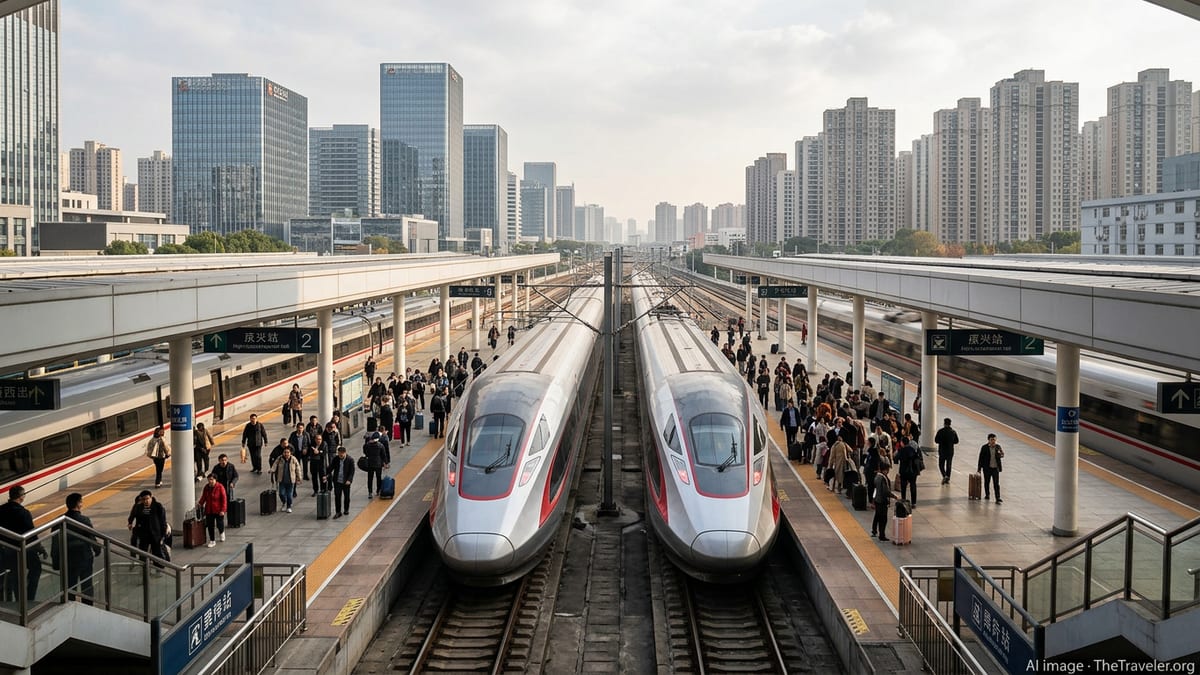
A Nationwide Network Built for Speed and Scale
Over less than two decades, China has built the world’s largest high-speed rail system, a grid of dedicated passenger lines that link almost every major city and many emerging tourism hubs. According to recent figures from the National Railway Administration and China State Railway Group, the country’s total operating railway mileage reached about 165,000 kilometers by the end of 2025, with high-speed tracks alone surpassing 50,000 kilometers and accounting for roughly one third of the entire network.
Those lines now form a dense mesh connecting coastal megacities with inland provincial capitals and regional centers. Flagship routes such as Beijing–Shanghai and Beijing–Guangzhou, as well as east–west corridors crossing central China, have been joined by newer intercity spurs that shorten journeys between secondary cities to under two hours. Many services run at 300 to 350 kilometers per hour, bringing door-to-door travel times between urban cores into direct competition with domestic flights.
Railway officials say the expansion is set to continue. National plans call for the high-speed network to reach around 60,000 kilometers by 2030, with new lines knitting together urban clusters such as the Guangdong–Hong Kong–Macao Greater Bay Area and the Yangtze River Delta. For travelers, that means additional departures, more direct city pairs and growing redundancy that makes last-minute itinerary changes easier than ever.
Record Passenger Volumes and a Shift in Travel Habits
The scale of passenger demand now flowing onto high-speed tracks underscores how central the system has become to Chinese mobility. Official data show that railways handled nearly 4.6 billion passenger trips in 2025, a new record and an increase on already-strong 2024 figures. High-speed services account for the vast majority of those journeys, with some estimates suggesting they carry around four out of every five long-distance rail passengers.
Daily volumes highlight how routine high-speed rail travel has become. During peak holiday periods such as Lunar New Year and the National Day “Golden Week,” China’s railways have moved more than 20 million passengers per day, with the bulk on G and D class high-speed services. Timetables published for 2025 show more than 10,000 high-speed trains scheduled daily, most operating during daylight hours on intensively used corridors.
Travel behavior has shifted in tandem. On city pairs where high-speed rail offers center-to-center journeys in under four hours, air traffic has often plateaued or declined, as travelers opt for trains that avoid airport transfers and security lines. For shorter routes of 500 to 800 kilometers, high-speed rail has become the default choice for business trips, family visits and weekend tourism, helping to normalize same-day intercity commuting for meetings and events.
Tourism Booms Along the Tracks
The tourism industry is one of the clearest beneficiaries of rapid intercity rail. Local governments report surging visitor numbers in cities that gained high-speed connections in recent years, as weekenders from larger metros use trains to reach historic towns, mountain scenery and coastal resorts that were once considered too far for short breaks.
New lines through central and western regions have brought destinations such as Yichang, gateway to stretches of the Yangtze River, within a few hours of major hubs like Wuhan and Chongqing. In southern China, high-speed links feeding into Guangzhou and onward to Guilin and Guizhou have made multi-city circuit trips more practical for both domestic and international tourists. Organized “tourist trains,” often timed around festivals or seasonal attractions such as autumn foliage and alpine skiing, have multiplied as operators tap pent-up demand for themed rail journeys.
Smaller cities are working to capture this footfall by upgrading station districts, adding shuttle links to historic quarters and scenic sites, and encouraging the development of boutique hotels and restaurants within a short ride of the platforms. Some provinces are explicitly marketing “two-hour tourism circles,” promising residents that a wealth of landscapes and cultural experiences now lie within a single high-speed train ride.
Seamless Mobility From Station to City Streets
The rapid rise in high-speed rail ridership has prompted parallel investment in what happens after passengers step off the train. Major stations in Beijing, Shanghai, Guangzhou, Chengdu and other large cities now function as multimodal hubs, with direct transfers to metro lines, city buses, airport express services and long-distance coaches designed to keep journeys flowing without long waits.
In many newer high-speed hubs, transit-oriented development has become a planning mantra. Municipal authorities have zoned for dense commercial and residential projects within walking distance of stations, bringing offices, malls, hotels and housing closer to the platforms. This approach aims to reduce the “last mile” time that can erode the advantages of high-speed travel and has helped turn some once-peripheral station areas into new urban subcenters.
Digital tools are further smoothing the experience. Nationwide e-ticketing via mobile apps, real-time occupancy data and integrated payment systems for urban transit allow travelers to move from a high-speed carriage to a city subway or bus using the same device and digital wallet. For tourists unfamiliar with local transit networks, that integration reduces friction and supports spontaneous day trips between neighboring cities.
Innovation and Challenges on the Horizon
China’s rail sector continues to test new technologies that could further reshape intercity mobility. Railway research institutes and equipment manufacturers are trialing advanced train control systems, 5G-based communications and more energy-efficient rolling stock tailored for high-frequency corridor service. Medium-speed maglev projects geared toward tourism, such as demonstration lines in Guangdong, are being observed as potential complements to conventional high-speed routes in heavily visited regions.
At the same time, authorities and analysts acknowledge that the model faces challenges. Some high-speed stations built on the fringes of smaller cities have struggled to attract sufficient ridership, raising questions about land-use planning and feeder transport. The heavy capital investment required to build and maintain high-speed lines has also sharpened debate about long-term financial sustainability, particularly on routes where demand has been slower to materialize.
Despite these pressures, policymakers remain committed to high-speed rail as a backbone of low-carbon transport and a driver of regional development. Targets for additional mileage, higher frequencies and improved service quality are being framed explicitly in terms of national goals for emissions reduction and balanced growth. For travelers, the effect is already tangible: in much of China, crossing provincial borders by train is now barely more complicated than riding a city metro, and that is rapidly redefining how people think about distance, leisure and the geography of opportunity.