

More news on this day
China has opened the Huajiang Grand Canyon Bridge in the southwestern province of Guizhou, a record breaking structure that now ranks as the world’s tallest bridge and a dramatic new focal point for global engineering and adventure travel.
Get the latest news straight to your inbox!
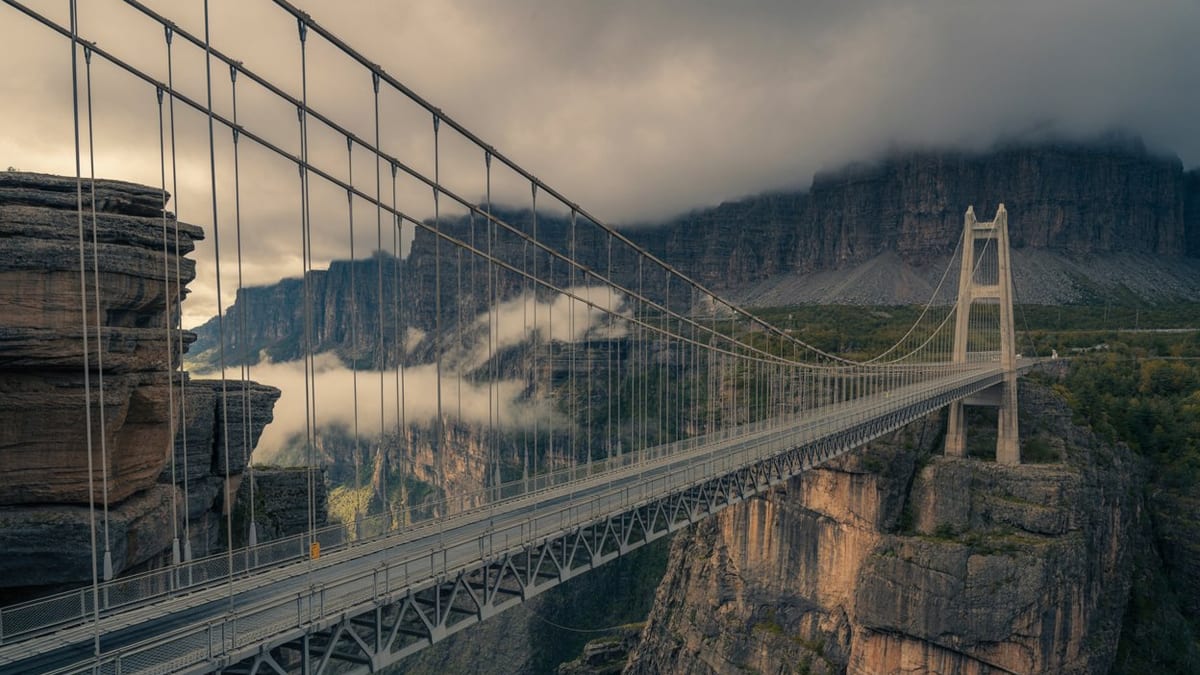
Image by Travel And Tour World
A Record Breaking New Giant in the Skies
Publicly available information shows that the Huajiang Grand Canyon Bridge soars about 625 meters above the Beipan River, placing its deck at roughly the height of a supertall skyscraper and eclipsing the previous record held by the nearby Duge Bridge. The suspension bridge extends close to 2.9 kilometers, with a main span of around 1,420 meters, making it one of the longest mountain bridges ever built and a new benchmark for high altitude crossings.
The bridge carries the Liuzhi Anlong Expressway across a deep chasm popularly described in Chinese coverage as the “Earth’s Crevice,” slashing a drive that once took around two hours on winding mountain roads to just a couple of minutes. Reports indicate that the structure was completed after more than three years of construction, involving complex work in steep karst terrain and subject to demanding wind and safety requirements at extreme height.
By opening to traffic in late 2025, the bridge formalizes China’s position at the top of the world rankings for high bridges, a category that tracks the vertical drop from deck to the valley floor. Engineering summaries and specialist bridge databases now list multiple Guizhou crossings among the top tier of tallest bridges, with Huajiang Grand Canyon Bridge at the summit.
Joining a Pantheon of Global Engineering Landmarks
The debut of the Huajiang Grand Canyon Bridge places China alongside long established champions of iconic bridge building in countries such as the United States, France, Japan and Switzerland. For years, structures like the Golden Gate Bridge in San Francisco, the Millau Viaduct in southern France, the Akashi Kaikyo Bridge in Japan and Switzerland’s towering alpine viaducts have anchored both national identity and international tourism.
In contrast to sea level crossings such as the Golden Gate, which is celebrated for its span and silhouette above San Francisco Bay, China’s latest bridge is defined by its extreme verticality. The drop from deck to river in Guizhou exceeds the height of the Millau Viaduct’s road deck over the Tarn Valley and rises far higher above the valley floor than prominent European and North American crossings. This shift in scale highlights how mountainous interior regions are becoming the stage for the next generation of “super bridge” tourism draws.
Chinese infrastructure has already produced a series of superlatives, from record setting high speed rail networks to some of the world’s longest cable stayed bridges. With the Huajiang Grand Canyon Bridge, the country adds an eye catching symbol of its bridge building expertise to a club of global landmarks that attract visitors as much for their spectacle as for their transport function.
Adventure Tourism on the Edge of a 625 Meter Drop
Regional authorities and project backers have promoted Guizhou as a rising destination for outdoor and adventure tourism, and the new bridge is expected to play a central role in that strategy. Reports from Chinese and international outlets note that the surrounding canyon landscape features sheer limestone cliffs, deep ravines and remote villages, framed by subtropical forests that lend themselves to hiking, climbing and scenic road trips.
Concept plans and local promotional material reference features such as glass viewing platforms, skywalks and potential bungee or rope based activities that could be added near the bridge or integrated into visitor centers. At 625 meters above the river, any such attractions would immediately rank among the world’s highest adventure experiences, inviting comparisons to glass bottom walkways in China’s Zhangjiajie region and to high altitude activities near European peaks.
Even without formal extreme sports facilities, the crossing itself is already being marketed as a bucket list drive for self guided travelers. Panoramic photographs circulating in media coverage show vehicles moving across a seemingly delicate thread of roadway suspended high above a canyon that could easily conceal large urban structures within its depth, reinforcing the sense of exposure that adventure oriented visitors seek.
Transforming Access to a Once Remote Corner of China
Beyond its visual impact, the Huajiang Grand Canyon Bridge is reshaping access to a historically isolated part of southwest China. Guizhou is known for its rugged karst topography, where steep mountains and gorges long limited road connectivity between small communities and larger cities. By bridging one of the region’s most dramatic gaps, the new structure ties local counties more closely into provincial and national expressway networks.
Publicly available planning documents highlight expectations that the expressway corridor will stimulate trade, logistics and tourism flows between Guizhou and neighboring provinces. Shorter travel times are forecast to encourage urban residents to make weekend trips into the canyon area, while allowing rural communities along the route easier access to services, markets and employment opportunities in regional hubs.
Analysts of China’s transport build out note that Guizhou already hosts a remarkable number of the world’s tallest bridges, many of which were built precisely to overcome barriers posed by its terrain. The Huajiang Grand Canyon Bridge extends that pattern, but does so at a scale that turns a piece of functional infrastructure into a national showpiece and potential driver of new tourism based income.
Engineering Feats and Global Competitive Signaling
The bridge’s completion also carries symbolic weight in the broader narrative of international engineering competition. Design and construction responsibilities were handled by major Chinese bridge institutes and contractors with long track records on large span projects, and reports describe the use of GPS guided cable cranes, wind monitoring systems and extensive load testing to meet safety standards at extreme elevation.
Commentary in Chinese media has positioned the project as a demonstration of technical capability comparable to headline bridges in the United States, France, Japan and Switzerland. While Western icons often emphasize aesthetic refinement and integration with urban or pastoral landscapes, the Huajiang Grand Canyon Bridge represents a different frontier: conquering some of the steepest and deepest landforms on the planet in the interest of regional development.
For global travelers, the result is a new landmark that connects two narratives at once. It is an audacious piece of civil engineering that pushes the limits of height and span, and it is a fresh venue for adventure tourism in a part of China that, until recently, remained far from the mainstream itineraries that focused on Beijing, Shanghai or coastal attractions. As visitor awareness grows, the world’s tallest bridge may increasingly be measured not only in meters, but in the number of travelers willing to look over its edge.