

More news on this day
China has carried out the maiden flight of its Lijian-2 Y1 carrier rocket, successfully delivering a trio of satellites into orbit and signaling a new phase in the country’s rapidly expanding commercial space capabilities.
Get the latest news straight to your inbox!
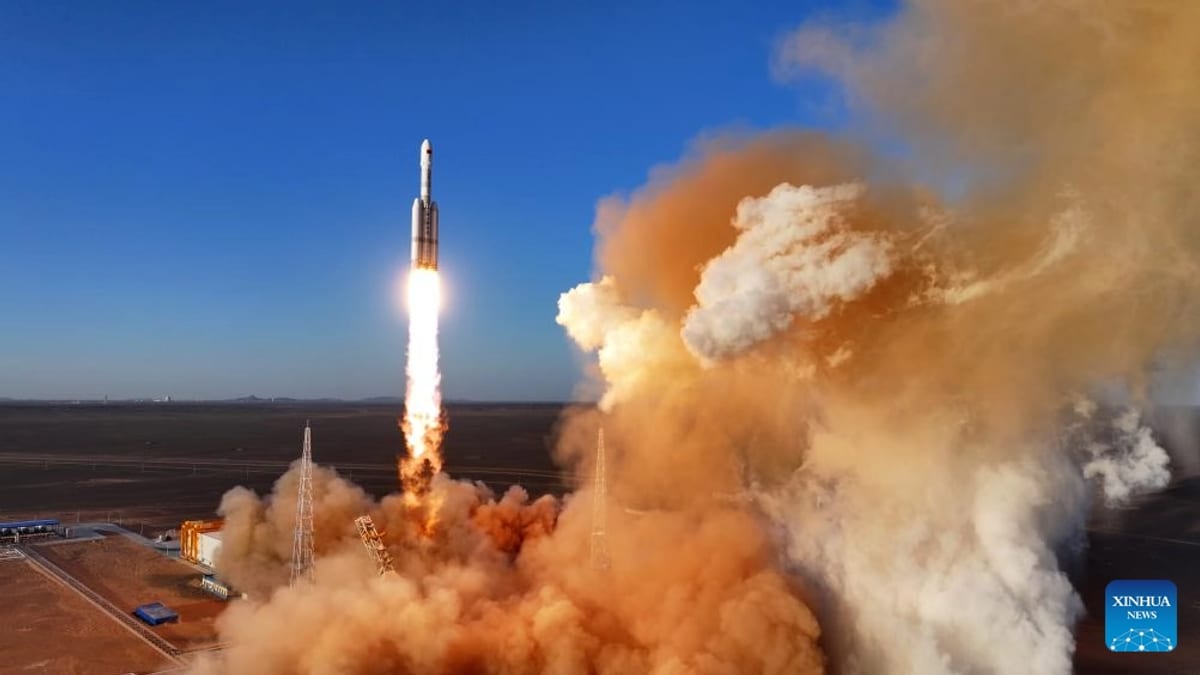
Image by Aviation News
New Liquid-Propellant Rocket Lifts Off From Northwest China
According to publicly available reports, the Lijian-2 Y1, also known in some English-language coverage as Kinetica-2 Y1, lifted off on March 30, 2026 from the Dongfeng commercial space innovation pilot zone in northwest China. The launch site forms part of a broader effort to create a dedicated hub for privately developed and commercially focused space missions.
The mission placed three satellites into their planned orbits, marking a full success for the new rocket’s debut. Information released after liftoff indicates that the payload stack consisted of the New March 01 technology demonstration satellite, the New March 02 experimental cargo spacecraft and the TS 01 educational satellite, all of which are designed to test new systems and support research applications.
Reports indicate that the flight profile involved insertion into low Earth orbit, an increasingly crowded region of space used for Earth observation, technology demonstration and small-scale cargo and experimental missions. The successful orbit deployment suggests that guidance, navigation and control systems on the new rocket performed as expected on its first operational test.
The launch comes at a time when China is pursuing a high tempo of orbital missions across both state-owned and commercial providers, positioning the country as one of the most active players in global spaceflight by annual launch count.
Engineering Features of the Lijian-2 Y1 Launch Vehicle
Publicly available technical descriptions identify Lijian-2 as a two-stage, non-reusable medium-lift launch vehicle powered by liquid propellant, using a kerosene and liquid oxygen combination that is now common among newer commercial rockets worldwide. The design approach aims to deliver relatively high thrust while keeping costs and complexity within a range suitable for frequent commercial missions.
The vehicle is reported to stand more than 50 meters tall with a liftoff mass in the hundreds of tons, placing it in a category capable of transporting payloads from roughly 2 tons up to around 20 tons to low Earth orbit when configured in its upper performance range. Such capacity gives it flexibility for multi-satellite rideshare missions as well as single, heavier payloads.
Developed by the commercial launch company CAS Space, Lijian-2 follows the earlier solid-fueled Lijian-1 rocket, which had already demonstrated the ability to deploy large clusters of small satellites on previous flights. The shift toward a powerful liquid-propellant system indicates a strategic move into larger payload classes and more complex mission profiles.
Engineers have highlighted the modular nature of the liquid engine clusters used on Lijian-2, noting that this architecture allows the thrust level to be scaled by varying the number of engines. That approach is intended to support a family of configurations optimized for different payload masses and orbits while keeping core technologies consistent.
Triple Satellite Payload Targets Technology, Cargo and Education
The three spacecraft launched on the inaugural Lijian-2 mission illustrate the diversity of payloads now flying on commercial rockets in China. New March 01 is described in coverage as a technology demonstration satellite, intended to test advanced subsystems that may later be applied to larger operational spacecraft or constellations.
New March 02, sometimes referred to as an experimental cargo spacecraft, is expected to trial concepts related to in-orbit logistics and the handling of experimental payloads in microgravity. While detailed specifications have not been widely disclosed, the mission is viewed as part of wider research into on-orbit services and the future commercialization of space-based laboratories and platforms.
The TS 01 satellite rounds out the payload as an educational platform, offering opportunities for universities and research institutions to participate in space-based experiments. Such missions typically host student-designed instruments, remote sensing cameras or communications payloads, providing hands-on experience in satellite design and operations.
By combining technology development, cargo experimentation and education within a single launch, the Lijian-2 Y1 flight demonstrates how new commercial rockets are being used to maximize orbital access for a wide range of users, from established aerospace institutions to emerging academic programs.
Implications for China’s Commercial Space Launch Sector
The debut of Lijian-2 Y1 adds another medium-lift launcher to China’s growing commercial fleet, which in recent years has included solid-fueled rockets such as Lijian-1 and Gravity-1, along with methane or kerosene liquid-fueled vehicles from several private companies. Industry observers note that this diversified ecosystem is designed to serve different niches in the satellite market, from high-volume rideshare missions to tailored launches for single customers.
Publicly available information shows that CAS Space is positioning Lijian-2 as a workhorse for commercial and institutional clients that need relatively high payload capacity without relying exclusively on the country’s state-run Long March rockets. That could help alleviate launch bottlenecks as the number of planned missions for communications, Earth observation and technology demonstration satellites continues to climb.
The launch also follows a period of mixed fortunes for parts of China’s wider launch industry, which has experienced both successful missions and notable setbacks involving other rocket families. Against that backdrop, a smooth inaugural flight for a new liquid-propellant commercial vehicle is seen as a significant technical and reputational milestone.
For the global launch market, the emergence of Lijian-2 underscores the intensifying competition to provide reliable, relatively low-cost access to orbit. Operators of small constellations, in particular, now have a growing menu of Chinese commercial launch options to weigh alongside providers in the United States, Europe and other regions.
Strategic Role in Future Orbital Missions
Looking ahead, analysts expect Lijian-2 to play a role in supporting China’s ambitions in areas such as large-scale low Earth orbit constellations, high-resolution Earth observation and technology pathfinder missions for future deep-space projects. The rocket’s payload capacity positions it to deploy batches of satellites efficiently, a key requirement for constellation operators seeking to populate or replenish orbital planes on tight timelines.
Reports indicate that CAS Space has already been testing reusable technologies on separate suborbital vehicles, suggesting a broader roadmap that could eventually combine high-capacity liquid launchers with recoverable stages or components. While Lijian-2 itself is currently described as non-reusable, experience gained from this class of rocket is likely to inform designs for future partially or fully reusable systems.
The Dongfeng commercial space innovation pilot zone, from which Lijian-2 Y1 launched, is also expected to benefit from the rocket’s regular use. Increased launch cadence typically drives associated investment in ground infrastructure, logistics and local supply chains, reinforcing the region’s role as a focal point for China’s commercial spaceflight activity.
For international observers and prospective customers, the successful first flight of Lijian-2 Y1 provides another data point in assessing China’s capacity to deliver complex, multi-satellite missions on newly developed commercial rockets. As follow-on launches are scheduled and additional performance data becomes available, the rocket’s place within both national and global launch landscapes will become clearer.