

More news on this day
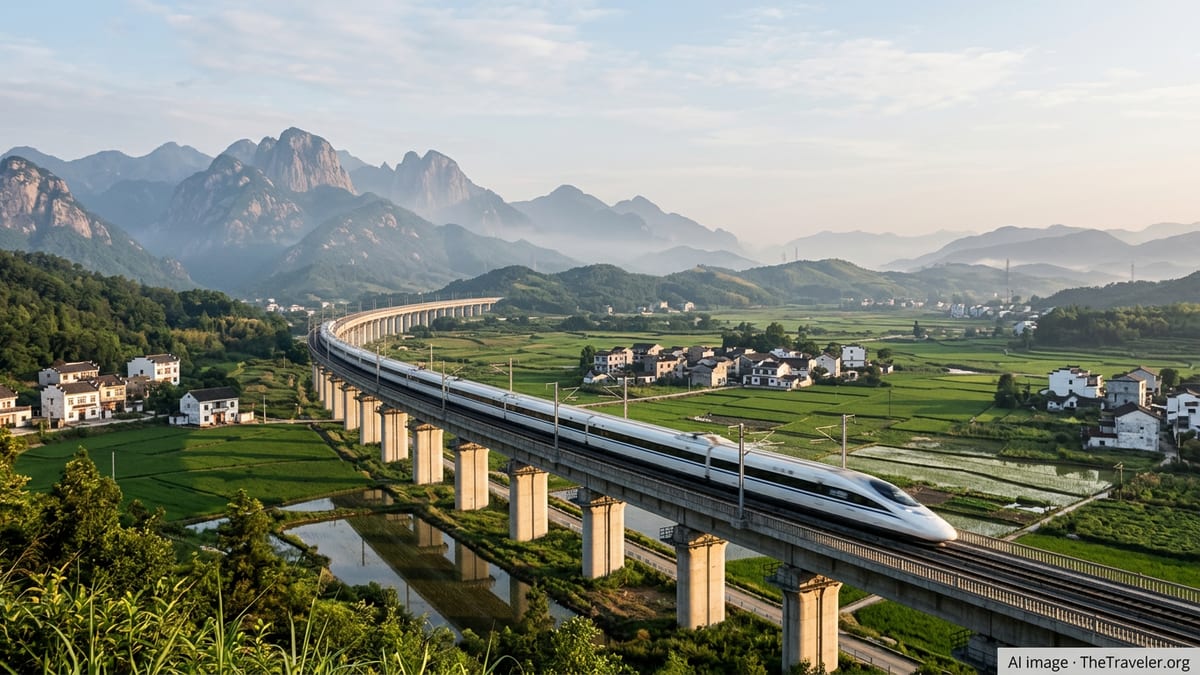
China’s latest wave of high-speed rail expansion is rapidly redrawing the country’s tourism map, with new and upgraded routes funneling visitors toward Huangshan in Anhui province, emerging cultural hubs across Zhejiang, and the vast grasslands of Inner Mongolia.
Get the latest news straight to your inbox!
A Record-Breaking Phase of Rail Expansion
China’s high-speed rail network continues to grow at a scale unmatched elsewhere, and the latest figures underline the speed of change. Publicly available information from national railway authorities shows that more than 3,100 kilometers of new railway lines were opened across the country in 2025, including about 2,862 kilometers of high-speed track. Ambitious targets for 2026 include facilitating more than 4.4 billion passenger trips, signaling that rail will remain the backbone of domestic travel.
This investment is reshaping how and where travelers move. Inland regions and second-tier cities are gaining direct access to high-speed services that previously concentrated on the coastal megacities. For international visitors planning multi-stop itineraries, that means more options to combine classic destinations such as Shanghai and Hangzhou with lesser-known areas like the Huizhou cultural belt around Huangshan or the grassland prefectures of Inner Mongolia.
New timetables and route launches are not just technical adjustments. Each updated schedule typically adds dozens or even hundreds of passenger services nationwide, opening up earlier morning departures, late-evening returns, and more frequent connections between tourism hotspots. The result is a more flexible rail grid that supports short-break tourism, weekend escapes, and spur-of-the-moment trips in ways that were far harder a decade ago.
For travelers, the key takeaway is that journey times between inland attractions are falling sharply, while seat capacity in peak holiday periods is rising. That combination is already changing crowd patterns at some of China’s most famous scenic sites and is expected to accelerate over the next two to three years.
Huangshan: Mountain Classic in a New High-Speed Era
Huangshan, the UNESCO-listed mountain landscape in Anhui province, is one of the clearest examples of how new rail links can turbocharge a mature destination. Recent openings of high-speed routes such as the Chizhou–Huangshan line, along with the Shanghai–Suzhou–Huzhou corridor and other Yangtze River Delta connections, have effectively pulled Huangshan into a wider one-and-a-half to two-and-a-half hour travel radius from major cities including Shanghai, Hangzhou and Hefei.
Rail-focused tourism coverage indicates that travel times from Shanghai’s main high-speed hubs to Huangshan’s modern stations have dropped to just over two and a half hours on the fastest services. This places the scenic area firmly within long-weekend territory for residents of the country’s most populous urban region. Local tourism operators report that “Huizhou-style” cultural towns, historic villages and tea-growing valleys around Huangshan are seeing a lift in short-stay visits tied directly to the new rail schedules.
Huangshan’s railway authorities have responded by boosting capacity during peak travel seasons, including spring blossom periods and major public holidays. Temporary additional services and longer train formations are being deployed to handle surges in visitor numbers between mid-March and mid-April, when domestic tourism to the mountains typically spikes. At the same time, local tourism campaigns have linked discounted or bundled scenic-area tickets to same-day high-speed rail arrivals, encouraging travelers to step off the train and head straight into the national park and surrounding heritage villages.
For international visitors, the high-speed network has simplified logistics considerably. It is now feasible to land in Shanghai, spend a night in the city, then travel by morning train to Huangshan and arrive in time for an afternoon hike or cable-car ascent. From Huangshan, frequent high-speed services continue toward neighboring Jiangxi’s rural attractions, making loop itineraries over rail far more practical than in the past.
Zhejiang’s One-Hour Travel Circles and Coastal Gateways
East China’s Zhejiang province, long established as a tourism powerhouse around Hangzhou and its West Lake, is entering a new phase of regional rail integration. Recent launches of high-speed corridors connecting Hangzhou with Wenzhou and Quzhou, along with a series of new stations such as Jiande South, Longyou North and Quzhou West, have tightened what provincial planners describe as a “one-hour transport circle” linking inland river valleys with the coast.
Data released by local authorities shows that the Hangzhou–Quzhou high-speed railway alone carried more than 140,000 passenger trips in its first month of operation, with tourism bureaus in Quzhou and surrounding counties quickly positioning themselves as accessible weekend retreats for travelers from Hangzhou and the Yangtze River Delta. New stations are being framed as gateways to nearby historic towns, red tourism sites and countryside homestays, often underpinned by shuttle buses timed to high-speed arrivals.
Zhejiang’s broader rail network continues to thicken. The latest national timetable update for early 2026 added more than 20 new pairs of passenger services across the Yangtze River Delta, bringing the region’s daily scheduled trains to over 1,430 pairs. This makes it easier to combine coastal cities like Wenzhou and Ningbo with inland destinations in a single trip, while also enabling day tours into rural areas that were once a full day’s journey away by road.
For travelers, the key shift is not just shorter travel times but greater choice in departure points and routes. Multiple high-speed lines now radiate from Hangzhou, allowing visitors to avoid backtracking through Shanghai when heading south or west. That flexibility encourages more experimental itineraries that add in lesser-known mountain resorts, river gorges and ancient water towns scattered across Zhejiang’s interior.
Inner Mongolia: Grasslands Brought Within Reach
Further north, Inner Mongolia is emerging as one of the main beneficiaries of China’s push to extend high-speed rail deeper into inland provinces. A landmark step came with the opening of the Jining–Datong–Yuanping high-speed line, which created a fast corridor linking Inner Mongolia with neighboring Shanxi. Reports on the route’s launch highlight that travel between Hohhot, the regional capital, and Taiyuan has been cut from around five hours to just over three hours on the new services.
The impact of such changes goes beyond business connectivity. Vast grassland areas around Hohhot, Baotou and the Xilingol League are hoping to attract more independent travelers and domestic tourists seeking cooler summer climates and wide-open landscapes. New long-distance high-speed services introduced in 2025 now connect Hohhot and Baotou to major tourism source markets including Shanghai, Hangzhou, Chengdu and Chongqing, substantially reducing the need for overnight conventional trains.
Additional lines are under construction or entering full operation across the region. The Baotou to Yinchuan high-speed link, connecting Inner Mongolia with the neighboring Ningxia Hui autonomous region, has begun full services, further reinforcing the northwestern rail grid. Meanwhile, construction of the Taizicheng–Xilinhot railway is progressing, with planners expecting that future through services will shrink travel times between Beijing and the grasslands of Xilingol to around four and a half hours.
For visitors, these upgrades open up new possibilities for rail-based itineraries that combine capital-city stays with multi-day excursions to prairie landscapes, desert fringes and nomadic heritage sites. It is increasingly realistic to plan journeys that run from Beijing or Shanghai to Inner Mongolia entirely by high-speed rail, with onward connections toward Ningxia and other inland regions.
What Travelers Should Watch in the Next Two Years
Looking ahead to 2026 and 2027, several trends in China’s high-speed rail build-out are particularly relevant for travelers eyeing Huangshan, Zhejiang and Inner Mongolia. First, more cross-regional services are likely as national timetables are refined. Recent updates have already added hundreds of daily trains nationwide and expanded long-haul high-speed routes from coastal hubs to inland cities. Similar adjustments are expected to further densify connections into Anhui and Inner Mongolia.
Second, incomplete segments now under construction are poised to close key gaps. In east China, new intercity high-speed sections around Jiande and Jinhua are set to strengthen links from Huangshan toward southeastern coastal cities, improving options for loop journeys that start and end in Shanghai. In the north, the gradual completion of routes such as the Taizicheng–Xilinhot line will make Inner Mongolia’s grasslands more accessible to independent travelers relying solely on rail.
Third, tourism products built around rail are becoming more sophisticated. Coverage from across China points to a steady rise in themed trains, seasonal charter services and flexible ticketing campaigns targeting scenic destinations. Huangshan’s half-price scenic-area admissions for recent high-speed arrivals, and Zhejiang’s promotion of rail-linked cultural circuits around Quzhou and Jiande, are early examples of how destinations are actively leveraging the new infrastructure.
For visitors planning trips, the practical advice is to treat the high-speed rail map as a dynamic tool rather than a fixed reference. Checking the latest timetable updates close to departure, looking for newly opened stations near scenic areas, and considering inland hubs such as Hohhot or Quzhou as starting points, can unlock routes that did not exist just a year or two ago. As China’s high-speed network continues its unprecedented growth, these evolving rail options are becoming central to how travelers experience the country’s landscapes and cultural heartlands.