

More news on this day
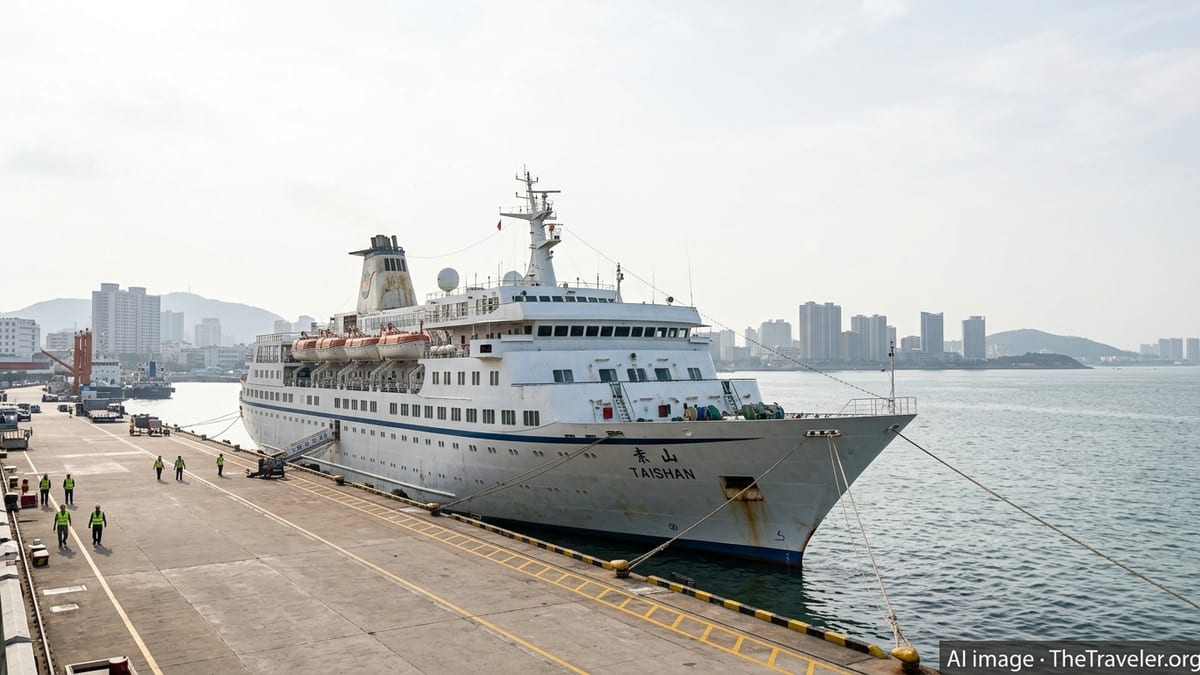
China’s first wholly owned and independently operated cruise ship, the Taishan, is set to be sold by Bohai Ferry for about 23 million dollars, signaling a new phase in the country’s still-recovering cruise industry and raising questions about the pace of China’s post-pandemic restart at sea.
Get the latest news straight to your inbox!
A Trailblazing Vessel in China’s Cruise History
Publicly available company information and sector analyses describe Taishan as a landmark ship in the evolution of China’s cruise sector. Operated by Bohai Ferry’s cruise division, the vessel was heralded as China’s first luxury cruise ship that was both fully owned and independently operated by a domestic company, marking a step change from the earlier model of relying heavily on foreign chartered tonnage.
Originally built in Europe in 2000 and later acquired by Bohai Ferry in 2014, the ship sailed under the name China Taishan or Chinese Taishan on regional itineraries. Historical coverage shows that it connected mainland ports such as Yantai and Zhoushan with destinations in Japan and on routes around Taiwan, giving Chinese travelers new access to cruise-style holidays close to home.
Industry reports note that Taishan’s introduction a decade ago was widely interpreted as a sign that Chinese operators were ready to transition from being predominantly distributors for international brands to becoming asset owners in their own right. The pending sale suggests that Bohai Ferry is now recalibrating that earlier strategy in light of changing market conditions.
Details of the Planned 23 Million Dollar Sale
Recent shipping market reporting indicates that Bohai Ferry has agreed or is close to agreeing a deal to sell the Taishan for around 23 million dollars. Although detailed transactional documentation is not yet widely available, the figure places the disposal in line with values seen for aging mid-sized cruise ships in a subdued post-pandemic market.
The vessel, displacing roughly 24,000 gross tons with capacity for close to 900 or more passengers according to technical registries, is considered small to mid-sized by current global standards. Its age, dating back more than two decades, and the need for ongoing investment in refurbishment and environmental compliance systems are seen as key factors informing the sale price.
Reports suggest that the buyer profile has not been fully disclosed, prompting speculation about whether Taishan will find a second life in emerging regional markets, be converted for alternative uses such as accommodation or floating hospitality, or ultimately head for recycling if future operations prove uneconomic. The valuation around 23 million dollars reflects these uncertainties as well as the limited pool of potential purchasers for older tonnage.
From Symbol of Ambition to Strategic Liability
When Bohai Ferry purchased the ship in 2014, analysts described the move as ambitious. The company, better known for its roll-on roll-off ferry operations across the Bohai Bay, positioned Taishan as a flagship for diversification into leisure cruising. At the time, China’s outbound and domestic cruise demand was growing rapidly, and expectations for a sustained boom were high.
However, the subsequent industry cycle unfolded very differently. Even before the pandemic, competition from international brands deploying newer and larger ships to Chinese ports intensified. Taishan’s relatively modest size and older design made it harder to compete on amenities, particularly as consumer expectations rose and home-grown projects for larger, more modern cruise ships gained momentum.
The impact of the Covid-19 pandemic then dramatically disrupted cruise operations across Asia. According to sector coverage, China-based cruise ships spent extended periods idle, and the restart of large-scale cruise tourism in Chinese waters has lagged other regions. In that environment, maintaining an older ship with limited near-term deployment prospects increasingly appeared to be a drag on Bohai Ferry’s balance sheet.
As a result, the vessel that once stood as a symbol of China’s drive to own and operate its own luxury cruise hardware has gradually shifted into the category of a strategic liability. The planned sale is being interpreted by observers as a pragmatic step to release capital and reduce exposure to a slow-to-recover niche.
Sale Comes as China Backs New-Generation Cruise Hardware
The timing of the Taishan transaction coincides with a broader pivot in China’s cruise industrial policy. While early milestones focused on acquiring existing ships from overseas operators, recent years have seen a shift toward building large cruise vessels domestically, supported by state-linked shipbuilders and joint ventures with global cruise groups.
China’s first domestically built large cruise ship, Adora Magic City, has entered service as a flagship for this new phase, demonstrating that the country’s shipyards can now deliver complex cruise hardware at scale. Public reporting highlights that these projects are intended not only to supply vessels for the local market but also to nurture a complete cruise industry chain spanning design, construction, operation, and services.
Against this backdrop, Taishan’s sale looks less like a retreat and more like an alignment with a new generation of assets. Operators and shipbuilders are prioritizing ships that are larger, more efficient, and better tailored to evolving regulatory and environmental standards. Older secondhand vessels that helped jump-start the market, like Taishan, are increasingly being sidelined in favor of purpose-built tonnage with longer commercial runways.
Analysts note that such portfolio reshaping is a common feature of maturing cruise markets. Early pioneer ships often make way for newer hardware once an ecosystem of ports, supply chains, and consumer demand has been established, even if the founding vessels retain historical significance.
Implications for Regional Routes and China’s Cruise Future
The withdrawal and sale of Taishan may temporarily reduce capacity on some of the regional routes it once served, particularly between northern China and nearby destinations in Japan and around Taiwan. Yet overall cruise supply in the wider Asia-Pacific region is expected to remain ample, with large international brands and new Chinese-built ships gradually returning to or entering service as conditions permit.
For Chinese travelers, the change is more symbolic than structural. Taishan represented an early, tangible expression of local ownership in an industry long dominated by foreign operators. Its departure from Bohai Ferry’s fleet underscores how quickly the sector has evolved from experimental forays with older secondhand ships to a phase defined by domestically built vessels and more coordinated national strategies.
Market observers suggest that capital released from the sale could eventually be redirected toward newer projects or used to strengthen Bohai Ferry’s core ferry and logistics operations, which remain significant players in regional transport. Whether the company reenters the cruise market with updated tonnage will likely depend on regulatory clarity, consumer confidence, and the performance of China’s latest crop of home-built cruise ships.
As the Taishan story enters its next chapter, the ship’s legacy as China’s first independently operated luxury cruise vessel is likely to endure. Its anticipated 23 million dollar sale serves as a reminder that pioneering assets often pave the way for successors better suited to the next stage of industry growth.