

More news on this day
As airlines race to connect China more tightly with tourism powerhouses such as Thailand, Spain, Italy, Egypt and Australia for tens of millions of international travelers, Taiyuan Wusu International Airport is quietly taking a different path, emerging as a fast-growing regional transit hub where carefully choreographed stopovers are more common than true nonstop long-haul flights.
Get the latest news straight to your inbox!
China’s New Wave of Global Air Connectivity
Across Asia, Europe and the Mediterranean, recent route launches and capacity increases are reshaping how travelers move between China and some of the world’s most visited destinations. Publicly available industry data and airline announcements show expanding networks that link Chinese cities with tourism magnets in Thailand, Spain, Italy, Egypt and Australia, reflecting strong demand from both leisure and business passengers.
Tourism market reports indicate that Southeast Asia, particularly Thailand, has remained one of the most popular outbound regions for Chinese travelers, supported by a dense mesh of short- and medium-haul flights from multiple Chinese gateways. Meanwhile, European leisure hubs in Spain and Italy continue to attract growing numbers of visitors from China, aided by a mix of direct and one-stop services via Middle Eastern and Asian hubs.
On the Mediterranean’s southern shore, Egypt’s beach resorts and cultural sites are increasingly marketed within broader multi-stop itineraries originating in Chinese cities, often routed through Gulf or European hubs. Australia, long seen as a premium long-haul destination, is also seeing renewed capacity as carriers rebuild post-pandemic networks and target high-yield passengers from China and the wider Asia-Pacific region.
Collectively, these developments are projected to support travel flows measured in the tens of millions of passengers annually across interconnected networks, even when only a fraction of the journeys are served by pure point-to-point nonstop routes.
Taiyuan Wusu: A Growing Hub Above Its Original Scale
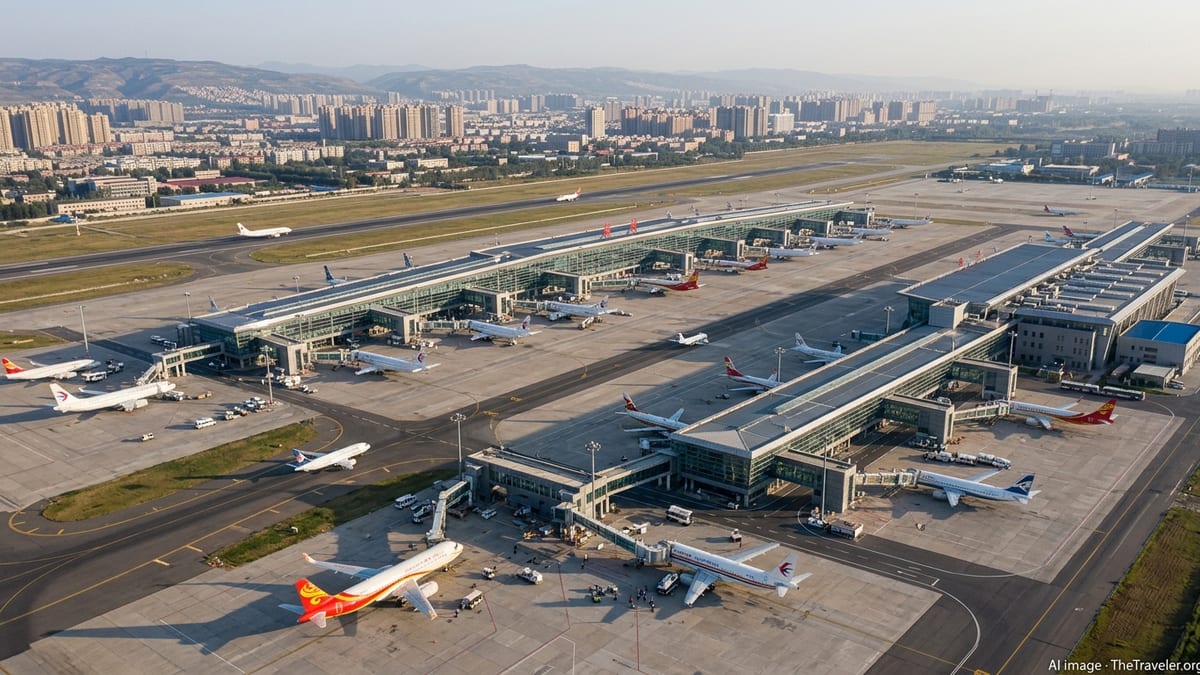
Within this wider connectivity push, Taiyuan Wusu International Airport in Shanxi Province offers a telling example of how regional Chinese airports are evolving. Public documents from the New Development Bank and planning materials indicate that the airport’s existing terminals have been handling passenger volumes more than double their original design capacity, prompting a multi-stage expansion program aimed at lifting overall throughput capability to around 40 million passengers per year in the coming decade.
Civil aviation statistics for recent years show that Taiyuan Wusu has already joined the ranks of busy mid-sized Chinese airports, with annual passenger numbers well into the multi-million range and rapid growth recorded before and after the pandemic disruptions. During peak travel periods such as the Spring Festival, published coverage describes the airport scheduling hundreds of daily flights and tailoring operations around surging domestic demand.
The ongoing “zero-carbon airport” initiative, backed by international development financing, is set to add a new terminal complex and upgraded airside infrastructure. Planning summaries describe a focus on energy-efficient buildings, improved ground transport links and enhanced passenger facilities designed for large-scale flow management, rather than a narrow emphasis on a small number of flagship intercontinental routes.
This expansion underlines how Taiyuan Wusu is being positioned as a high-capacity regional hub within China’s interior, integrated into national aviation and rail networks that funnel travelers toward major coastal and international gateways.
Stopover Services Take Priority Over Nonstop Flights
Despite its international designation, Taiyuan Wusu’s scheduled network remains dominated by domestic services and short-haul or one-stop itineraries, making true nonstop long-haul international flights an exception rather than the rule. Historical route announcements highlight a pattern in which international connectivity has often been built around “bridge” flights that combine domestic and overseas segments, such as Taiyuan-to-coastal-city legs that then continue onward to long-haul destinations.
Publicly available route histories have referenced examples such as Taiyuan–Haikou–Sydney or Taiyuan–Shanghai–Chicago services, where Taiyuan functions primarily as a spoke feeding a larger hub or as an intermediate stop for passengers originating elsewhere. More recently, reports of a Taiyuan–Moscow passenger route and Taiyuan–Almaty all-cargo service illustrate the airport’s role in stitching Shanxi into broader Belt and Road transport corridors, often with at least one stop incorporated into the itinerary.
For passengers, this configuration translates into a travel experience defined by transfers. Domestic flyers heading to Europe, the Middle East or Oceania frequently route through coastal hubs like Shanghai, Guangzhou or international megahubs in the Gulf. International travelers entering China via major gateways may then connect onward to Taiyuan on separate domestic sectors rather than flying directly to Shanxi’s capital.
As a result, nonstop international services at Taiyuan Wusu remain relatively scarce, particularly on long-haul routes. The airport’s growth strategy, as reflected in public planning documents and traffic data, appears to prioritize frequency, connectivity and transit handling capabilities over securing a limited roster of flagship nonstop intercontinental links.
A Transit-Oriented Blueprint for Interior China
The emphasis on stopover services at Taiyuan Wusu aligns with broader trends in China’s aviation planning, where many inland hubs are being tasked with feeding traffic into a layered network of coastal and regional gateways. Policy and planning commentary often describe this approach as a way to distribute economic benefits more evenly across provinces while avoiding unnecessary duplication of long-haul capacity at every city.
By concentrating true long-range nonstop flights in a select group of tier-one and secondary hubs, airlines can maintain higher load factors and more sustainable schedules. Airports like Taiyuan Wusu then focus on optimizing transfer experiences, including coordinated connection windows, expanded security and customs capacity for through-travelers, and facilities designed around rapid domestic–domestic and domestic–international transfers.
Recent holiday travel coverage from Taiyuan highlights how this model works in practice. The airport’s measures have included adjusting flight schedules to match peak connection banks, prioritizing support for time-sensitive travelers and coordinating resources for late arrivals so that passengers can safely make onward flights. These operational details underscore the shift toward a transit-oriented role rather than a pure origin-and-destination focus.
For Shanxi’s tourism and business communities, this configuration has a dual effect: it improves access to a much wider global network via convenient connections, even as the number of nonstop international options from Taiyuan itself remains limited compared with China’s coastal giants.
What It Means for Travelers and Global Tourism Flows
For international travelers planning itineraries that touch China, Thailand, Spain, Italy, Egypt or Australia, the current landscape increasingly favors multi-stop journeys that balance price, convenience and network breadth. Airline and airport strategies indicate that many of the ten million or more travelers moving annually along these corridors will do so via at least one intermediate hub, whether in China, the Gulf, Southeast Asia or Europe.
From a passenger perspective, Taiyuan Wusu represents a microcosm of this dynamic. Travelers using the airport are more likely to encounter carefully orchestrated stopovers and timed connections than dedicated nonstop intercontinental links. As terminal expansions and the zero-carbon airport project progress, the focus is expected to remain on improving the quality and reliability of these transit experiences rather than rapidly multiplying nonstop long-haul destinations.
For the global tourism industry, the model emerging in Taiyuan and similar Chinese cities suggests that connectivity will not be defined solely by marquee city-pair routes. Instead, growth is likely to come from dense, flexible networks in which interior hubs move large numbers of passengers efficiently into global flows, even if their own boards list only a handful of international destinations by name.
As China’s aviation sector continues to coordinate with partners in Thailand, Spain, Italy, Egypt, Australia and beyond, Taiyuan Wusu’s evolution as a stopover-focused airport illustrates how regional infrastructure can underpin a revolution in global connectivity without relying on a long roster of nonstop flights.