

More news on this day
Escalating conflict across the Middle East has triggered sweeping airspace closures and mass flight cancellations, forcing Chinese airlines and Gulf carriers to rip up schedules and leaving travellers from Guangzhou, Hong Kong, Doha and Dubai scrambling for alternatives.
Rapid Escalation Turns Key Hubs into Bottlenecks
The latest wave of disruption began on 28 February 2026, when coordinated US and Israeli strikes on Iran were followed by Iranian missile attacks across the region. In response, several Middle Eastern states moved quickly to close portions of their airspace, while Qatar temporarily shut its skies entirely as it came under direct fire.
The closures have shattered the carefully choreographed long-haul networks that link Asia with Europe and Africa. Airlines that normally funnel traffic through Gulf hubs such as Doha and Dubai, or over Iran on direct China–Europe sectors, suddenly found themselves without viable routings. Schedules that were rebuilt only recently after the pandemic have again been thrown into disarray.
Industry analysts say the current disruption is the most severe since the Covid-19 crisis, as thousands of flights are cancelled or forced to make lengthy detours around the growing no-fly zones. For travellers, that translates into last-minute cancellations, long queues at airport service desks and nights spent in transit hotels while carriers work through mounting backlogs.
With military operations still ongoing as of early March, carriers and aviation authorities are warning that further changes are likely at short notice. Passengers are being urged to treat timetables as provisional and to stay closely in touch with their airline or agent before heading to the airport.
Guangzhou and Hong Kong See China–Middle East Links Severed
For travellers in southern China, the most immediate impact is on direct services from Guangzhou and Hong Kong to the Gulf. Chinese mainland carriers, including Air China, China Eastern and China Southern, have suspended flights to key Middle Eastern destinations after Gulf states and Iran restricted overflights. Several Guangzhou departures bound for Doha and Dubai in recent days were cancelled outright as airlines reassessed safety and routing options.
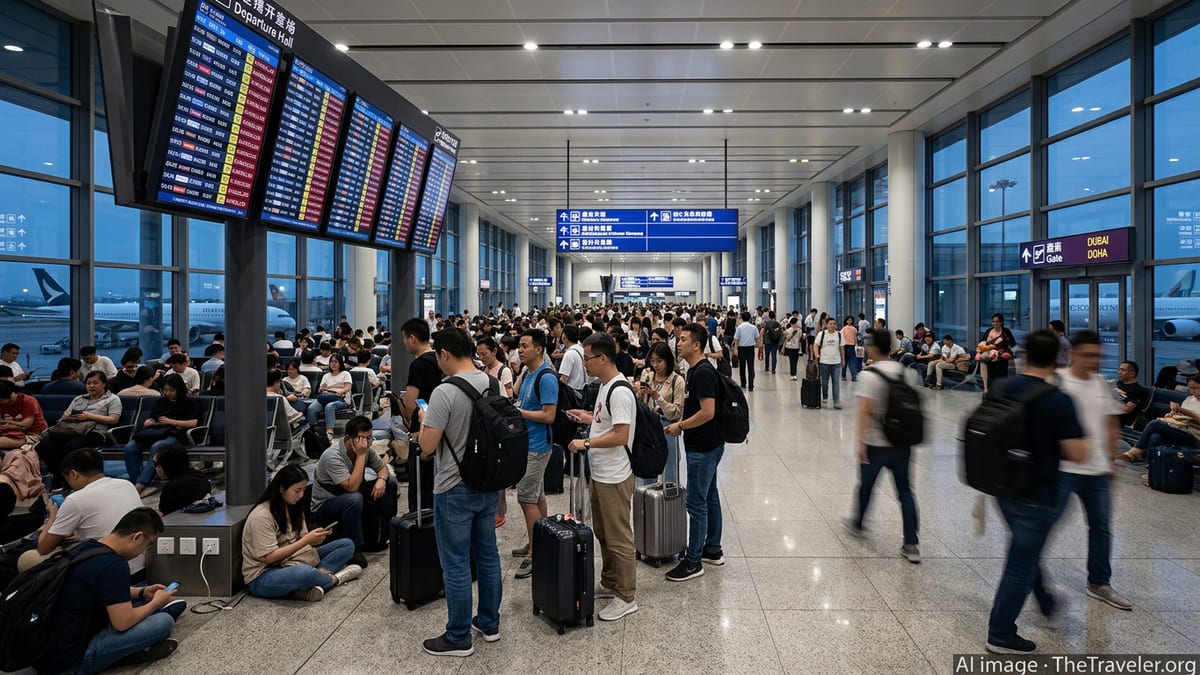
In Hong Kong, disruptions have been highly visible in the terminals. Over the weekend, at least two dozen flights between the city and destinations such as Riyadh, Doha and Dubai were delayed or cancelled, stranding hundreds of passengers at Hong Kong International Airport as they waited for rebooking. Cathay Pacific, along with several foreign carriers, has halted passenger and cargo services to and from affected Middle Eastern cities until conditions stabilise.
The knock-on effects are global. Many travellers from mainland China and Southeast Asia use Guangzhou or Hong Kong as gateways to connect via the Gulf to Europe and Africa. With those links compromised, itineraries that once relied on a simple one-stop connection now require complex multi-stop routings or, in some cases, are impossible to complete in the short term.
Chinese airlines have announced temporary rebooking and refund waivers for tickets touching the affected region, but availability on alternative routes is tightening quickly as demand concentrates on the remaining corridors through Central Asia, South Asia and Northern Europe.
Gulf Mega-Hubs in Doha and Dubai Temporarily Fall Silent
The shockwaves are being felt just as strongly in the Gulf. Doha, usually one of the busiest transfer points for Asia–Europe traffic, has seen its operations sharply curtailed after Qatar closed its airspace when Iranian missiles struck targets in the country. Qatar Airways has grounded most passenger services in and out of Hamad International Airport, offering only limited special flights to reposition stranded travellers.
Dubai, home to Emirates and a linchpin of long-haul connectivity between China and the wider world, has also been forced to slash flights as surrounding airspace becomes unusable. Airlines operating from Dubai and nearby Abu Dhabi have cancelled or rerouted services across their networks, as safe corridors over Iran, Iraq and parts of the Gulf are withdrawn. That has broken the usual web of one-stop connections from Chinese cities through the United Arab Emirates to Europe, North America and Africa.
For passengers originating in Doha or Dubai with tickets to Guangzhou or Hong Kong, this has meant sudden cancellations, lengthy rebooking processes and uncertainty over when full services might resume. Some travellers have been re-routed via alternative hubs in South or Central Asia, but those options are limited by aircraft availability and crew duty-time regulations.
Airports that normally pride themselves on seamless transfers have become holding points, with terminal hotels and lounges filling up fast. Travellers without through-tickets or comprehensive travel insurance are finding themselves particularly exposed to extra costs for accommodation and new tickets when separate legs of their journey fall apart.
What Affected Travellers Should Do Now
Airlines serving Guangzhou, Hong Kong, Doha and Dubai are broadly adopting similar policies in response to the crisis, offering free date or route changes and, in many cases, full refunds for tickets involving affected Middle Eastern destinations over the coming days. Chinese carriers have publicised flexible change options on their official channels, while Gulf airlines are prioritising passengers who were already in transit when the closures took effect.
Travellers are being advised to avoid heading to the airport until they have confirmed the status of their flight directly with the airline. Rebooking queues at check-in counters are long, and many carriers are prioritising changes through digital channels and call centres. Those who booked through online travel agencies may need to work through those intermediaries for reissues and refunds, which can add further delay.
Experts recommend that travellers whose journeys are not urgent consider postponing trips involving Middle Eastern hubs entirely, rather than attempting complex workarounds that may unravel as the situation evolves. Where travel is essential, passengers should be ready for multi-stop routings, extended layovers and last-minute schedule shifts as airlines test and refine alternative flight paths around closed airspace.
Travel insurance policies should also be reviewed carefully. Many standard policies exclude cover for disruptions caused by war or military action, meaning some travellers may have to rely on airline goodwill rather than insurance payouts for additional accommodation, meals or replacement flights. Keeping receipts and documenting all communications with carriers can be crucial if compensation options arise later.
Looking Ahead as Airlines Rebuild Around New No-Fly Zones
While safety remains the overriding priority, airline planners are already working on longer-term adjustments to keep at least some traffic flowing between China and the Middle East. Options include routing flights further south over the Arabian Sea and Indian Ocean or shifting connecting traffic to alternative hubs in South Asia and Central Asia. These workarounds, however, add time and fuel costs, and may not be feasible at scale if airspace closures remain in place.
Analysts note that Chinese airlines had been steadily rebuilding and expanding international networks through the 2025–26 winter season, including new long-haul links from Guangzhou and increased frequencies to popular destinations. The sudden loss of key Middle Eastern corridors will require a rapid rebalancing of capacity, with more seats likely to be pushed onto Asia–Pacific and Europe routes that avoid the conflict zone.
For travellers, the immediate outlook is continued uncertainty. Even if some airspace restrictions are eased in the coming days, it could take weeks for airlines to fully restore regular schedules and reposition aircraft and crews. Passengers planning spring and early summer trips that rely on Gulf or Middle Eastern connections should monitor developments closely and be prepared to adjust itineraries if tensions remain high.
Until the regional security picture improves, the once straightforward journey between southern China and the Middle East will remain complicated, with travellers from Guangzhou, Hong Kong, Doha and Dubai facing a more fragmented, less predictable map of global air links.