

More news on this day
Travelers moving through China’s biggest aviation hubs are facing fresh disruption as around 40 flights operated by major mainland carriers have been cancelled, affecting routes linking Beijing, Shanghai, Guangzhou and Shenzhen with destinations including Shenyang, Chengdu, Xiamen, Bahrain and Doha, according to airline schedules and airport information screens reviewed on March 23, 2026.
Get the latest news straight to your inbox!
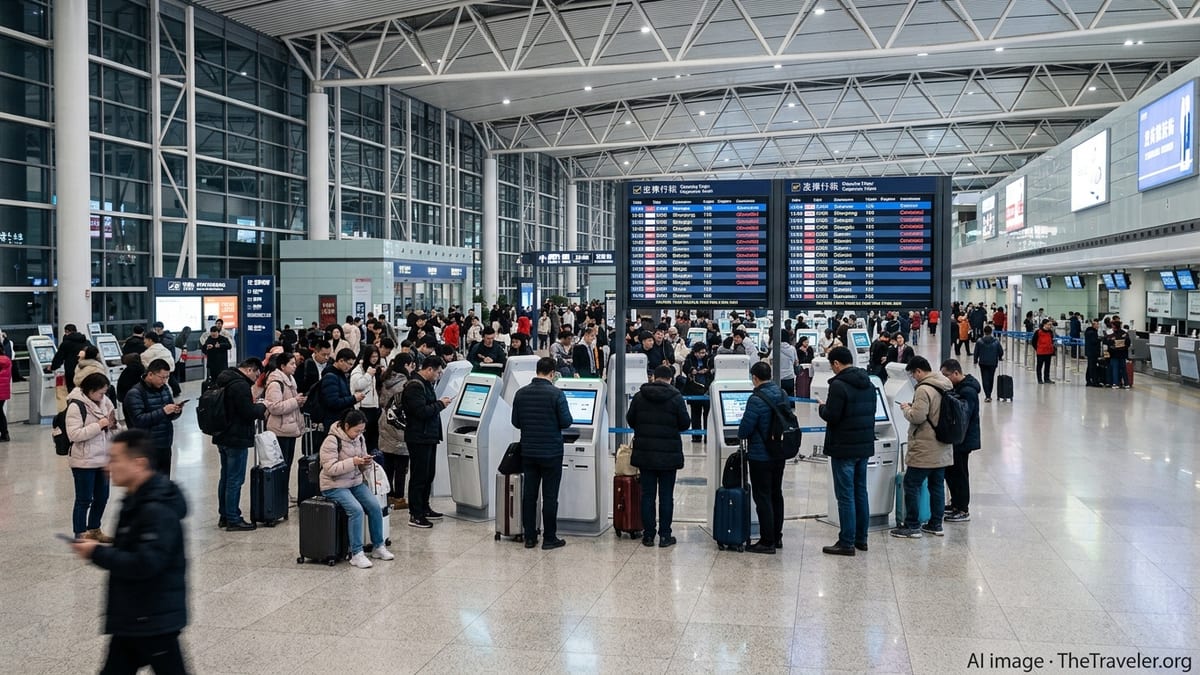
Key Chinese Hubs See Wave of Cancellations
The latest disruptions are concentrated at China’s four primary gateway airports: Beijing, Shanghai, Guangzhou and Shenzhen. Publicly available schedule data and airport departure boards on March 23 indicate that dozens of services operated by Air China, China Southern and China Eastern have been pulled from the day’s operations, with additional cancellations reported on other mainland carriers.
The pattern of disruption is uneven across the network but significant enough to impact both domestic and international itineraries. In Beijing and Shanghai, several trunk routes that normally see high-frequency service have been trimmed, while at Guangzhou and Shenzhen a mix of regional and long-haul flights have disappeared from departure lists, prompting rebooking queues and longer waits at service counters.
While 40 flights is a fraction of the hundreds of daily departures handled by these hubs, the cancellations are hitting peak periods and key connecting banks, amplifying the effect for travelers who rely on tight transfer windows to reach onward destinations in China, the Middle East and beyond.
Routes to Shenyang, Chengdu and Xiamen Among Domestic Casualties
Within China, routes linking big coastal cities to secondary centers such as Shenyang in the northeast and Chengdu and Xiamen in the south have experienced noticeable schedule cuts. These services are typically operated multiple times per day by Air China, China Eastern, China Southern and affiliated carriers, forming key spokes in their domestic networks.
On March 23, timetable snapshots and app-based flight trackers show several rotations on these sectors listed as cancelled or removed from sale. Travelers with same-day connections into these cities have been pushed onto later departures, alternative routings via other hubs, or in some cases next-day flights, extending total journey times.
The impact is particularly acute for passengers traveling from smaller Chinese cities who depend on a single daily connection through a major hub. When a hub leg or the onward domestic sector disappears from the schedule, options quickly narrow, especially during the busy late-March travel period when load factors are already high.
Middle East Links via Bahrain and Doha Affected
Internationally, connections between China and the Middle East are also feeling the strain. Publicly available information from flight-tracking platforms and airport displays indicates that some services touching Bahrain and Doha have been withdrawn or rescheduled, disrupting long-haul itineraries that rely on these cities as transit points.
Flights linking Chinese hubs with Doha are a critical component of wider networks that feed passengers onward to Europe, Africa and South Asia. When these flights are cancelled at short notice, travelers can lose carefully timed connections, often requiring complete re-routing or overnight stays while new itineraries are arranged.
Routes involving Bahrain, though generally less frequent than Doha services, play a similar role for a smaller segment of traffic. Cancellations on these links can strand travelers mid-journey, especially those holding separate tickets or complex multi-airline itineraries that are harder to re-protect when schedules change suddenly.
Operational Pressures and Ongoing Schedule Volatility
The latest wave of cancellations comes against a backdrop of continued schedule volatility among Chinese carriers. Recent months have seen a series of timetable adjustments across the region, with some airlines scaling back certain international routes and tweaking domestic frequencies in response to demand patterns, fleet availability and wider geopolitical developments.
Industry analysts quoted in recent regional coverage have pointed to several contributing factors, including aircraft rotations stretched by high utilization, evolving bilateral traffic rights, and uncertainty on some cross-border corridors. Ad hoc cancellations like those seen on March 23 are a visible manifestation of these pressures, especially when they cluster on a single day or across a handful of high-profile hubs.
Public timetables for late March and early April continue to show minor day-to-day changes, suggesting that travelers booking or holding tickets on routes involving Beijing, Shanghai, Guangzhou and Shenzhen may encounter further last-minute adjustments as airlines refine their schedules.
What Travelers Through China Should Expect Now
For travelers currently in transit or planning imminent trips through Chinese hubs, the cancellations underline the importance of checking flight status frequently in the 24 to 48 hours before departure. Airline websites, mobile apps and airport information screens remain the primary reference points for up-to-date operational details, and many carriers are pushing schedule changes through SMS and email alerts where contact information is available.
When cancellations occur, publicly available policy information indicates that most Chinese airlines are offering rebooking on later services or alternate routings at no additional fare, subject to seat availability. However, during busy travel periods, replacement options may be limited, particularly for long-haul flights and for passengers traveling in groups or on fixed-date itineraries.
Travelers connecting to or from Shenyang, Chengdu, Xiamen, Bahrain, Doha and other affected destinations are likely to face longer total journey times, extended layovers or even overnight stays if same-day alternatives are not available. Those with time-sensitive plans may wish to build in additional buffer time or consider more flexible arrangements while carriers work through the current disruption at China’s main air gateways.