

More news on this day
Passengers across China faced long queues, missed connections and overnight airport stays as Xiamen Airlines, China Southern Airlines and China United Airlines recorded 40 cancellations and 342 delays, disrupting domestic travel in Beijing, Wenzhou, Hangzhou and other major hubs.
Get the latest news straight to your inbox!
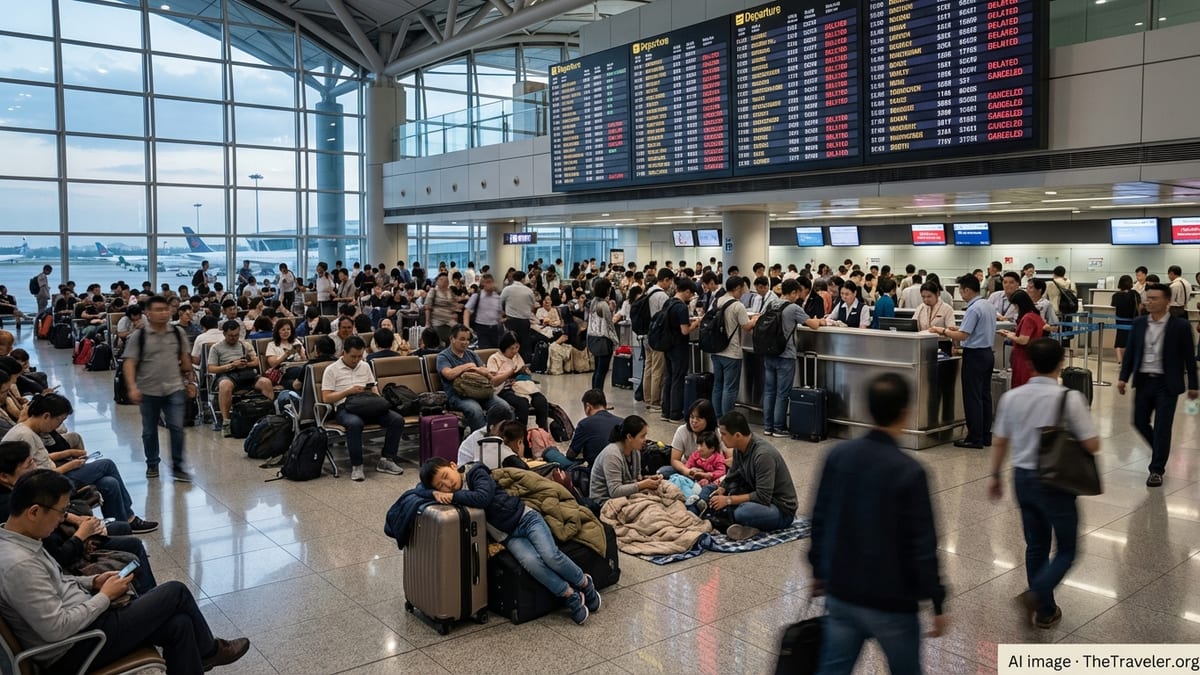
Airline Disruptions Ripple Through Major Chinese Cities
Publicly available operational data and aggregated aviation trackers indicate that a fresh wave of disruptions has hit China’s domestic network, with Xiamen Airlines, China Southern Airlines and China United Airlines among the most affected carriers. Across multiple airports, including Beijing, Wenzhou and Hangzhou, the three airlines together accounted for 40 cancelled services and 342 delayed departures and arrivals during the latest reporting period.
The figures form part of a wider pattern of irregular operations reported in recent days across China’s busiest hubs. Coverage in specialist travel and aviation outlets describes passengers stranded at gate areas, extended check in queues and rebooking desks under pressure as airlines attempt to re thread tightly scheduled domestic rotations.
In Beijing, delays were concentrated at both Capital and Daxing airports, where major state owned and regional carriers share congested airspace and limited runway capacity. Hangzhou Xiaoshan International Airport and Wenzhou Longwan International Airport also reported heavy knock on disruption, as late arriving aircraft and crew scheduling constraints forced rolling delays across the day.
Industry commentators note that while the 40 cancellations represent a fraction of total daily movements, the 342 delays underscore how even modest schedule shocks can cascade through a network that already operates close to capacity.
Beijing, Hangzhou and Wenzhou Bear the Brunt
Recent coverage of China’s domestic air travel performance highlights Beijing, Hangzhou and Wenzhou as recurring hotspots for disruption, reflecting their roles as key nodes in national airline networks. Beijing Capital International Airport remains one of the country’s primary hubs for China Southern Airlines and other major carriers, while Beijing Daxing functions as a fast growing base for Xiamen Airlines and additional operators.
Reports show that high delay volumes have become common at Beijing’s airports on busy days, particularly when adverse weather, airspace restrictions or flow control measures come into play. Similar patterns have been observed at Hangzhou, which serves as a focus city for several airlines and an important gateway for eastern China, and at Wenzhou, where rapid growth in traffic has at times outpaced available capacity.
In the latest disruption, passengers departing these airports encountered a mix of short tactical delays and prolonged waits stretching to several hours. Some travelers arriving from secondary cities missed onward connections to other parts of China, while others were left searching for last minute hotel rooms when late night departures were eventually cancelled.
Travel media analysis suggests that the disruptions were not confined to the headline airports. Smaller regional fields feeding into Beijing, Hangzhou and Wenzhou also experienced schedule knock ons, as aircraft and crews were held at origin points when destination slots became constrained.
Multiple Stress Factors Behind Cancellations and Delays
The precise mix of causes behind the latest 40 cancellations and 342 delays varies by route and airport, but recent reporting on China’s aviation performance points to several recurring stress factors. Weather remains a significant trigger, particularly during periods of seasonal fog, convective storms or low visibility conditions that reduce runway acceptance rates and force traffic metering.
In parallel, China’s busy air corridors continue to face structural congestion, with civil and military traffic sharing limited airspace. When flow control is imposed, airlines including Xiamen Airlines, China Southern Airlines and China United Airlines may be required to hold aircraft on the ground or in airborne stacks, which quickly translates into rolling delays for subsequent legs.
Operational constraints such as crew duty time limits and aircraft rotation complexity can also compel carriers to cancel rather than delay certain services. Travel industry commentary following earlier disruption spikes in February and March noted that once delays pass a critical threshold, airlines sometimes consolidate lightly booked flights or trim frequencies on shorter routes to reset the network.
Analysts tracking Chinese aviation policy additionally point to ongoing debates about slot allocation and infrastructure investment at major hubs. Recommendations published after previous episodes of severe disruption have called for more flexible slot swapping and enhanced contingency planning to create additional resilience when multiple airports experience stress on the same day.
Knock On Effects for Travelers Across China
For passengers, the operational statistics translate into missed meetings, disrupted holidays and unexpected expenses. Travel and tourism outlets covering the latest events describe scenes of crowded terminal halls, with travelers lining up at service counters to request rebooking or refunds and others turning to mobile apps and online agencies for faster alternatives.
Many affected passengers on Xiamen Airlines, China Southern Airlines and China United Airlines flights reportedly sought same day re accommodation on other services, only to find limited availability as remaining departures filled up. Those departing from cities such as Beijing and Hangzhou sometimes faced the choice of accepting long connections, overnight stays or routings through secondary hubs to complete their journeys.
Consumer advocates in China have recently renewed calls for clearer communication of delay causes and more transparent handling of compensation or care obligations during severe disruptions. While policy frameworks differ from those in regions such as the European Union, commentators argue that consistent standards for meals, accommodation and alternative transport would help maintain traveler confidence as domestic demand continues to grow.
Travel planners advise that during periods of network strain, passengers should monitor flight status frequently, allow additional connection time at major hubs and keep digital copies of boarding passes and receipts to support any subsequent claims.
What the Disruptions Signal for China’s Aviation Recovery
The recent wave of cancellations and delays involving Xiamen Airlines, China Southern Airlines and China United Airlines comes as China’s air travel market continues a strong rebound from earlier pandemic era restrictions. Traffic volumes on many domestic corridors have already surpassed pre crisis levels, placing renewed pressure on airport infrastructure, air traffic management and airline operations.
Coverage in regional business and travel publications suggests that these operational hiccups highlight both the resilience and fragility of the current system. On one hand, airlines have demonstrated an ability to ramp up capacity quickly in response to surging demand. On the other, the concentration of traffic at a handful of mega hubs, combined with ongoing airspace limitations, leaves the network vulnerable when weather or geopolitical factors intervene.
Industry observers note that how carriers and regulators respond to episodes like the current disruption will help determine the shape of China’s aviation landscape in the coming years. Measures under discussion include further expansion of secondary airports, investment in air traffic management technology and revised slot policies designed to spread peak loads more evenly across the day.
For travelers, the message emerging from recent events is that China’s domestic skies are once again busy, but not yet entirely smooth. As the market matures and infrastructure catches up, occasional days of significant disruption, such as those that produced 40 cancellations and 342 delays this week, may remain an unwelcome but predictable feature of the journey.