

More news on this day
Bohai Ferry’s decision to prioritize roll-on/roll-off freight operations over cruises is reshaping the outlook for its once-flagship vessel Chinese Taishan, highlighting shifting economics in China’s short-sea shipping and cruise sectors.
Get the latest news straight to your inbox!
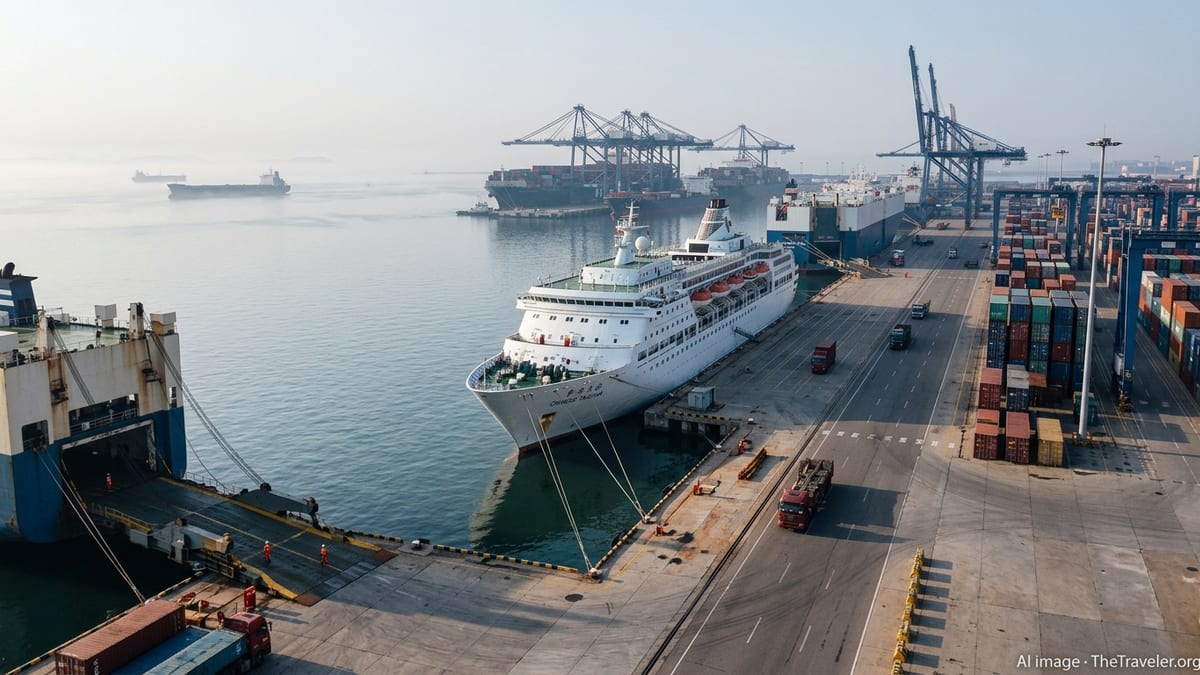
A Veteran Cruise Ship Left at Anchor
Chinese Taishan, a 24,427‑gross‑ton vessel built in 2000 and converted for the Chinese market in the mid‑2010s, was once promoted as Bohai Ferry’s entry ticket into the country’s emerging homegrown cruise segment. Publicly available fleet data and trade circulars describe the ship as offering around 396 cabins for roughly 900 passengers, positioning it in the small to mid‑size cruise category compared with today’s mega‑ships.
The vessel has not operated regular sailings since the onset of the Covid‑19 pandemic. Specialist cruise and maritime publications list Chinese Taishan as inactive from around 2020, with no clear indication of a return to service, even as other Chinese cruise and ferry brands have revived or repositioned capacity in the region.
In the wider context of China’s cruise restart, the ship’s prolonged lay‑up stands out. While new tonnage and refurbished ex‑international ships are being steered into Chinese deployment, Chinese Taishan remains absent from schedules, signaling that Bohai Ferry’s experiment with cruise operations may be drawing to a close.
Bohai Ferry Leans Into Ro‑Ro and Freight Growth
Recent corporate disclosures and industry analyses indicate that Bohai Ferry Group is concentrating on its core roll‑on/roll‑off passenger and freight services in the Bohai Rim, where demand for vehicle and cargo transport has strengthened. Company filings describe a strategy centered on stable ro‑ro capacity, expanded transshipment services and deeper penetration into hinterland logistics markets.
This freight‑first posture aligns with broader trends in China’s coastal shipping, where ro‑ro operators are targeting automotive exports, including vehicles from brands such as BYD and Chery, and seeking to position their networks as “golden waterways” for regional trade. The emphasis on consistent freight flows contrasts with the more volatile, discretionary nature of leisure cruising.
Analysts of China’s cruise sector note that Bohai Ferry’s dedicated cruise subsidiary, established in 2014 to operate Chinese Taishan, has not scaled in line with newer entrants and joint ventures that are now backed by major shipyards and state‑linked tourism initiatives. Instead, the parent group appears to be allocating capital and management attention toward freight and logistics segments that promise steadier returns.
Cruise Capacity Shifts While Chinese Taishan Waits
The sidelining of Chinese Taishan comes at a time when China is simultaneously investing in its own large cruise shipbuilding capabilities. The domestically built Adora Magic City has already entered service, and a second large cruise ship is under construction with delivery targeted before the end of 2026, according to shipyard and government statements. These vessels represent a strategic, long‑term commitment to a national cruise industry anchored by new, purpose‑built hardware.
At the same time, several international ships are being refurbished for Chinese operators. Coverage of the market highlights acquisitions of former Western cruise vessels by emerging Chinese brands, with extensive upgrades planned in shipyards such as Shanghai Waigaoqiao and Qingdao Beihai. These projects aim to capture pent‑up domestic demand with hardware that can compete on scale and onboard amenities.
Within this landscape, Chinese Taishan looks increasingly like a legacy asset. Its smaller size, older design and long lay‑up period make it less competitive compared with newer or fully modernized ships now entering or re‑entering the region. Industry observers suggest that extensive investment would be required to bring the vessel up to contemporary cruise standards, at a time when Bohai Ferry appears more focused on expanding freight‑oriented tonnage.
Strategic Options: Sale, Conversion or Prolonged Lay‑Up
Trade newsletters and ro‑ro market reports from late 2024 and 2025 point to asset disposals and reshuffling among Chinese ferry operators, including Bohai Ferry, as they optimize fleets for freight growth. While Chinese Taishan has not been formally listed in public sale announcements, its absence from operating plans and the group’s freight emphasis invite speculation about its eventual fate.
Potential pathways often discussed in similar cases include selling older cruise tonnage to secondary markets, converting vessels for alternative uses such as accommodation or training ships, or retaining them in long‑term lay‑up as reserve capacity. Each option carries different cost, regulatory and reputational implications, particularly for a ship associated with early efforts to build a domestic Chinese cruise brand.
For now, publicly accessible ship tracking and registry sources still identify Chinese Taishan under Bohai Ferry’s umbrella, but with no active schedule or announced refurbishment program. The longer this status persists, the more likely it becomes that any return to mainstream cruising would require a comprehensive technical and commercial reassessment.
What Bohai Ferry’s Pivot Signals for China’s Cruise Ambitions
Bohai Ferry’s apparent move away from dedicated cruise operations underscores a broader reality in China’s maritime economy: not all early cruise pioneers are positioned to benefit equally from the market’s next phase of development. Large state‑backed projects, integrated tourism zones and newbuild cruise orders increasingly dominate the narrative, while smaller cruise ventures weigh the opportunity cost against more predictable freight earnings.
For travelers in northern China, Chinese Taishan’s prolonged absence means fewer locally branded cruise options originating from Bohai Rim ports, even as other homeports and operators roll out new regional itineraries. The vacuum could eventually be filled by newer vessels or different brands, but the specific role Bohai Ferry will play in leisure cruising remains uncertain.
As China’s cruise and ferry landscape continues to evolve toward 2026, Chinese Taishan stands as a reminder of an earlier stage in the country’s cruise experiment. Its future, whether as a reactivated ship, a repurposed asset or a candidate for disposal, will reflect how operators balance aspirational tourism projects with the hard metrics of freight demand and fleet utilization.