

On my last Vancouver Island trip, I split my time between Nanaimo and Parksville instead of committing to just one base. I wanted the convenience and transport links of a small city, but I also craved the long, shallow beaches I kept seeing in photos of Parksville and nearby Rathtrevor Beach Provincial Park.
After hauling my bags between the two, navigating ferry schedules, testing transit and trying everything from harbor walks to tide pools, I came away with a much clearer sense of who each place really works for. This is the comparison I wish I had read before I started booking.
First Impressions: City Hub vs Classic Beach Town
Nanaimo greeted me with ferry horns, busy traffic and the kind of slightly scruffy, working-port energy I associate with real cities, not curated resorts. Stepping off at Departure Bay after the Horseshoe Bay crossing, I could feel that Nanaimo is a gateway as much as a destination. It has mid-rise apartment buildings, big-box shopping, a compact downtown, and a waterfront that is part scenic harbor and part industrial. It was not love at first sight, but it felt practical and lived in, and that mattered more as the trip went on.
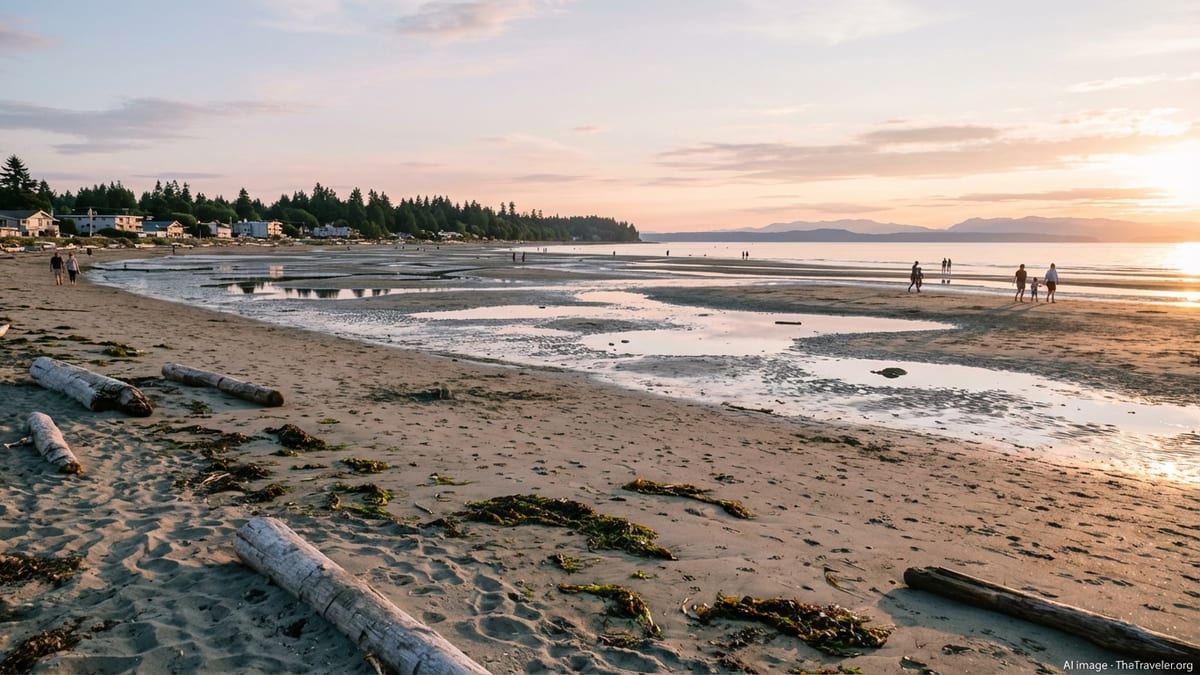
Parksville, which I reached after driving roughly 35 minutes north from Nanaimo along Highway 19, felt like a reset. The town center itself is small and unremarkable, but the moment I walked out onto Parksville Community Beach at low tide, the place clicked. The sand stretched far into the Strait of Georgia, families were dragging wagons across the tidal flats, and the mood was relaxed in a way Nanaimo never is. Parksville is a beach town first, everything else second, and it wears that identity openly.
My expectations were almost reversed. I had assumed Nanaimo would be more polished because it is larger and often marketed as a rising city on Vancouver Island. In reality, some streets felt a bit tired, and there are still pockets downtown that I did not feel like lingering in late at night. Parksville, which I had quietly written off as too family focused, surprised me with how soothing it was to simply walk the shoreline every evening, especially near Rathtrevor Beach where the tide can retreat close to a kilometer at low tide and then slowly creep back in.
Neither place delivered a perfect postcard moment, but each set a tone. Nanaimo is about movement, logistics and access to the rest of the island. Parksville is about slowing down and arranging your day around the tide table. Once I accepted that, my planning choices started to make more sense.
Location & Getting There: Ferries, Driving Time and Transit Tradeoffs
From a logistics perspective, Nanaimo wins on pure connectivity. It has two major BC Ferries terminals linking to Metro Vancouver: Departure Bay for Horseshoe Bay and Duke Point for Tsawwassen. My Horseshoe Bay to Departure Bay sailing took about 1 hour and 40 minutes dock to dock, and when I traveled in 2026 all vehicle traffic from Horseshoe Bay to Departure Bay needed to be booked and prepaid in advance because of ongoing construction work and reduced staging space at Horseshoe Bay. That requirement removed the old drive-up gamble and forced me to be more organized, but it also meant less anxiety about missing out on a spot.
Once in Nanaimo, it was straightforward to fan out. The drive from Departure Bay to downtown took me around 10 minutes in light traffic, and from there it was roughly 35 to 40 minutes by car to Parksville. Highway 19 is fast and simple, but public transit between Nanaimo and Parksville felt slow and infrequent for anything but a budget traveler with time to spare. Buses exist, but I quickly realized that if I wanted to bounce between beaches, parks and trailheads in both areas, renting a car was worth it.
Parksville itself is easy to reach by road but has no ferry terminal. That means every visitor coming from the mainland is effectively using Nanaimo as their funnel. On the plus side, once I based myself in Parksville, day trips to places like Qualicum Beach, Englishman River Falls Provincial Park and Coombs were all within roughly 20 to 40 minutes of driving. It felt like a clean hub for the so-called Oceanside region rather than for the whole island.
The main downside with Nanaimo as a base, from a location standpoint, is that it can encourage too much backtracking. I found myself driving through the same highway stretches repeatedly for day trips north and then returning to a cityscape that never quite matched the wild coastal scenery I had spent the day chasing. In Parksville, the scenery around my accommodation matched my day trips more closely. If your goal is primarily beaches, short hikes and smaller communities in the central east coast of Vancouver Island, Parksville is the more coherent base. If you are zigzagging the island, Nanaimo’s ferries and road links keep winning the practical argument.
Beaches, Nature & Atmosphere: Where It Actually Feels Like a Vacation
This is where Parksville completely outperformed my expectations. The combination of Parksville Community Beach and Rathtrevor Beach Provincial Park created an easy daily rhythm that I never quite found in Nanaimo. Parksville’s main beach has a broad, sandy shoreline, a large playground and a flat walkway that made evening strolls effortless. When the tide was out, I could walk far into the bay over hard-packed sand, watching shorebirds and kids racing to catch tiny crabs in the tidal pools. It felt wide open and soft edged, exactly the kind of low-effort nature that makes a short trip feel longer.
Rathtrevor Beach Provincial Park, just southeast of town, turned out to be even more impressive. The park includes several kilometers of sandy beach, a stand of mature Douglas firs and a large campground. At low tide, the waterline recedes close to a kilometer, which transformed the shoreline into an enormous walking and beachcombing zone. I spent one cool evening there watching the sunset with my feet in sun-warmed shallows, and it remains the clearest “this is why you come here” moment of the trip. The only frustration was that in summer the park’s campsites and nearby beachfront resorts book out quickly, and day use parking can feel competitive on peak weekends.
Nanaimo does have waterfront spaces, but they feel more segmented and urban. The Harbourfront Walkway is pleasant, and walking out to the viewpoint near Maffeo Sutton Park gave me a nice angle on the marina and downtown. I took the small passenger ferry to Saysutshun (Newcastle Island) for an afternoon and that was the closest Nanaimo came to offering the same sense of calm I got in Parksville. The island’s loop trails, pocket beaches and First Nations history made it a worthwhile micro escape. But my default evenings in Nanaimo tended to be more about restaurants, pubs and errands than unrolling a blanket on the sand.
If you visualize your ideal trip as salt on your skin, bare feet on a warm beach and long, shallow water that stays friendly for kids, Parksville is the clear winner. If you are more excited by urban vantage points, harbor views, short ferry hops to nearby islands and a livelier waterfront, Nanaimo can work, but I would never choose it over Parksville purely for atmosphere.
Costs, Accommodation & Value for Money
I found Nanaimo slightly cheaper on average for standard hotels, especially outside of high summer. Chain hotels and budget motels cluster around the highway and downtown, and prices there often undercut comparable options in Parksville by a modest margin, especially midweek. Nanaimo also gave me better last-minute flexibility; I shifted one night by a day with only a minor rate increase and still found multiple options with same-day availability.
Parksville was a more complicated picture. Traditional hotels closer to the highway or away from the waterfront were reasonably priced, but the accommodations that make Parksville special are the oceanfront resorts, cabins and condos that line the shore near Rathtrevor and the main beach. Those properties carried a noticeable premium in July and August, and many required minimum stays of two or three nights during peak periods. I personally felt that the price jump for true beachfront was justified when I factored in how much time I actually spent out on the sand, but it is not a good destination for travelers trying to keep lodging costs low.
One thing I noticed is that Parksville rewards early planners more than Nanaimo. Waterfront units with kitchens and direct beach access were snapped up months ahead for summer dates, while inland motels still had rooms. If you are the sort of traveler who books late or likes to change plans based on the weather forecast, Nanaimo’s larger overall inventory and slightly softer demand curve felt more forgiving. I was also able to find reasonably priced short term rentals in Nanaimo’s residential neighborhoods, something that felt tighter and more competitive in Parksville.
In terms of overall value, my personal takeaway is this: Nanaimo is better value if you see it as a functional base between ferries and other Vancouver Island destinations, and you do not expect your accommodation to be part of the experience. Parksville offers better value if you are actually going to spend a lot of waking hours at or near your hotel, walking the beach, sitting on balconies and letting the tide schedule shape your day. Paying a premium for beachfront is wasted if you are out driving all day, but it feels entirely fair if you are mostly there for slow mornings in the sand.
Food, Nightlife & Everyday Convenience
I underestimated how much the everyday details would matter. In Nanaimo, getting a decent coffee, finding a grocery store or grabbing a casual dinner was never an issue. The city has multiple supermarkets, big-box retailers, independent cafes and a decent spread of restaurants across different price points. Downtown has a modest but real nightlife scene, with pubs and a few spots that stay open late enough to make an evening out feel like an option rather than a stretch.
Parksville, by contrast, felt thinner away from the waterfront hotels and resort restaurants. There are a handful of good spots in and around downtown Parksville and near the beach, and I had a couple of solid meals with sunset views. But on a rainy shoulder season evening, the town felt sleepy and I ended up back at my rental cooking more often than I expected simply because nothing nearby looked particularly appealing or open late. If dining variety and nightlife matter to you, that low-key atmosphere can quickly feel limiting.
On the convenience front, Nanaimo also wins for transit and errands. I used city buses a couple of times to avoid parking headaches downtown, and while the service is not fast, it exists and runs on a predictable schedule. In Parksville, I did not feel like I could rely on transit for anything beyond the most basic movements, and even then the waiting times felt long. When I forgot sunscreen and a charging cable, Nanaimo sorted me out in one short trip; in Parksville it took a car ride and more trial and error.
Where Parksville holds its own is in those small, high-quality experiences rather than overall variety. Grabbing fish and chips to go and eating them on a driftwood log at low tide, or having a drink on an oceanfront patio after a beach walk, felt more memorable than anything I ate in Nanaimo. If you are happy to trade choice for setting, Parksville is satisfying. If you get restless or picky about food options, Nanaimo is a safer bet.
Seasonality, Crowds & Booking Strategies
My experience of both places shifted dramatically with the season. In summer, Parksville fills with families and retirees escaping the heat from inland British Columbia and Alberta. The beaches, especially during events like the Parksville Beach sand sculpting festival, can feel busy and parking near the waterfront tight. Rathtrevor’s day-use area and campground are popular, and it is common to see campgrounds and oceanfront resorts fully booked well in advance for July and August dates. If you plan to stay in Parksville in high season, booking accommodation several months ahead is prudent, and I would lock in any ferry reservations to Nanaimo as soon as trip dates are firm.
Outside peak summer, Parksville softens considerably. In spring and early fall, I shared long stretches of beach with only a handful of walkers, and the pace was quiet but not dead. Some seasonal businesses reduce hours, but the core town remains functional. That shoulder season sweet spot is when Parksville felt most appealing to me personally, combining comfortable weather, open sand and relatively easier bookings.
Nanaimo spreads its visitors more evenly across the year because it functions as a transport hub. Ferry traffic ebbs and flows with holidays and long weekends, but the city rarely felt as seasonally spiky as Parksville. I did notice that on summer Fridays and Sundays, ferry congestion into and out of Nanaimo could create long waits if I had not booked or mistimed my travel. With the newer requirement that all vehicles traveling from Horseshoe Bay to Departure Bay book in advance, some of that drive-up uncertainty has shifted into planning time, but you still feel the holiday surges in town, especially around the waterfront and highway corridor.
If you are planning now, my advice is straightforward. For a summer beach-focused trip, prioritize Parksville but lock in accommodation and ferries as early as possible and accept that the most iconic spots will be lively. For flexible dates, consider staying in Nanaimo in shoulder seasons and doing day trips to Parksville and Rathtrevor; you can then choose your days based on weather and tide forecasts without paying peak beachfront rates.
Real Decision Moments: What I Chose and What I’d Change
The first big decision I faced was whether to base entirely in Nanaimo and drive to Parksville and beyond, or to commit to a split stay. Initially I leaned hard toward Nanaimo because of the ferries and the idea of a single hotel. The clincher that pushed me into a split stay was a late-night moment of honesty: the images in my head of this trip were all about giant tides and beach walks, not harborfront streets. I decided to spend my first three nights in Nanaimo to handle ferries and local islands, then four in Parksville at a modest but true beachfront place. In hindsight, that was the right call for me; I did not resent the move, and those extra Parksville evenings on the sand justified the logistics.
The second decision point involved cost versus location within Parksville itself. I could either book a cheaper inland motel on the highway or pay noticeably more for a smaller, older unit right on the water near Rathtrevor. I chose the overpriced-but-on-the-beach option, and I still think that was the right move. Waking up and walking straight onto the sand at low tide and watching the water roll in at sunset changed my entire sense of the trip. If I had to trim costs, I would rather cut days off the trip than give up that direct access.
The third decision was whether to keep a rental car the entire time or try to pair transit and occasional taxis. After juggling ferry timing, the distance between the two towns and the scatter of trailheads and viewpoints, I kept the car and ate the cost. If I had tried to do this trip by bus, I would have spent more time waiting and less time in places I actually cared about. The only thing I would change next time is to coordinate my ferry arrivals and departures a bit tighter to avoid long layovers in Nanaimo with a packed car and nowhere appealing to linger.
Looking back, the main thing I would tweak is the number of nights in each place. I would shave one night off Nanaimo and add it to Parksville or to a different coastal community farther north. Nanaimo did its job as a hub, but it did not need quite as many evenings as I gave it. Parksville, on the other hand, grew on me with each tide cycle, and by the time I settled into its slower rhythm, it was already time to leave.
The Takeaway
After staying in both, I do not see Nanaimo and Parksville as rivals so much as complementary pieces of a single trip. Nanaimo is the practical entrance: it has the ferries, the shopping, the services and a few small-scale excursions that justify at least a night or two. Parksville is where the trip starts to feel like a holiday, with its shallow, sweeping beaches and tide-dependent days that nudge you into a slower, more mindful pace.
If your priorities are cost control, flexibility and using one base to explore a wide stretch of Vancouver Island, Nanaimo is the better choice. You will likely pay a little less, find it easier to book last minute and spend less time worrying about where to buy groceries or fix a broken phone charger. You will not get the archetypal sandy beach experience on your doorstep, but you can always day trip to Parksville.
If you are traveling with kids, crave daily beach time or simply want a place where you can abandon your car for days at a time and walk the same shoreline morning and evening without getting bored, Parksville is worth the higher accommodation costs. The tide cycles, the long soft beaches and the quieter evenings create exactly the sort of low-key restorative break that people imagine when they think “island getaway.” Just be prepared to book early and accept that in July and August you will be sharing that dream with plenty of other people.
For my own future trips, I plan to keep using Nanaimo as a necessary but brief gateway and give the bulk of my nights to Parksville or other smaller coastal communities nearby. Under the right conditions however tight schedule, last-minute planning, or a trip built around ferries rather than beaches Nanaimo can still be the more rational place to stay. The key is to be honest with yourself about whether you want a base that gets you everywhere, or a base that makes you want to stay put.
FAQ
Q1. Is it better to stay in Nanaimo or Parksville for a first-time visit to Vancouver Island?
For a first visit focused on ferries, logistics and seeing several regions, I would stay in Nanaimo. For a first visit centered on beaches and relaxation, I would pick Parksville.
Q2. How long does it take to get from Nanaimo to Parksville?
By car it took me roughly 35 to 40 minutes along Highway 19 in normal traffic. Public transit exists but is slower and less convenient for most visitors.
Q3. Are beaches better in Nanaimo or Parksville?
Parksville has significantly better classic sandy beaches, especially Parksville Community Beach and Rathtrevor Beach, with long, shallow tidal flats that Nanaimo simply cannot match.
Q4. Which is cheaper, Nanaimo or Parksville?
In my experience, standard hotels and motels were slightly cheaper and easier to book last minute in Nanaimo, while true oceanfront stays in Parksville were noticeably more expensive, especially in summer.
Q5. Is a car necessary if I stay in either Nanaimo or Parksville?
I found a car very helpful in both places, essential in Parksville for reaching beaches and nearby parks, and useful in Nanaimo for exploring beyond the downtown core.
Q6. How far in advance should I book accommodation in Parksville?
For July and August, I would try to book oceanfront accommodations and campsites several months in advance. In shoulder seasons you have a bit more flexibility, but prime beachfront still fills early.
Q7. Is Nanaimo safe to walk around at night?
Most central areas felt fine with normal urban awareness, but I personally avoided some quieter downtown side streets late at night and stuck to busier, better lit routes near the waterfront.
Q8. Can I visit Parksville as a day trip from Nanaimo?
Yes, I did this easily by car. The drive is short, and you can comfortably spend a full day between Parksville Beach and Rathtrevor, then return to Nanaimo in the evening.
Q9. Are there enough restaurants in Parksville for a week-long stay?
There are enough options, especially around the beach and main road, but variety is limited compared with Nanaimo. I was glad to have a kitchen in my accommodation for some self-catered meals.
Q10. Who should definitely choose Parksville over Nanaimo?
Travelers with children, beach lovers, and anyone seeking a quiet, walkable seaside base with long sandy beaches and minimal nightlife will likely be happier in Parksville.