

On my last two trips to Vancouver Island, I split my time between Victoria and Tofino, trying each one as a main base.
I went in with the same questions most travelers have: should I stay in the provincial capital with its walkable harbor and culture, or head straight to the wild beaches and rainforest on the west coast?
After wrestling with ferry schedules, watching my accommodation budget balloon in Tofino, and discovering what was actually practical on the ground, I came away with a clear sense of who each place really works for and when.
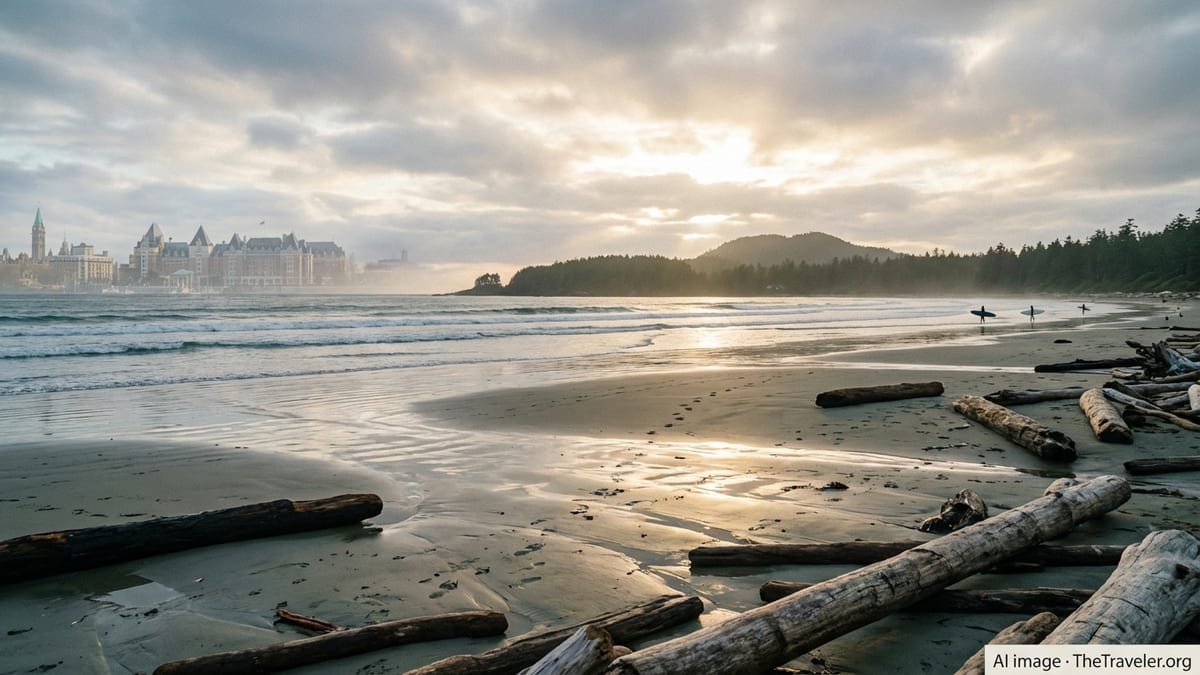
First Impressions: City Harbor vs Wild Pacific Edge
Arriving in Victoria, my first impression was how compact and civilized it felt. The Inner Harbour is almost theatrical: parliament buildings, historic hotels, seaplanes landing, harbor ferries puttering around. I could roll my suitcase off the bus and be in the middle of things in minutes. It felt like a soft landing: easy to navigate, full of cafes, and with everything from museums to whale watching tours within a short walk.
Tofino was the opposite kind of arrival. After hours of driving across the island and winding over mountain passes, I finally emerged into salty air and tall trees. The town itself is small and a little scruffy around the edges, with a main strip of surf shops, food trucks, and modest buildings, but the surrounding landscape is dramatic. Long, sandy surf beaches and dark rainforest make the village feel almost incidental.
Emotionally, Victoria put me at ease, while Tofino plugged me straight into nature. In Victoria, I found myself people-watching on patios and browsing bookstores. In Tofino, I forgot about my phone and ended up timing my whole day around the tide tables and the surf report. Both felt good, but in very different ways.
What surprised me most was that Tofino, which I had imagined as quiet and low-key, often felt more intense than Victoria. The weather, the surf culture, and the prices all felt dialed up. Victoria, which I feared might be a bit staid, was actually more relaxed and forgiving as a base, especially when I wanted to take things slow.
Getting There, Getting Around, and Dealing With Logistics
My first major decision moment was where to actually anchor the trip, knowing that getting to Tofino is a commitment. Victoria is straightforward: ferries from the mainland bring you to Swartz Bay, and from there it is roughly a 30 to 40 minute drive or bus ride to downtown, with no mountain passes or remote stretches to worry about. Once I checked into my hotel near the Inner Harbour, I barely used my car. Most key sights were within a 15-minute walk, and the city buses covered the rest.
Tofino required more planning and patience. From Nanaimo or Victoria, it is several hours of driving across Vancouver Island, including long stretches with limited cell service. Tourism Tofino and provincial travel advisories currently warn about ongoing highway upgrades between Port Alberni and Tofino, with single-lane traffic and delays that can add 30 minutes to over an hour at certain times, especially in summer and early fall. ([tourismtofino.com](https://tourismtofino.com/plan-your-trip/getting-here/?utm_source=openai)) I hit one of those delays head-on and ended up parked on the highway, staring at a clear blue lake while a crew blasted rock above the road.
Driving from Victoria to Tofino took me roughly five hours including a short break, which tracked with the official guidance of about 4 hours 20 minutes from downtown Victoria in ideal conditions and closer to 4 hours 40 minutes from the Swartz Bay ferry terminal. ([tourismtofino.com](https://tourismtofino.com/plan-your-trip/getting-here/?utm_source=openai)) Add construction delays or stormy winter driving, and it can easily stretch further. That distance matters if you are thinking about “basing” in one and day-tripping to the other. In reality, doing a day trip Victoria to Tofino and back is exhausting and not something I would recommend.
Once in Tofino, I found that having a car was almost essential. Beaches like Cox Bay, Chesterman, and access to Pacific Rim National Park reserves are spread out along the highway corridor. There is a local shuttle in peak season and some resorts are walkable to one or two beaches, but it is not the same effortless, car-free setup I had in downtown Victoria. In hindsight, I would structure a trip as: land in Victoria, stay car-free for a couple of nights, then rent a car specifically for the Tofino portion rather than paying for a parked car in the city.
Accommodation Reality: Prices, Availability, and What You Actually Get
Accommodation was where my romantic idea of Tofino ran straight into 2025 pricing. In downtown Victoria, I was able to find solid mid-range hotels, including well-known chains near the Inner Harbour, for around the low 200s Canadian dollars per night during a winter and shoulder-season visit. Tourism campaigns in recent years have advertised special downtown rates around 219 to 229 dollars for reputable central hotels during off-peak events, which matched what I saw when I shopped around outside the core summer weeks. ([tourismvictoria.com](https://www.tourismvictoria.com/eat-drink/dine-around/stay-in-town?utm_source=openai)) Prices do climb in July and August, but I still had real choice across budget tiers.
Tofino was another story. In peak summer, recent reporting and rate checks show beachfront hotels on major surf beaches often starting well above 600 dollars per night, with some popular places around Cox Bay and Chesterman listed around 650 to 700 dollars for standard rooms, plus taxes, and sometimes with two to four night minimums. ([vancouverisawesome.com](https://www.vancouverisawesome.com/highlights/hotel-rates-soar-as-tofino-becomes-a-tourist-town-on-steroids-10850022?utm_source=openai)) My own attempt to book a last-minute July weekend was basically impossible unless I was willing to pay more than I would for a city boutique hotel in New York or London.
On a later off-season Tofino trip, I had a much better experience. Storm watching packages and winter specials brought rates at good waterfront lodges down into the 400s or even lower per night, with some offers advertised from around 470 to just over 500 dollars outside summer. ([longbeachlodgeresort.com](https://www.longbeachlodgeresort.com/offers/?utm_source=openai)) That is still not cheap, but the value felt more reasonable once I was sitting inside watching Pacific swells hammer the coast. I also saw locally run hostels and basic guesthouses in the area at much lower rates, under 100 dollars for dorms or simple private rooms, but availability was patchy and those options come with compromises on privacy and amenities. ([tbgf.org](https://www.tbgf.org/cfs/rates/?utm_source=openai))
Camping and RV stays near Tofino, which I assumed would be the budget escape hatch, are no longer bargain-basement either. Dynamic pricing at beachside campgrounds commonly lands in the 80 to 130 dollar per night range in busy months, and some full-service resorts advertise fall and winter RV specials dropping back toward 40 dollars per night only for longer stays and outside summer. ([gokanada.ca](https://www.gokanada.ca/tofino-hotel-prices-2025/?utm_source=openai)) In practical terms, Victoria gives you a much broader accommodation spectrum. In Tofino, prices are compressed at the higher end and planning ahead by several months for summer is not a nice-to-have, it is almost mandatory.
Weather, Seasons, and How Your Trip Feels
The second big decision moment I faced was when to go. I have now experienced Victoria in winter and spring, and Tofino in both late spring and midwinter storm season. Victoria’s climate is mild by Canadian standards: it is often gray and damp in winter but rarely extreme, with flowers appearing surprisingly early. Even on rainy days, I could still wander the harbor, duck into the Royal BC Museum, or linger over coffee without worrying about being exposed to the elements for hours.
Tofino’s weather defined my visit far more. The region has a temperate maritime climate with cool summers and wet winters. Typical summer highs are in the mid to high teens Celsius, spring and fall sit a bit cooler, and winter is mild but stormy. Recent seasonal breakdowns for the Tofino and Pacific Rim area describe June to August as the sunniest and driest period, ideal for beach days and families, while September and October offer good surf and slightly calmer vibes. From November to February, the focus shifts to storm watching, with powerful Pacific systems generating the dramatic waves Tofino is famous for. ([tourismtofino.com](https://tourismtofino.com/activity/storm-watching/?utm_source=openai))
My storm season stay was spectacular but also limiting. There were days when the wind and rain were so intense that any plan to hike in the rainforest or linger on the beach was cut short. Watching 20-foot swells crash into the rocks from a warm room was unforgettable, but if I had only planned a single two-day window in Tofino in winter, I might have been frustrated. By contrast, shoulder season in late spring gave me a nice balance: long enough daylight for hikes, reasonably mild weather, and far fewer crowds than July or August.
If you are sensitive to weather or traveling with kids, Victoria is the safer all-season base. A rainy day in Victoria does not wreck the trip; you just shift indoors. In Tofino, especially in winter, your enjoyment is directly tied to how prepared you are for heavy rain, wind, and flexible planning. I would not schedule a bucket-list Tofino trip for midwinter without at least a little contingency time.
Things To Do: Culture, Food, and Outdoor Experiences
My third decision moment was how to split limited days between city experiences and outdoor adventures. In Victoria, my days filled themselves: I walked the Inner Harbour, toured historic sites, visited museums, and hopped on a whale-watching boat without needing a car. There is a respectable food scene, with plenty of seafood, local beer, and a mix of casual and upscale options. I found that I could improvise my plans day by day without penalty. Restaurant reservations are helpful in peak weekends, but I did not have to book everything weeks in advance.
Tofino required more advance structure. Surf lessons, guided kayak trips, and bear or whale watching excursions all run on fixed schedules, and popular operators do sell out in peak season. The same goes for highly regarded restaurants and even some food trucks that develop cult followings. Having watched storm forecasts and swell charts, I realized my days would often revolve around a narrow window of good weather or the right tide. When it worked, it was magic: dawn surf sessions on Chesterman Beach, long walks along Cox Bay, and quiet hours in Pacific Rim National Park reserves where the only sounds were waves and ravens.
That focus on the outdoors is Tofino’s strength and its limitation. If you are heading there, you should genuinely want to be outside, get wet, and embrace a slower pace. On my rainiest days, I was grateful I had brought waterproof everything, but I did occasionally wish for a backup plan like Victoria’s galleries or performances. In short: Victoria is a cultural city that happens to be on the water, while Tofino is an outdoor base camp that happens to have a small town attached.
Food-wise, both destinations impressed me. Victoria has more variety and some reasonably priced options, from food trucks to mid-range bistros. Tofino’s food scene feels smaller but more concentrated, leaning heavily on seafood, fresh baked goods, and the surf-town vibe. Prices in Tofino, particularly for dinner and drinks, skew high in line with accommodation costs, which is something I felt very clearly when I looked at my credit card bill afterward.
Crowds, Atmosphere, and Overall Comfort
In terms of crowds, Victoria is busy but rarely overwhelming. Cruise ship days can make the harbor and a few central streets feel congested, yet it still feels like a functioning city with locals going about their business. I could usually walk a few blocks away and find quieter corners. The atmosphere is polished, sometimes touristy around the main harbor, but also grounded by everyday life and the presence of government and university communities.
Tofino swings more dramatically with the seasons. In July and August, the word I heard locals use was “intense.” Accommodation occupancy runs high, beaches are busy, and the town’s limited infrastructure can feel stretched. Parking near popular beach access points fills quickly and there is real competition for restaurant seats and activity slots. Combined with high prices, it sometimes felt like the place was organized around short, high-value summer stays.
In the shoulder seasons and winter, I found Tofino much more relaxed. With fewer visitors, I could chat with staff, linger over coffee, and have long stretches of beach almost to myself. Storm-watching season, from roughly November onward, has become a niche draw in its own right, but it still feels less crowded compared with summer. ([tourismtofino.com](https://tourismtofino.com/activity/storm-watching/?utm_source=openai)) For comfort, I actually preferred Tofino in these quieter months, even though the weather was harsher.
Safety-wise, both Victoria and Tofino felt generally safe, but in different ways. In Victoria, standard city awareness is enough; I stuck to well-lit downtown areas at night and had no issues. In Tofino, the biggest safety considerations were the drive in and the ocean itself. Winter storms, high tides, and rip currents demand respect, and local guidance about where and when to walk on exposed beaches is worth heeding. Storm watching is remarkable, but it is not something to do casually at the water’s edge.
Cost, Value, and Who Gets the Better Deal
When I added up the costs after both trips, Victoria came out as the better value for most types of travelers. Accommodation, food, and local transport were simply more forgiving. I could choose between budget hotels, mid-range, or splurge options and still walk to the main sights. Day tours like whale watching or wine country excursions were not cheap, but they did not feel wildly out of line with other North American cities.
Tofino, by contrast, felt like a premium destination almost regardless of how I tried to game it. In high summer, nightly hotel rates on the beaches can rival international luxury stays, and even campgrounds and basic lodgings are no longer particularly budget-friendly. ([vancouverisawesome.com](https://www.vancouverisawesome.com/highlights/hotel-rates-soar-as-tofino-becomes-a-tourist-town-on-steroids-10850022?utm_source=openai)) Food, gear rentals, and guided activities all stack on top. If you divide the total spend by the number of available activities in bad weather, the effective cost per “great day” can be high, especially if you hit an unlucky stormy week in summer.
That said, when I timed things right, Tofino delivered a sense of place that is hard to price. Walking alone along a windswept beach with giant swells offshore, or soaking in a hot tub while rain hammered the windows, felt like the very essence of a Pacific Northwest trip. For me, the value in Tofino came from leaning into its strengths: going in shoulder or storm season, picking one well-located place to stay rather than hopping around, and committing to getting outside regardless of drizzle.
If your budget is tight, I would lean toward Victoria as a base and maybe add a shorter Tofino segment in off-peak months. If you have more flexibility and the outdoors are your main goal, Tofino can still feel worth the premium, as long as you are realistic about costs and book far in advance.
How I Would Plan It Next Time
Having tried both approaches, I would not choose between Victoria and Tofino in such an absolute way again. Instead, I would be more intentional about what I want out of a specific trip and how much hassle I am willing to accept. On a shorter visit of five to six days, I would base in Victoria, add one or two day trips to nearby nature spots, and save Tofino for a future trip when I can give it at least three or four full days.
If I had a full week or more and wanted a deep dive into Vancouver Island, I would split it, but not evenly. I would spend two or three nights in Victoria at the start to recover from travel, enjoy the city, and organize gear. Then I would rent a car and drive to Tofino for four or five nights, aiming for shoulder season like late May, June, or September rather than peak July or August. That balance would let me absorb the long drive and have enough time in Tofino to ride out a bad weather day without feeling cheated.
Crucially, I would also book key parts well ahead: accommodation in Tofino several months out for summer or prime storm season weeks, surf lessons or wildlife tours a few weeks in advance for weekends, and restaurant reservations for must-try spots. On my first visit, I left too much to chance and ended up compromising on where I stayed and when I could eat at certain places.
The one thing I would not do again is try to treat Victoria as a day-trip base for Tofino or vice versa. The distance, highway conditions, and very different vibes make them better as distinct chapters in the same trip rather than interchangeable bases. If you only have the time or budget for one, choose based on whether you want culture and convenience (Victoria) or raw nature and higher stakes on weather and cost (Tofino).
The Takeaway
After staying in both Victoria and Tofino, my honest conclusion is that neither is objectively “better.” They simply serve different priorities. Victoria is the place I would send first-time visitors to Canada West Coast who want walkable charm, history, good food, and manageable logistics. It works in almost any season, handles last-minute planners reasonably well, and offers better overall value.
Tofino is the destination I would recommend to travelers who are specifically chasing wild coastal scenery, surfing, and the feeling of being at the edge of the continent. It rewards those who plan ahead, accept higher prices, and are flexible with the weather. For them, the payoff is huge: vast beaches, ancient forests, and storm watching that is unlike anywhere else in the country.
If you are deciding between the two, be honest with yourself about what matters more right now. If you want easy, sociable, and culture-rich, stay in Victoria and maybe add a taste of nature through day trips. If you want to stand in the spray of the Pacific and are ready to pay for it, commit to Tofino for at least a few nights, ideally outside the most crowded weeks. Either way, Vancouver Island is not the kind of place you visit only once. My guess is that if you choose one this time, you will be planning a trip back for the other sooner than you think.
FAQ
Q1. Is it realistic to stay in Victoria and day-trip to Tofino?
In my experience, no. The one-way drive takes around 4.5 to 5 hours from Victoria under good conditions, and current highway upgrades between Port Alberni and Tofino can add up to an hour of delays. Trying to do that distance twice in a day would turn the trip into an exhausting car marathon with almost no real time on the beach.
Q2. When is the best time of year to stay in Tofino?
For typical beach weather and family trips, June to August offer the sunniest, driest conditions, but they are also the most crowded and expensive. I personally prefer late spring or early fall for fewer crowds and somewhat better value, or winter if I am specifically going for storm watching and do not mind heavy rain and wind.
Q3. How far in advance should I book accommodation in Tofino?
For summer or prime storm-watching weekends, I would be looking at options three to four months in advance for popular beachfront properties, and at least six to eight weeks for shoulder season weekends. Last-minute deals do occasionally appear in winter, but relying on that in July or August is risky and usually expensive.
Q4. Is Victoria much cheaper than Tofino?
Overall, yes. Mid-range downtown hotels in Victoria often run in the low to mid 200s Canadian dollars per night in off-peak periods, while comparable oceanfront stays in Tofino can easily run several times that in summer. Food and activities also skew pricier in Tofino. You can still spend a lot in Victoria, but your budget generally stretches further there.
Q5. Do I need a car in Victoria or Tofino?
In Victoria, you can comfortably stay in the Inner Harbour area without a car, using walking and public transit for most sights. In Tofino, I found a car close to essential, since beaches and trailheads are spread along the highway and bus options are limited outside peak times. If you are trying to choose where to rent a car, I would time the rental to start when you leave Victoria for Tofino.
Q6. Is Tofino suitable for young kids or older travelers?
Yes, but with caveats. For young kids, summer offers calmer weather and easier beach days, but crowds and high prices can be challenging. Older travelers or anyone with mobility concerns will want to choose accommodations with good beach access and be mindful of the long, winding drive and stormy winter conditions. Victoria, with its flat harborfront and shorter walks, is generally more forgiving for all ages.
Q7. What if the weather is terrible in Tofino?
If you go in winter or shoulder season, assume you will have at least one truly wild weather day. On mine, I shifted to storm watching from indoors, reading by the fire, and short, safe walks along more sheltered parts of the coast. I was glad I had chosen a comfortable place to stay, because the room itself became the main attraction when hiking and long beach walks were off the table.
Q8. How long should I stay in each place?
For Victoria, two to three nights is enough to see the main sights at an easy pace. For Tofino, I would aim for at least three nights, and ideally four or five, to justify the long drive and give yourself a buffer against bad weather. If you only have three or four total nights on Vancouver Island, I would stay in Victoria and save Tofino for another trip.
Q9. Is Tofino worth it if I am not into surfing?
Yes, as long as you like beaches, coastal scenery, and being outside. I enjoyed Tofino without surfing by focusing on long walks, photography, wildlife watching, and simply watching storms roll through. If those things do not appeal to you, then the premium pricing and logistics might not feel worth it, and Victoria will likely be a better fit.
Q10. If I have to choose one, which do you recommend?
If you are a first-time visitor, traveling with a broad group, or want an easier, more affordable trip, I would choose Victoria. If you are a repeat visitor, an outdoor enthusiast, or someone who has always dreamed of standing on a wild Pacific beach in the rain, then Tofino is the better choice, as long as you are prepared for higher costs and more complicated logistics.