

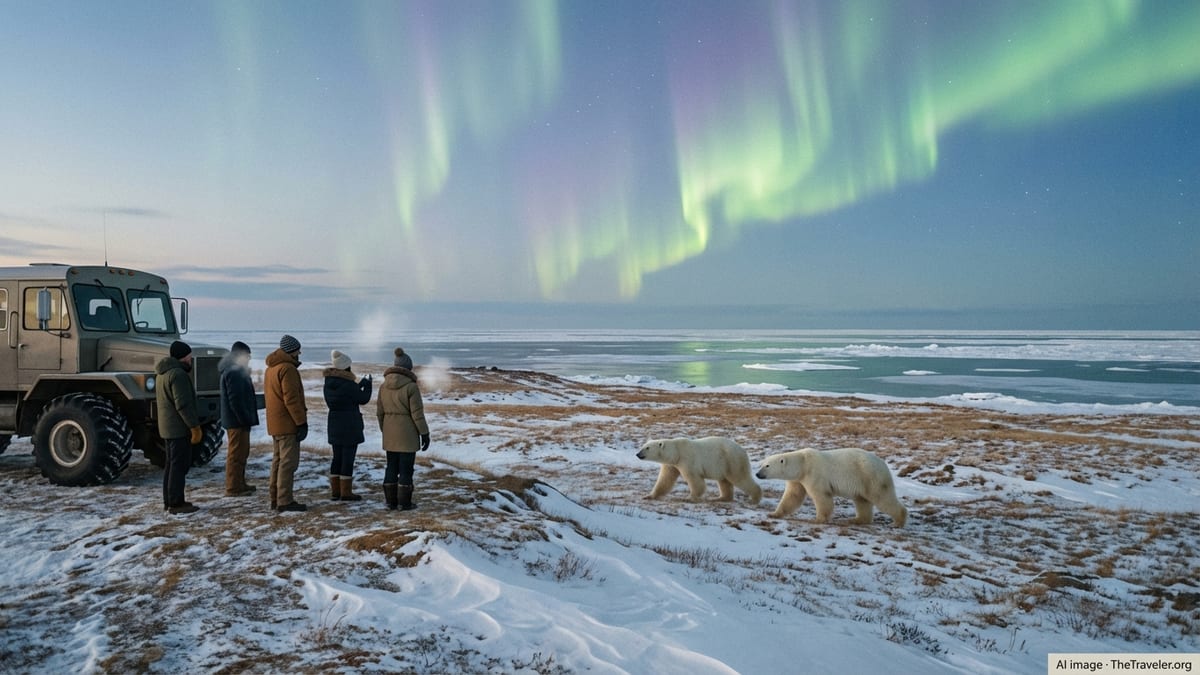
For many travelers, the ultimate Arctic dream is a single trip where polar bears roam the horizon by day and the northern lights ripple overhead at night. Few places on Earth make that combination genuinely possible, and each destination comes with trade-offs in cost, comfort, reliability, and risk. Churchill, on the shore of Hudson Bay in northern Manitoba, has built a global reputation as the polar bear capital of the world and a northern lights hotspot, but it is not the only option. Understanding what Churchill does uniquely well, and where other Arctic destinations quietly excel, is the key to planning the right trip for you.
Churchill at a Glance: Why This Tiny Town Looms So Large
Churchill is a remote community on the southwest coast of Hudson Bay, reachable only by plane or train. It sits directly under the auroral oval and along a natural migration corridor for Western Hudson Bay polar bears, which gather near town each fall as the sea ice begins to form. That confluence has turned a working northern town into one of the world’s best-known hubs for both polar bear and northern lights tourism.
In practical terms, Churchill offers a relatively structured, guided way to experience the Arctic. Established operators run polar bear viewing in large tundra vehicles, smaller private rovers, and from fly-in wilderness ecolodges along the coast. Accommodation ranges from simple guesthouses to higher-end lodges, with winter clothing rental commonly included in package trips. For northern lights, visitors can watch from outside town, in heated domes, or in custom-built glass structures designed to maximize sky views.
What makes Churchill unusual is how concentrated and seasonal the wildlife encounters are. From late October into mid November, polar bears are often seen daily on organized tours, sometimes in high numbers as they wait for the bay to freeze. At other times of year, a few bears may linger along the coast, but sightings are less predictable. Meanwhile, the town can see auroras on roughly 300 nights a year given clear skies, though tour operators emphasize midwinter, especially February and March, as the most reliable window for dedicated northern lights trips.
All of this comes with caveats. Churchill is expensive by the time you add flights, tours, and specialist clothing, and weather can disrupt both transport and activities. The small size of the town also means that peak-season space sells out many months in advance. Still, for travelers who want a high chance of seeing polar bears in safety, with a reasonable prospect of catching the northern lights on the same trip, Churchill remains one of the most compelling bets in the Arctic.
When to Go: Polar Bear and Aurora Timing in Churchill
The timing of your Churchill trip will determine what you are likely to see. For polar bears, the classic viewing season runs from roughly mid October to mid November, when bears gather along the coast waiting for the first stable sea ice. During these weeks, specialized tundra vehicles fan out over the surrounding tundra, and visitors commonly see bears resting on the snow, roaming the shore, or sparring with one another. Photography conditions are appealing, with low-angle subarctic light and a landscape often dusted in fresh snow.
Outside this fall peak, expectations should be adjusted. In summer, especially July and August, a handful of bears can sometimes be seen along the coast or from boats on beluga whale tours, but they are more dispersed and typically less active as they conserve energy on land. Once Hudson Bay fully freezes from late November into winter, most bears head out onto the ice to hunt seals, and sightings close to town diminish sharply. That is why most specialist polar bear trips remain tightly focused on the October to early November window.
For northern lights, Churchill’s timing curve is different. The aurora can appear in the sky at almost any time from late summer through spring, but serious aurora programs are concentrated between January and March, when long, dark, often very cold nights increase the odds of clear skies. Local tourism bodies note that Churchill’s position within the auroral oval means the town has auroras overhead on the majority of winter nights given clear weather, which is why February and early March itineraries tend to focus on sky watching rather than wildlife.
If your dream is to combine both polar bears and northern lights in a single trip, fall offers a compromise. During late October and early November, nights are long and dark enough for aurora displays, and some visitors are lucky enough to see both bears on the tundra by day and lights overhead at night. However, cloud cover and transitional weather at this time of year mean the lights are far from guaranteed. Travelers should approach a fall visit as a polar bear trip with a chance of aurora, rather than a dedicated northern lights expedition.
Other Arctic Hotspots for Polar Bears
While Churchill has an unusually reliable fall bear season, it is part of a broader circumpolar world where polar bears range across sea ice and remote coasts. Travelers willing to venture farther, accept less predictability, or spend significantly more can consider destinations such as Svalbard, northeastern Greenland, Alaska’s Arctic coast, or Canada’s High Arctic islands. Each offers different balances of access, cost, and wildlife certainty.
Svalbard, a Norwegian archipelago north of mainland Europe, is one of the few places where polar bears live year-round in relatively accessible terrain. Spring and summer expedition cruises navigate ice-choked fjords seeking bears on floes, alongside walrus colonies, nesting seabirds, and dramatic glaciers. Sightings can be spectacular but are never assured, and strict regulations require that ships and guides maintain careful distances to avoid disturbing the animals. Visitation here often feels more like a general Arctic expedition, with polar bears as one highlight among many.
On the opposite side of the Arctic, small communities along Alaska’s Beaufort Sea, such as Kaktovik, host fall seasons when polar bears gather near shorelines and bone piles outside town. Visitor numbers here are tightly managed, accommodations simple, and logistics complex, often involving multiple flights from Anchorage or Fairbanks. The experience can be intimate and photographically rewarding, but it is best suited to travelers comfortable with remote travel and limited infrastructure.
Canada’s High Arctic islands and the coasts of northwestern Greenland are also home to polar bears, typically visited on expedition cruises or chartered trips in summer. Here, bears are usually spotted at a distance along shores or on drifting sea ice, and there is no guarantee of close viewing. As climate patterns shift, the distribution of sea ice and seal hunting areas is also changing, adding further unpredictability to bear encounters in many of these far-flung regions.
Where the Northern Lights Shine Brightest Outside Churchill
If your priority is the northern lights, a number of destinations outside Churchill arguably offer comparable or even better odds of clear skies and frequent aurora displays. Across northern Scandinavia, places like Abisko in Sweden, Tromsø in Norway, and remote corners of Finnish Lapland market themselves on their combination of stable winter weather and access to the auroral oval. Abisko in particular has earned a reputation for unusually clear skies thanks to a local rain shadow effect, with some guides suggesting that travelers staying several nights have a high chance of seeing at least one display, though no location can promise a guarantee.
In North America, the city of Yellowknife in Canada’s Northwest Territories and the interior around Fairbanks, Alaska, are widely regarded as reliable aurora destinations. Both lie under the auroral oval in regions with relatively low cloud cover and dry, cold continental climates for much of winter. As with Churchill, operators there often quote success rates across multi-night stays, but emphasize that solar activity and weather remain outside human control. Midwinter periods from roughly December to March are generally favored, with some operators targeting the weeks around the equinoxes when geomagnetic activity can be slightly enhanced.
These northern lights hubs differ from Churchill in several ways. They often have more varied accommodation options, from city hotels to wilderness lodges and glass-roofed cabins, and they tend to offer broader winter activity menus including dog sledding, reindeer experiences, snowmobiling, and Sami or Indigenous cultural visits. In many cases, they function primarily as aurora destinations, with wildlife a secondary element rather than the core draw.
The trade-off is that if polar bears are on your wish list, these aurora-focused spots will not satisfy that goal. While Arctic foxes, reindeer, moose, or muskoxen may appear in some regions, true polar bear encounters are tightly restricted to specific coastal and sea-ice environments across the High North. For travelers whose main interest is photographing the northern lights with a relatively high day-to-day comfort level, Scandinavian Lapland, Yellowknife, or Fairbanks can be excellent choices. For those who want a realistic shot at both lights and bears, Churchill or a specialist expedition cruise becomes much more appealing.
Comparing Costs, Comfort, and Accessibility
Churchill sits in the middle of the Arctic travel spectrum when it comes to cost and comfort. Package polar bear trips, often lasting four to seven days, are undeniably expensive once flights, guided excursions, and winter clothing are included, yet they are often still cheaper than long High Arctic expedition cruises. Accommodations are generally warm and functional rather than indulgent, but some coastal ecolodges offer higher-end experiences with chef-driven meals and very small group sizes.
Reaching Churchill typically involves a domestic flight from Winnipeg or a train journey of around two days each way. Because there are no roads into town, weather-related disruptions and schedule changes are possible, and travelers should build flexibility into their plans. For northern lights trips, midwinter temperatures can be severe, with extreme windchill, so good gear and a tolerance for cold are essential. Many tour providers supply heavy parkas, insulated boots, and outer layers to help visitors cope.
By contrast, some aurora-focused destinations are easier and sometimes cheaper to reach. Cities like Tromsø, Rovaniemi, or Fairbanks have direct or one-stop flight connections from major hubs, and travelers can mix aurora hunting with daytime activities without committing to a fully packaged expedition. Lodging choices range from basic hostels to boutique hotels and specialized glass-roof cabins, giving more room for budget control. On the other hand, the absence of polar bears and the less concentrated nature of wildlife viewing mean that the experience, while memorable, is fundamentally different from Churchill’s intense, wildlife-driven focus.
At the remote end of the spectrum, Svalbard, Kaktovik, or High Arctic cruises often exceed Churchill in both cost and complexity. Charter-style travel, specialized guides, and strict safety protocols are essential where polar bears may wander close to settlements or landing sites, and insurance and equipment requirements can be more demanding. For some wildlife enthusiasts and photographers, these challenges are part of the adventure. For others, Churchill’s combination of relatively defined seasons, established infrastructure, and clear safety frameworks makes it the more approachable option.
Safety, Ethics, and the Changing Arctic
Wherever you encounter polar bears, safety and ethics are intertwined. In Churchill, strict regulations keep people inside tundra vehicles or behind protective barriers when bears are nearby, and local authorities actively manage “problem bears” that approach town too closely. Travelers typically view bears from elevated, enclosed platforms or through lodge windows and fences, which reduces pressure on the animals while allowing close observation. Responsible operators emphasize not feeding bears or trying to lure them in, as habituation can be fatal for wildlife.
In more isolated Arctic settlements and on expedition ships, the safety equation shifts. Residents in parts of Svalbard, Greenland, or the Russian Arctic are legally required or strongly encouraged to carry firearms outside settlements as a last line of defense if a bear charges. Guides on ship-based trips receive specialist training in bear awareness and deterrence. Travelers may see polar bears at greater distances and in more natural hunting contexts, but they must also adapt to stricter rules about where they can walk, how landings are conducted, and what to do if a bear appears unexpectedly along a hiking route or shoreline.
Climate change adds another layer. As sea ice patterns shift across the Arctic, polar bear behavior is changing in subtle and sometimes visible ways. In Hudson Bay, the timing of freeze-up and break-up influences when bears gather near Churchill and how long they remain on land. In other regions, reduced sea ice can push bears closer to human settlements or alter traditional denning and hunting areas. For visitors, this means that timing and conditions that worked a decade ago may not hold forever, and reputable operators frequently update their itineraries, routes, and timing to adapt.
Ethically, it is worth asking how your trip contributes to or mitigates pressure on fragile Arctic ecosystems. Some Churchill-based ecolodges and international expedition companies invest in scientific research, conservation initiatives, and local employment. Others are primarily commercial operations. Choosing providers that demonstrate real commitments to the community and environment, minimizing waste and unnecessary flights where possible, and treating wildlife with respect are all ways travelers can help ensure that polar bear and aurora tourism remains sustainable in a rapidly changing North.
How to Decide: Matching Your Trip to Your Priorities
When travelers weigh Churchill against other Arctic destinations, the choice often comes down to priorities. If seeing wild polar bears at relatively close range is your non-negotiable goal, the October to early November season in Churchill remains one of the most reliable and accessible options. You are likely to spend most of your days focused on wildlife, with the possibility of northern lights as a welcome bonus on clear nights. The trade-offs are cost, cold, and a degree of logistical complexity in reaching a remote rail-and-air town.
If your primary dream is to stand under vivid auroras, with days filled by a mix of soft adventure and cultural experiences rather than intensive wildlife viewing, then destinations such as Abisko, Tromsø, Finnish Lapland, Yellowknife, or Fairbanks may serve you better. Their midwinter northern lights seasons often combine higher chances of clear skies with more varied activity menus and a broader range of accommodation styles. Polar bears will not be on the agenda, but dog sledding, snowshoeing, ice fishing, and Indigenous cultural experiences can make for a rich, varied itinerary.
Travelers who want a broader Arctic expedition with a chance of polar bears but are comfortable with more uncertainty might turn to Svalbard, Greenland, or High Arctic cruises. These trips are longer, costlier, and more remote, but they can offer powerful encounters with ice, wildlife, and polar landscapes that extend beyond any one species. Polar bears, if seen, are part of a larger tapestry that may include whales, walruses, vast bird cliffs, and immense glaciers calving into fjords.
For a small subset of visitors, it is possible to plan multiple shorter trips, for instance combining an autumn visit to Churchill for bears with a later winter or early spring voyage to an aurora hotspot elsewhere. This approach spreads costs over time and allows you to tailor each journey more precisely to its main goal. Whichever path you choose, being honest about your priorities and your tolerance for cold, cost, and remoteness is the surest way to end up in the right corner of the Arctic.
The Takeaway
Churchill’s enduring appeal lies in its rare combination of predictable polar bear viewing and strong northern lights potential, all anchored in a community that has been welcoming visitors to the edge of Hudson Bay for decades. For a single trip that leans toward wildlife, particularly in late October and early November, it is very hard to beat. Bears gather on the tundra, trained guides manage encounters with an emphasis on safety, and on clear nights the aurora can transform the sky above frozen ponds and snow-dusted spruce.
Yet the Arctic is not a single place but a vast mosaic of coastlines, islands, and interior plateaus, each with its own rhythm of seasons. Northern lights chasers may find more stable clear-sky statistics in Abisko, Yellowknife, or Fairbanks. Expedition-minded travelers may feel drawn to the deep fjords of Svalbard or the ice-choked waters of Greenland, where polar bears, if spotted, are part of a broader exploration rather than the central purpose. There is no universal best destination, only better matches for different kinds of journeys.
As climate shifts reshape sea ice and weather patterns, all of these destinations are adapting. That makes it more important than ever to work with reputable operators who understand local conditions, respect wildlife, and contribute meaningfully to the communities and environments they depend on. Whether you end up on a tundra rover outside Churchill, a glass-roofed cabin in Lapland, or the deck of a small ship nosing through Arctic pack ice, thoughtful choices can help ensure that your dream of seeing polar bears and the northern lights supports, rather than harms, the fragile polar world you have come so far to witness.
FAQ
Q1. Can I reliably see both polar bears and northern lights in Churchill on one trip?
It is possible but not guaranteed. The classic polar bear season in Churchill runs from mid October to mid November, when bears gather along the Hudson Bay coast waiting for sea ice. During these weeks there is a realistic chance of seeing the northern lights on clear nights because darkness has set in, but fall weather can be cloudy. Travelers should treat auroras as a bonus during bear season, not a certainty.
Q2. When is the best time to visit Churchill purely for northern lights?
For a trip focused on auroras rather than wildlife, many local operators highlight February and March. Long, dark nights and typically cold, drier air often mean more clear skies, and Churchill’s location under the auroral oval gives good odds of activity whenever the sky is cloud free. Expect severe cold and plan for high-quality winter clothing and flexible late-night schedules to maximize your chances.
Q3. How does Churchill compare with Abisko or Yellowknife for aurora reliability?
All three are strong locations under or near the auroral oval, but they differ in weather patterns and trip style. Abisko benefits from a local microclimate that often produces clear skies even when surrounding regions are cloudy, which is why it is frequently cited as one of the most reliable spots in Europe. Yellowknife offers many clear, very cold winter nights in Canada’s interior. Churchill has strong auroral activity but can see more cloud and coastal weather, especially in fall, so it is often chosen for the combination of bears and lights rather than lights alone.
Q4. Are polar bear encounters closer in Churchill than on Arctic cruises?
In many cases, yes. In Churchill’s fall season, bears often approach tundra vehicles or lodge fences out of curiosity, giving relatively close views while still maintaining safety buffers. On ship-based expeditions in Svalbard, Greenland, or the High Arctic, bears are usually seen from a greater distance along shorelines or on sea ice, and strict regulations typically keep ships, zodiacs, and landing parties farther away. Every encounter is different, but Churchill is generally known for its combination of frequency and proximity.
Q5. Is it safe to visit places where polar bears live, such as Svalbard or Alaska’s Arctic coast?
Traveling with qualified guides and following local rules makes these destinations reasonably safe for visitors, but polar bears are powerful wild predators and must always be treated with caution. In some Arctic communities, residents are required or strongly advised to carry firearms outside settlements as a last resort for self defense. Tour operators and expedition leaders receive training in bear behavior and non lethal deterrence, and they set strict rules about where guests can walk and how groups move on land.
Q6. How far in advance should I book a Churchill polar bear trip?
Space in Churchill during peak bear season is limited and demand is high, so booking many months in advance is wise. For popular October and early November departures, it is common for tours and preferred accommodations to fill a year ahead, especially with specialist operators and small coastal lodges. Last minute spots sometimes appear, but travelers with fixed vacation dates or specific photography goals should plan well ahead.
Q7. Will climate change affect my chances of seeing polar bears in Churchill?
Shifts in sea ice conditions around Hudson Bay are already influencing the timing and duration of the polar bear season. Earlier break-up and later freeze-up can lengthen periods when bears are on land and adjust when they concentrate near Churchill. From a visitor perspective, that means timing that worked in past decades may evolve gradually, and responsible operators monitor yearly patterns to fine tune their schedules. No single trip can see these long term changes, but the broader trend is an important context for any polar bear visit.
Q8. What kind of clothing do I need for a winter or late fall trip?
Proper cold weather layering is crucial. Travelers should plan for thermal base layers, insulating mid layers such as fleece or wool, and windproof, insulated outerwear. Heavy parkas, insulated snow pants, warm boots, mittens, hats, and face protection like balaclavas or neck gaiters are standard. Many Churchill and Arctic tour operators supply or rent expedition grade outerwear and boots, but you will still need quality base layers and small items like thin liner gloves for photography.
Q9. Are there ways to make an Arctic trip more sustainable?
Yes. Choosing operators that support local communities, hire regional guides and staff, and contribute to conservation or research is a meaningful step. Traveling in smaller groups, minimizing internal flights where realistic, and avoiding unnecessary single use plastics can also reduce your footprint. Once on site, following wildlife viewing rules, staying on established routes, and respecting local cultures help ensure that your presence has a lighter impact on fragile Arctic environments.
Q10. If I only have one Arctic trip in my lifetime, should I prioritize Churchill or another destination?
The answer depends on what you want to remember most. If you picture yourself looking into the eyes of a wild polar bear from the safety of a tundra vehicle or lodge, Churchill in late October or early November is one of the most compelling choices. If your dream image is a sky filled with auroras above a quiet cabin, destinations like Abisko, Yellowknife, or Fairbanks may be a better fit. For a broader sense of the polar regions, a longer expedition cruise through Svalbard or Greenland might be worth the extra complexity and expense. Clarifying which of these visions matters most to you will point you to the right corner of the Arctic.