

More news on this day
China’s shipbuilding ambitions have taken a significant step forward as CIMC Raffles clinches a headline-grabbing contract with Bruton Ltd for the company’s first-ever very large crude carrier orders, signaling a new phase in China’s bid to dominate the premium end of the global tanker market.
Get the latest news straight to your inbox!
A Breakthrough VLCC Contract at a Strategic Chinese Yard
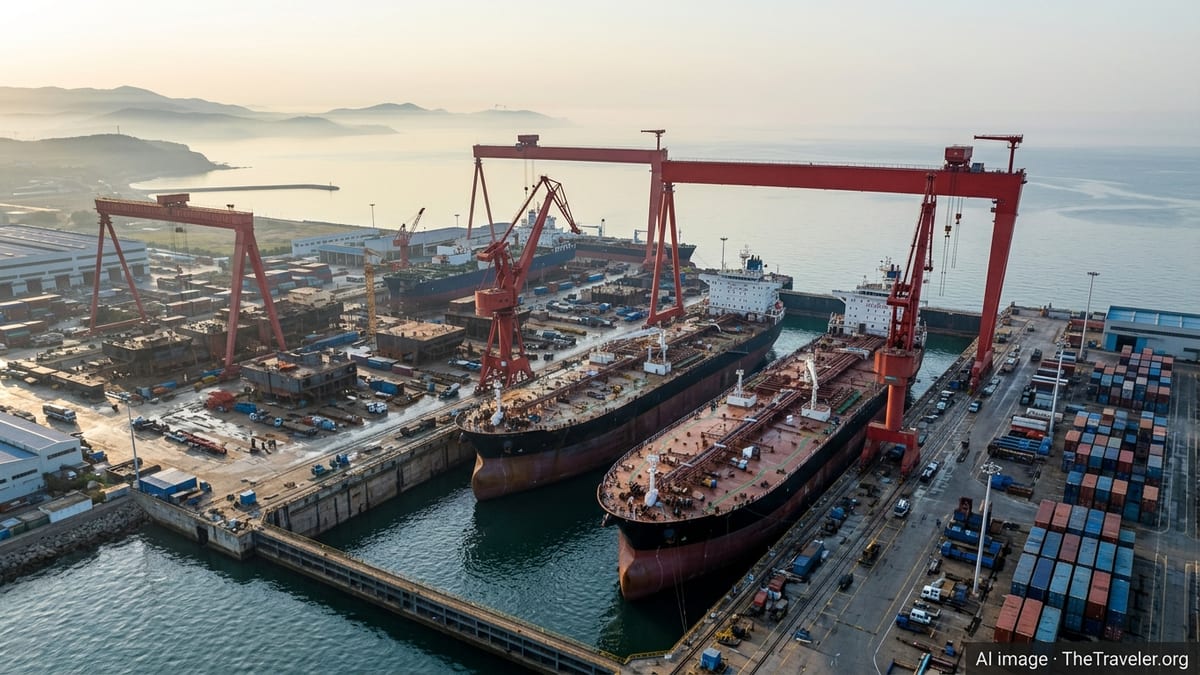
The agreement between CIMC Raffles and Bruton Ltd, a Bermuda-based crude tanker owner, centers on the construction of new very large crude carriers at Yantai CIMC Raffles Shipyard in Shandong Province, one of China’s most strategically located deepwater yards. Publicly available information describes CIMC Raffles as a key offshore and marine fabrication base within the CIMC group, positioned on the Bohai Bay and Yellow Sea corridor, a region that has become a powerhouse for world shipbuilding.
While Bruton has previously focused on newbuildings at other Chinese shipyards, notably New Times Shipbuilding for dual-fuel VLCCs, sector reports indicate that this new deal at CIMC Raffles marks a notable diversification in its yard portfolio. Market commentary frames the contract as Bruton’s first VLCC engagement with this particular builder, effectively expanding both sides’ reach in the high-capacity crude transportation segment.
The vessels are expected to follow the latest generation of eco-efficient VLCC designs, echoing Bruton’s existing focus on fuel-flexible, regulation-ready tankers. For CIMC Raffles, traditionally associated with offshore units and specialized vessels, the order signals a broadening of its product mix into the mainstream deep-sea crude trades where freight demand is driven by long-haul routes between the Atlantic Basin and Asia.
Analysts following the tanker market note that a VLCC deal of this size not only adds volume to the Chinese orderbook, but also highlights how newer Chinese yards are moving into complex, high-value ship segments previously associated with established builders in South Korea and Japan.
Why VLCCs Matter for Global Trade and Travel Corridors
VLCCs, typically exceeding 300,000 deadweight tons, form the backbone of long-haul crude oil transport, connecting exporting regions in the Middle East, West Africa and the Americas with refining and consumption hubs in East and Southeast Asia. As these ships crisscross major maritime chokepoints, from the Strait of Hormuz to the Singapore Strait, their deployment patterns shape traffic density along some of the world’s most important travel and trade corridors.
Industry documents from Bruton highlight the company’s belief that modern, fuel-efficient VLCCs can secure premium earnings in a market where compliant emissions profiles and flexible fuel capability are increasingly valued by charterers. By commissioning newbuildings in China, the owner is effectively anchoring its growth strategy to a country that is both the world’s largest importer of crude oil and an emerging leader in building the ships that carry it.
For international travelers and port cities, the expansion of modern VLCC fleets often translates into further investment in deepwater terminals, pilotage services and marine infrastructure. As more Chinese-built VLCCs enter service, ports from Ningbo-Zhoushan and Qingdao to major transshipment hubs in Southeast Asia are expected to see continued upgrades in navigation systems, bunkering options and environmental safeguards.
Observers note that the geographic positioning of CIMC Raffles near the busy Northeast Asian shipping lanes makes it an ideal base for constructing and commissioning vessels that will operate intensively on these long-distance crude routes. The Bruton contract reinforces this coastal belt’s role as a production and deployment center for the world’s largest tankers.
China’s Ascendancy in High-Value Shipbuilding
China has steadily increased its share of the global orderbook for large commercial vessels, and recent industry research describes Chinese yards as commanding a leading position across several categories, from container ships to bulk carriers. With VLCC orders now flowing more frequently to Chinese builders, the country is moving beyond volume leadership to challenge rivals in higher-value, technologically advanced segments.
The CIMC Raffles and Bruton collaboration arrives at a time when tanker analysts describe VLCC order coverage as historically lean relative to the existing fleet, a factor that has encouraged well-capitalized owners to move early on newbuilding slots. Marketing materials from Bruton refer to a low overall VLCC orderbook as a supportive backdrop for investment, particularly when paired with stricter emissions regulations that reward newer, more efficient ships.
Reports covering shipbuilding trends point out that Chinese yards have sharpened their competitiveness through a mix of state-backed infrastructure, access to domestic steel and component supply chains, and a rapid learning curve in complex vessel types. CIMC Raffles, with decades of experience in offshore engineering, is viewed as well positioned to apply that expertise to large tankers that demand robust hull construction and advanced propulsion systems.
This VLCC deal therefore carries symbolic weight. It illustrates how Chinese shipyards are winning the confidence of international owners not only on cost, but also on design sophistication, delivery capability and after‑sales technical support. For China’s broader industrial strategy, contracts of this kind help solidify the country’s reputation as a full-spectrum maritime manufacturing power.
Technology, Sustainability and Future-Proof Tanker Design
Available corporate presentations from Bruton emphasize a preference for dual-fuel or conversion-ready propulsion systems, giving vessels the ability to burn conventional fuel oil while retaining the option to switch to cleaner alternatives such as liquefied natural gas. Market watchers expect similar design philosophies to be applied to the new VLCCs being commissioned at CIMC Raffles, in line with tightening rules on carbon intensity and greenhouse gas emissions.
Shipbuilding documentation and regulatory guidance underscore the growing impact of international carbon measures on fleet renewal decisions. Owners are increasingly seeking hull forms, engines and onboard systems that can accommodate future fuels and digital optimization tools, from advanced hull coatings to voyage-planning software that cuts unnecessary fuel burn.
China’s yards, including CIMC Raffles, have been investing in research and development partnerships aimed at integrating these technologies into export-oriented vessels. A VLCC project for a publicly listed owner adds an extra incentive to showcase low-emission features, efficient cargo-handling systems and redundancy in key machinery, all of which can enhance the commercial appeal of the ships in a competitive charter market.
For global travelers who encounter supertankers mainly as silhouettes on the horizon or distant lights off major coasts, the shift toward cleaner and more efficient VLCCs has less visible but still significant implications. Reduced emissions in busy sea lanes and port areas contribute to better air quality, while enhanced safety and navigation systems support smoother coexistence between heavy commercial traffic and growing cruise and ferry networks.
Implications for Maritime Hubs and the Wider Shipping Network
The CIMC Raffles Bruton VLCC deal is expected to feed into a broader realignment of global shipping networks in which Chinese-built vessels serve as the backbone of long-haul crude trades. As more tonnage is ordered in Chinese yards, regional ecosystems of marine equipment suppliers, service providers and training institutions are expanding around coastal industrial zones.
Major maritime hubs from Shanghai and Shenzhen to Singapore and Dubai are closely linked to these developments, as chartering, ship finance and classification activities increasingly revolve around fleets with significant Chinese construction content. Sector reports suggest that this concentration of expertise reinforces Asia’s role as the primary axis of global seaborne trade, particularly for energy commodities.
For coastal destinations and port cities featured on international travel itineraries, higher volumes of modern VLCC traffic can translate into more investment in deepwater access channels, breakwaters and environmental monitoring. Such infrastructure upgrades often arrive alongside broader urban redevelopment, cruise terminal expansion and coastal tourism projects, knitting heavy industry and travel economies more tightly together.
With CIMC Raffles now associated with a flagship VLCC program for Bruton, observers see a clear message to the market: China intends not only to remain the world’s largest shipbuilding nation by volume, but to shape the technological and environmental standards of the next generation of ocean-going tankers that power the global economy.