

More news on this day
China’s CIMC Raffles has secured a breakthrough contract with Bruton Ltd for a series of very large crude carriers, a move that industry observers view as a major turning point in China’s advance into the top tier of global tanker shipbuilding.
Get the latest news straight to your inbox!
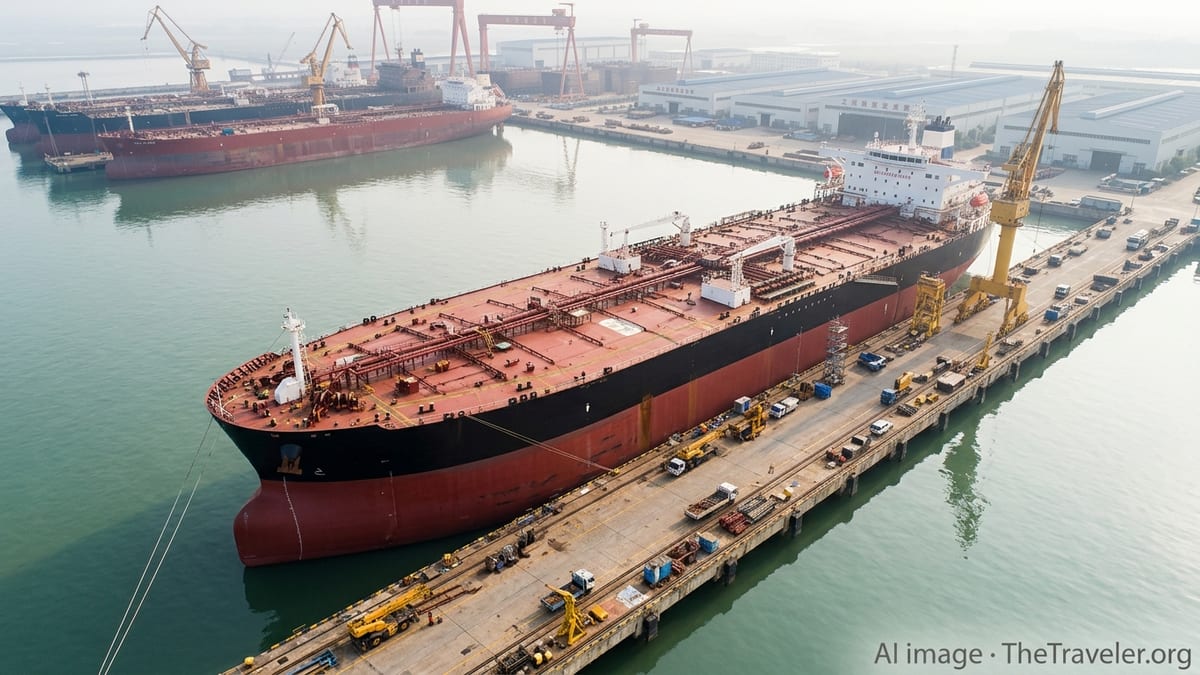
First VLCC Breakthrough for CIMC Raffles
Publicly available industry coverage indicates that the new agreement represents CIMC Raffles’ first orders in the very large crude carrier segment, a category traditionally dominated by established South Korean and Japanese builders. The contract with Bruton Ltd, an Oslo-listed tanker owner focused on modern, fuel-efficient crude carriers, is being described across trade media as a game-changing step that broadens China’s role from bulk carrier and container ship specialist to a leading supplier of advanced crude tankers.
The deal positions CIMC Raffles, based in Yantai in China’s Shandong province, alongside other major Chinese yards that have recently expanded their orderbooks with large crude tankers and gas carriers. While Chinese builders have steadily increased their share of global orders in recent years, the entry of a yard best known for offshore and specialized marine constructions into the VLCC space is seen as evidence of rising technical capabilities and growing confidence among international shipowners in Chinese yards.
Market reports highlight that the CIMC Raffles contract adds to a wave of new Chinese tanker orders from owners such as Bruton Ltd, which has rapidly built a large VLCC newbuilding program at Chinese shipyards. For the wider market, the CIMC Raffles deal is viewed as confirming that complex, high-value tanker projects are now firmly part of China’s mainstream shipbuilding portfolio.
Details of Bruton’s Expanding VLCC Program
Bruton Ltd has emerged over the past two years as one of the most active VLCC investors globally, adding a string of newbuildings at Chinese yards to create a uniform, fuel-efficient tanker fleet. According to recent stock exchange filings and company presentations, Bruton has eight VLCCs firmly on order in China, with delivery dates stretching from 2026 through 2029, and is evaluating options that could take its program into double digits.
The company’s earlier orders have focused on LNG dual-fuel or LNG-ready VLCC designs that combine scrubbers with the option to switch to cleaner-burning fuels as regulations tighten. Industry summaries of the CIMC Raffles agreement indicate that the new ships follow this pattern, emphasizing energy efficiency, reduced emissions and operational flexibility on long-haul crude routes between the Atlantic Basin, Middle East and Asia.
Bruton’s decision to spread its program across more than one Chinese yard, now including CIMC Raffles, is being interpreted as a vote of confidence in the country’s broader industrial base. Analysts note that by securing multiple slots at different facilities, the owner can diversify construction risk, optimize delivery timing and build negotiating power with financiers and charterers seeking low-emission tonnage.
China’s Ascent to Global Shipbuilding Leadership
The CIMC Raffles contract arrives at a time when published industry statistics place China at or near the top of global rankings for shipbuilding completions and new orders, measured by both compensated gross tonnage and deadweight. Over the past decade, Chinese yards have transitioned from primarily competing on cost to winning contracts for sophisticated vessels in segments such as LNG carriers, large container ships and now high-specification crude tankers.
Trade data compilations for 2025 and early 2026 show that China’s share of the global tanker orderbook has continued to rise, supported by a domestic supply chain for key components and active policy measures aimed at sustaining shipyard employment and technological upgrades. The willingness of international owners like Bruton Ltd to place large, multi-ship programs in China is viewed as a practical endorsement of those efforts.
Industry commentary also notes that the distribution of VLCC orders is gradually shifting away from a near-duopoly of Korean and Japanese yards toward a more balanced landscape in which Chinese builders hold a growing share. The CIMC Raffles deal is cited as a tangible example of how new players within China’s shipbuilding ecosystem are moving into the upper tier, increasing competition and potentially reshaping pricing and delivery dynamics across the tanker market.
Technology, Green Requirements and Financing
The VLCCs tied to Bruton’s Chinese program are closely aligned with tightening environmental regulations, including energy efficiency standards and greenhouse gas intensity targets on international shipping routes. Publicly available briefings on Bruton's fleet strategy emphasize hull forms optimized for lower fuel consumption, advanced propeller and rudder systems, and the option to employ alternative fuels such as LNG to meet future carbon rules.
Reports on related VLCC projects show that financing structures are evolving alongside technology. Recent disclosures indicate that Bruton has secured proposals covering a high proportion of construction costs for some of its dual-fuel VLCCs, reflecting lenders’ growing appetite for modern, environmentally advanced tonnage. Analysts say the CIMC Raffles contract is likely to be supported by similar funding mechanisms, particularly as banks and leasing houses place greater emphasis on emissions performance when backing new ships.
For CIMC Raffles, participation in a project built around low-emission operation is expected to strengthen the yard’s credentials in energy-efficient design and project execution. Successful delivery of VLCCs that meet the latest environmental benchmarks would broaden CIMC Raffles’ reference list and could open the door to future contracts in both tanker and gas-carrier segments as global regulations tighten further.
Implications for Global Trade and Shipping Routes
The new VLCC orders are also framed within a wider discussion about how fleet renewal will influence major crude trades in the coming decade. With a significant portion of the existing VLCC fleet approaching or surpassing 20 years of age, analysts point out that replacement capacity is needed to maintain service on long-haul routes linking suppliers in the Middle East, Atlantic Basin and West Africa with refiners in East and South Asia.
By adding modern VLCCs from Chinese yards such as CIMC Raffles, owners like Bruton are expected to improve fuel efficiency on these routes, potentially reducing voyage emissions and operating costs while maintaining flexibility to serve both term charters and spot trades. Market observers suggest that newer vessels with competitive consumption profiles could gain an advantage in securing employment from trading houses and refiners seeking to align freight choices with their own climate targets.
From a geographic perspective, the concentration of large tanker orders in China reinforces the country’s role not only as a leading manufacturing and export hub, but also as a strategic center for maritime infrastructure and logistics. As more long-haul crude carriers are designed, financed and built in Chinese yards, shipping analysts expect China’s influence over future standards, design preferences and delivery schedules in the VLCC sector to deepen further.