

More news on this day
Cleveland Hopkins International Airport is confronting a fresh wave of operational turmoil as Spirit Airlines winds down service and Frontier Airlines grapples with mounting delays and cancellations, creating a volatile environment for budget-conscious travelers across key spring travel dates.
Get the latest news straight to your inbox!
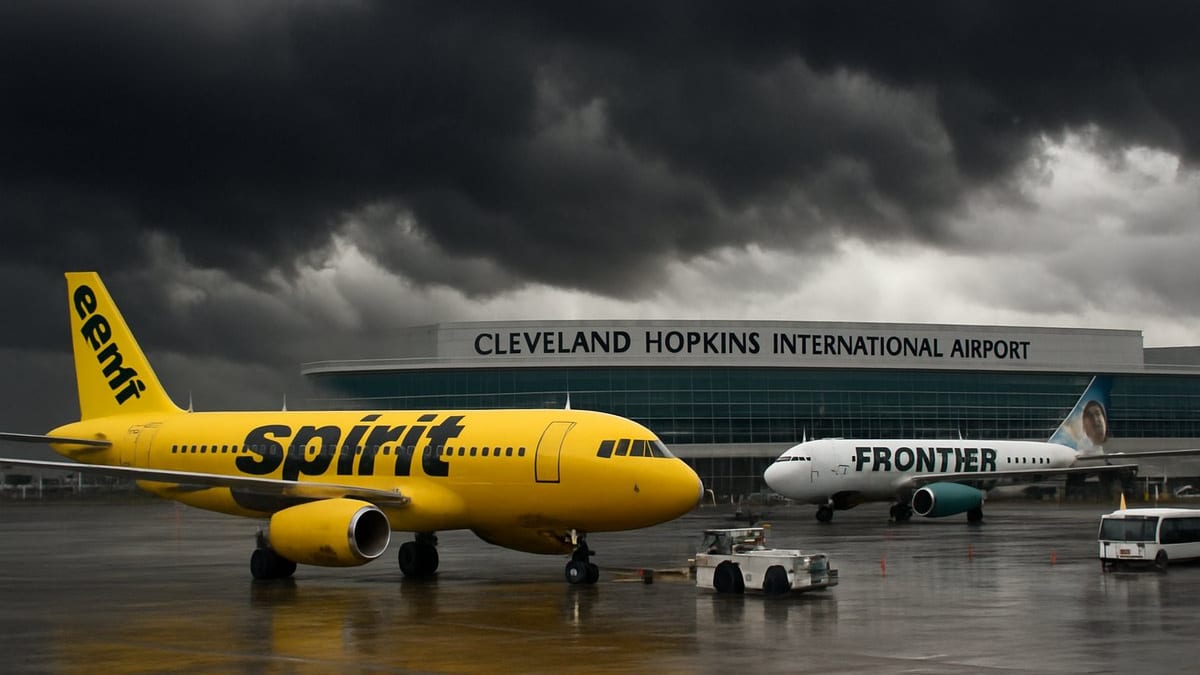
Spirit’s Cleveland Exit Collides With a Month of National Disruption
Publicly available airline statements and regional coverage indicate that Spirit Airlines is preparing to cease operations at Cleveland Hopkins in mid to late April 2026, drawing down its final flights just as spring travel demand accelerates. The move follows a prolonged period of capacity cuts and weaker performance in the Cleveland market compared with rival low cost and legacy carriers.
Industry tracking data compiled over recent weeks points to one of Spirit’s most turbulent operational stretches of the year, with elevated cancellation and delay levels across its national network. Coverage in specialist travel outlets describes clusters of Spirit disruptions at large bases such as Fort Lauderdale and Orlando, feeding into cascading schedule problems on connecting routes and smaller stations that depend heavily on a limited number of daily flights.
For Cleveland Hopkins, the timing means passengers already booked on Spirit in the run up to the carrier’s exit are exposed to two overlapping risks: broader national irregular operations affecting the airline’s on time performance and the structural schedule changes associated with shutting down a station. Publicly available policy information notes that travelers on controllable cancellations may be eligible for refunds or rebooking, but options can narrow quickly once a station is removed from the route map.
Aviation analysts quoted in regional business coverage have previously highlighted the sensitivity of mid sized airports like Cleveland to sharp schedule reductions by value oriented carriers. Spirit’s drawdown adds to a recent pattern of passenger softness and shifting market share among airlines at Hopkins, leaving a smaller set of low cost options at precisely the moment demand typically rises for leisure travel.
Frontier Becomes Gap Filler as Operational Pressures Mount
As Spirit steps back, Frontier Airlines is emerging as a primary low cost operator at Cleveland Hopkins, taking over select leisure routes and increasing its relative importance for travelers seeking budget fares. Airport communications in recent months have pointed to Frontier and other carriers absorbing capacity on sun and short haul routes that were once part of Spirit’s portfolio.
Yet the same travel disruption reports that spotlight Spirit also show Frontier facing its own operational challenges this spring. National data aggregated by aviation trackers indicates that Frontier has recorded dozens of delays and a noticeable share of cancellations during late March and early April, especially at core hubs in Denver and key East Coast markets. Because many of Frontier’s Cleveland flights are fed through those hubs, even remote weather or congestion events can quickly spill into Ohio.
Travel focused outlets describe a pattern in which low cost carriers, operating dense schedules with tight aircraft utilization, struggle to absorb shocks when storms, air traffic flow restrictions or crew imbalances arise. For passengers at Cleveland Hopkins, this means that the apparent handoff from Spirit to Frontier is not a simple substitution, but rather a shift to another carrier that is also navigating a volatile operating environment.
Some consumer commentary circulating on public forums underscores this fragility, with travelers weighing whether to keep low fare reservations on Spirit or Frontier or pivot to more expensive legacy options to reduce the chance of last minute disruption. While such anecdotal accounts are not formal data, they mirror what published statistics show: both airlines are contending with higher than normal irregular operations this season.
Spring Weather, Congested Hubs and Network Ripple Effects
The challenges at Cleveland Hopkins are unfolding against a national backdrop of widespread airline disruption. Travel industry analyses published in late March and early April describe multiple days in which more than a thousand flights across the United States were delayed or cancelled, affecting carriers of all types and sizes. These reports attribute the problems to a combination of spring storm systems, congested airspace and resource constraints at some airlines.
Data compiled by aviation news sites points to pronounced slowdowns at major hubs such as Chicago, New York, Orlando and Fort Lauderdale, many of which are important nodes for both Spirit and Frontier. When operations seize up at those airports, knock on effects rapidly appear at spoke cities like Cleveland Hopkins, where a single cancelled rotation can wipe out an entire day’s service on a given route.
In recent weeks, travel publications have singled out low cost carriers as particularly exposed to these ripple effects. Schedules built around rapid aircraft turns and lean spare capacity leave little margin when storms force ground stops, when crew members time out under duty rules, or when maintenance issues remove aircraft from service. The result is that delays in one region can cascade into cancellations several time zones away, often with limited rebooking options.
For Cleveland based travelers, this means that disruptions attributed to weather in Florida or congestion in New York can translate into long lines, rolling departure time changes and, in some cases, overnight stays far from home. The pattern has been especially evident on peak travel days, when alternative seats on other airlines are scarce and prices climb rapidly once problems emerge.
Passenger Impact at Cleveland Hopkins and Limited Alternatives
Recent tallies published by travel news organizations show that Cleveland Hopkins has experienced a steady drumbeat of delayed and cancelled departures in line with, and at times exceeding, typical seasonal baselines. One report at the end of March highlighted more than 60 combined delays and cancellations in a single day linked to a mix of regional and mainline carriers operating through the airport.
Within that total, Frontier featured prominently as one of several airlines reducing schedules or canceling individual flights in response to weather and operational strain. Spirit’s presence in those counts has been shrinking as its Cleveland schedule winds down, but remaining flights into April still face intermittent disruption as the broader network weathers spring storms and air traffic control programs.
Travelers relying on ultra low cost fares from Cleveland report encountering a constrained set of alternatives when disruptions strike. Because Spirit and Frontier often operate limited daily frequencies on specific routes, a cancellation can mean that the next available flight is not until the following day or requires an inconvenient connection through another hub. Publicly available guidance from consumer advocates therefore encourages passengers to monitor flight status closely, travel with flexible plans when possible, and be familiar with airline policies on refunds and reaccommodation.
For the airport itself, the combination of a carrier exit and ongoing delays presents a reputational challenge as well as an operational one. Passenger satisfaction metrics and on time performance statistics, both tracked by industry observers, are likely to remain under pressure in the near term as Cleveland Hopkins works with remaining airlines to stabilize schedules and manage peak periods.
New Entrants and Longer Term Market Realignment
Despite the current turbulence, there are signs that Cleveland Hopkins is attempting to reposition its airline mix for the longer term. An airport press release dated March 18 announced that Avelo Airlines will begin service at Hopkins in June 2026, adding fresh competition on select leisure routes and potentially offsetting some of the capacity lost with Spirit’s departure.
Published coverage of the announcement notes that Avelo’s arrival continues an incremental reshaping of the Cleveland market, where low cost and ultra low cost carriers have gradually gained share even as individual airlines have trimmed or refocused operations. Frontier’s growth, United’s evolving hub strategy and the entry of new players all form part of a broader attempt to rebuild connectivity after earlier cuts.
In the short term, however, travelers face a difficult adjustment period in which the benefits of new entrants are still months away while the drawbacks of schedule cuts and irregular operations are being felt immediately. Industry commentators suggest that performance through the upcoming summer travel season will be an important test of whether Cleveland Hopkins and its airline partners can reverse the perception of chronic disruption and restore confidence among passengers.
For now, the picture at Cleveland Hopkins is defined by volatility: Spirit’s exit, Frontier’s elevated delay profile and a national pattern of weather driven disruption are converging to produce a particularly punishing stretch for travelers who rely on low cost flights into and out of northeast Ohio.