

More news on this day
Independent hotels are entering 2025 under mounting pressure as fresh data from Cloudbeds shows online travel agencies tightening their grip on bookings, demand leveling off, and guests growing more price sensitive and harder to retain.
Get the latest news straight to your inbox!
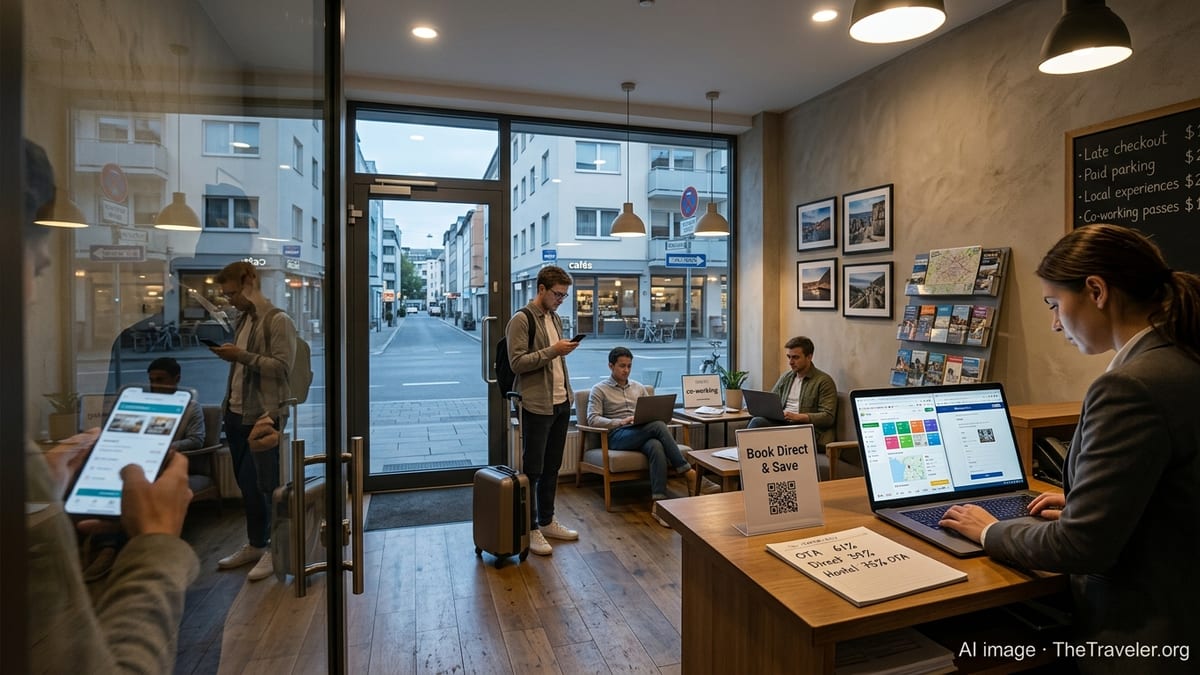
OTA Share Climbs As Direct Channels Lose Ground
Cloudbeds’ latest State of Independent Lodging Report indicates that online travel agencies now account for roughly six in ten bookings at independent properties worldwide, a modest but telling increase from the previous year. The shift underscores how heavily smaller hotels still rely on commission-based intermediaries, even after years of campaigns to drive more direct reservations.
Industry coverage of the report notes that OTAs captured about 61 percent of independent hotel bookings in 2024, edging up from 2023 and extending a multiyear trend of growing dominance in the distribution mix. By comparison, branded hotels are described as significantly less dependent on third-party channels, with OTA contribution closer to one-third of bookings, highlighting a widening structural gap between chains and independents.
This growing reliance comes at a time when independent operators are already squeezed by higher operating costs and cautious consumers. Each incremental point of share flowing to OTAs effectively transfers margin away from hotels in the form of commissions, making profitability more fragile and leaving less room for investment in technology, staff and property upgrades.
Cloudbeds’ parallel analysis of the hostel segment points to an even stronger OTA concentration, with around three quarters of hostel bookings reportedly coming through the major platforms. That pattern suggests the shift is not limited to traditional hotels but is reshaping distribution across the broader independent lodging ecosystem.
Softer Demand Turns 2025 Into a Fight for Market Share
While pandemic-era recovery drove robust growth in 2022 and 2023, Cloudbeds’ data shows that demand largely stabilized in 2024, turning 2025 into what several trade publications describe as a “year of optimizing performance” rather than expansion. Occupancy trends in the report point to steady but no longer surging travel volumes, meaning that independent hotels can no longer count on rising demand to lift results.
Average daily rate appears to have hit a ceiling in many markets. Hospitality media summarizing the Cloudbeds findings highlight a slight global decline in ADR of around 1 percent in 2024, a reversal after years of aggressive pricing power. The dip is interpreted as evidence of softening demand and growing price sensitivity, with travelers pushing back against rate hikes and shopping harder across channels before committing to a stay.
With top-line growth slowing, competition for each guest has intensified. Independent properties are being urged by analysts to focus on market share, revenue per available room and profitability rather than simple occupancy gains. That recalibration is particularly acute in destinations where new supply from branded hotels and short-term rentals continues to come online, fragmenting demand that has stopped expanding at the same pace.
The combination of flat volumes, moderating rates and rising distribution costs linked to OTA commissions is leaving many owners feeling that they are “on the brink” of a more challenging cycle, even if headline travel numbers remain relatively healthy on a global basis.
Guest Behavior Shifts Toward Shorter, Value-Driven Stays
Beyond topline metrics, the Cloudbeds report and related data releases highlight clear changes in how guests are planning and experiencing trips. Booking windows have normalized compared with the volatility of the early recovery period, but patterns now show more deliberate comparison shopping, a bias toward flexible policies and an aversion to perceived overpricing.
Cloudbeds’ booking behavior dashboard points to shorter average lengths of stay and a higher share of short-break travel across several regions. Separate market pulse updates from the company note that average length of stay declined month over month for much of 2025 relative to 2024, reinforcing the impression of travelers favoring more frequent but briefer trips, often booked closer to arrival.
Value-driven decision making is another prominent theme. The 2025 State of Independent Lodging Report identifies value rather than pure price as a key driver, with guests weighing inclusions such as breakfast, parking, co-working space or wellness access alongside rate. Analysts say that shift is encouraging independent hotels to rethink packages and ancillary offerings, using add-ons to boost revenue while still presenting competitive headline prices on OTAs and direct channels.
At the same time, higher cancellation rates on OTA bookings, documented in both hostel and hotel data sets, are forcing operators to refine policies, overbooking strategies and payment terms. The friction adds operational complexity and heightens the risk that rooms remain empty if last-minute cancellations are not replaced.
Rising Costs, Labor Strains and the Push for Ancillary Revenue
Cloudbeds’ research and subsequent industry commentary stress that independent hotels are contending with persistent cost inflation in areas such as labor, utilities and supplies. Even as top-line growth moderates, wage pressures and staffing shortages continue to weigh on margins, particularly for smaller properties that cannot easily spread costs across large portfolios.
The report highlights labor shortages and high turnover as structural challenges that have yet to ease meaningfully. Hotels that cut services during the pandemic have in many cases struggled to restore full housekeeping and food and beverage offerings, which can in turn affect guest satisfaction scores on the very OTA platforms they depend on for demand.
To offset these pressures, Cloudbeds points to a rising dependence on ancillary revenue streams. Independent hotels are experimenting with paid early check-in and late check-out, parking fees, room upgrades, co-working passes and curated local experiences to lift total revenue per guest. Trade coverage of the report notes that these initiatives are increasingly important in an environment where room rates alone may not cover rising costs without eroding competitiveness.
Technology adoption, including automation and the use of artificial intelligence in operations, is presented as another lever to control expenses. From automated messaging to revenue management tools that respond dynamically to demand shifts, independent properties are being encouraged to invest in systems that can help them do more with leaner teams.
Strategies Emerging as Independents Seek to Rebalance Power
Faced with the dual challenge of OTA dependence and uncertain demand, many independent hotels are reportedly rethinking distribution and marketing strategies. Industry analyses of Cloudbeds’ findings emphasize a renewed focus on improving direct booking journeys, including faster websites, mobile-friendly booking engines and clearer rate structures that make direct channels more compelling.
Some properties are also working to diversify their OTA mix, leaning on regional and niche platforms to tap new segments while trying to negotiate better terms with the largest players. Cloudbeds’ broader work on OTA performance suggests that smaller agencies can outperform in certain markets or demographics, creating opportunities for independents to reduce overreliance on any single partner.
Guest relationship management is emerging as a critical differentiator. By collecting first-party data through direct bookings, loyalty programs and on-property interactions, independent hotels aim to personalize offers and encourage repeat business that bypasses intermediaries. The goal is not to abandon OTAs, which remain essential for visibility and volume, but to convert at least a portion of one-time OTA bookers into long-term direct guests.
Analysts observing the sector note that the coming year will be a test of how quickly independent hotels can adapt. With OTAs strengthening their position, demand growth cooling and travelers changing how they plan and value trips, the margin for error is narrowing. Operators that invest in smarter distribution, sharper value propositions and leaner operations may still find room to thrive, while others risk being pushed to the edge by forces largely outside their immediate control.