

The Cologne Cable Car is one of the city’s most quietly spectacular experiences, gliding over the Rhine and linking two riverfront parks with a six minute ride in the sky.
Known locally as the Kölner Seilbahn, this modest looking gondola line offers some of the most cinematic views of Cologne’s cathedral, bridges and riverside promenades, while also serving as a practical connector between the zoo quarter and the recreational lawns of the Rheinpark.
For visitors, it is an outing, a viewpoint and a piece of living postwar history all rolled into one. This guide explains the complete route, what you see along the way, how the system actually works and how to ride it smoothly during your time in Cologne.
What Is the Cologne Cable Car
The Cologne Cable Car is a short gondola lift that crosses the Rhine at the height of the Zoo Bridge, just north of Cologne’s Old Town. It was originally built for the 1957 Federal Horticultural Show, intended as a temporary aerial link between exhibition grounds on both banks. Its popularity quickly turned it into a permanent attraction. Today, more than half a million passengers ride it each year during the operating season, making it one of Cologne’s best loved sightseeing experiences.
Technically, it is a monocable circulating gondola: a continuous steel cable loops between stations and pylons, and small four person cabins are clamped onto that moving cable. Passengers board at ground level, the cabin doors close and the cable pulls them smoothly upwards until they reach a height of roughly 50 meters above the river. The ride is sedate rather than thrilling, with a top speed around 10 kilometers per hour and a total distance of just under one kilometer from bank to bank.
From the outside, the system looks simple and almost nostalgic. Many of the 40 plus cabins are painted in bright colors or decorated with promotional motifs, and the line’s low profile pylons give it a gentler appearance than alpine ski lifts. Yet behind this charm sits a modernized mechanical system with carefully monitored cables, emergency brakes and regular inspections that keep the attraction operating safely through hundreds of thousands of journeys each season.
The Route: From Zoo to Rheinpark
The Cologne Cable Car runs in a straight line across the river between two compact stations. On the west (left) bank, the station stands beside the Cologne Zoo and the Flora Botanical Garden, in a leafy residential area north of the city center. On the east (right) bank, the station sits at the edge of the Rheinpark, close to the riverside lawns and the Claudius Therme thermal baths. The line more or less parallels the Zoobrücke road bridge, but stays slightly upstream of it.
In total, the route is about 930 to 935 meters long, depending on the measurement quoted, and the full crossing in one direction takes around six minutes. You begin by boarding at one of the terminals, where cabins slow to walking pace as they pass through the building. Once the doors close, the cabin gently accelerates as it leaves the station, climbing away from the bank on a cable that soon levels out above the middle of the river.
There are two large support pylons on the route, one near each bank. As the cabin glides over these towers, you will feel a small bump and a subtle change in angle. Between the towers lies the broad central span over the Rhine itself, where the water lanes, passing barges and sweeping river curves are fully in view. From here, the gondola appears to float in open space, well above the sidewalks and cycle paths that follow the riverbanks below.
Views From the Sky: What You See on the Ride
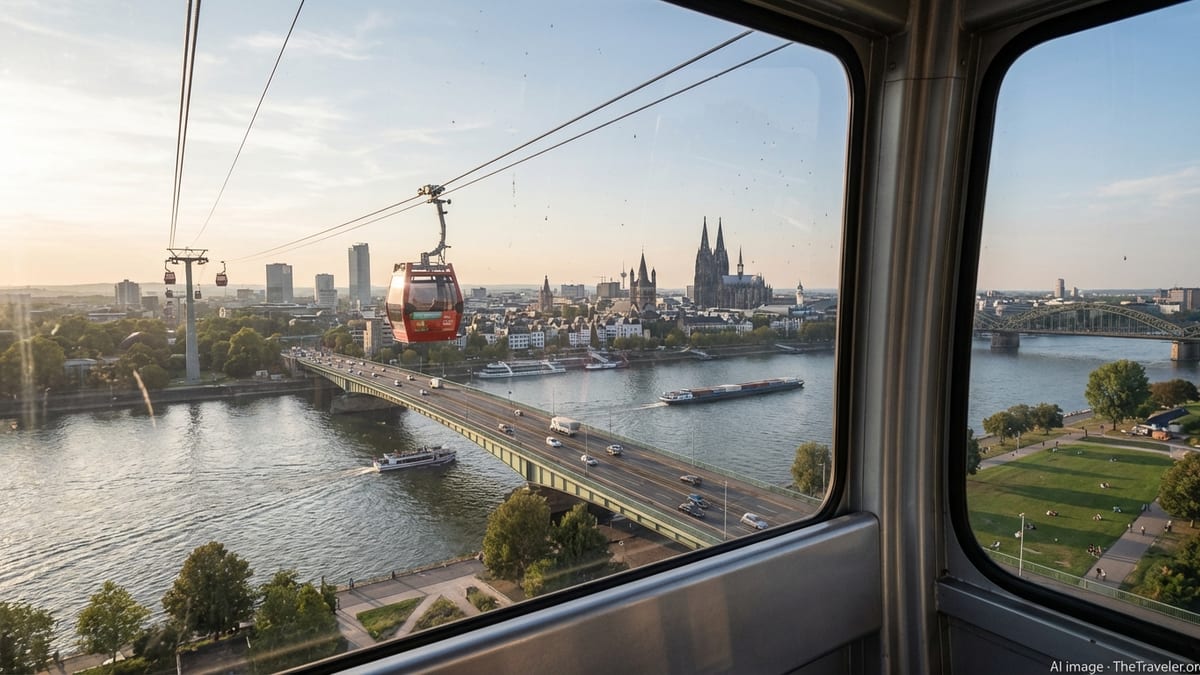
The Cologne Cable Car is short, but the variety of views it packs into those six minutes is remarkable. Looking upstream and downstream, you see the Rhine bending through the city, busy with container ships, excursion boats and river cruisers. The Zoobrücke runs almost parallel to the cable car, so you can gaze down at traffic streaming beneath you, an odd reversal of the usual perspective from the roadway.
To the southwest, the twin spires of Cologne Cathedral rise above the cityscape, an unmistakable silhouette on clear days. From mid river, the cathedral appears framed by the arches of the Hohenzollern Bridge and the lower skyline of the Old Town. On the opposite bank, the cluster of modern high rises in the Deutz district and the angular facade of the Kölntriangle tower complete a contrast between medieval and contemporary Cologne that is particularly photogenic at sunset.
Looking straight down, the river becomes a moving patchwork of wakes, reflections and industrial rhythms. Barges pass beneath the cabins, their containers and cars looking like toys from 50 meters up. On the west bank, you can spot the enclosures and treetops of the zoo and the geometries of the Flora’s formal beds. On the east bank, the Rheinpark spreads out as a broad green strip of lawns, pathways and play areas, often dotted with sunbathers, picnickers and cyclists when the weather is warm.
As you approach or depart the eastern station, there is a unique overhead view of the Claudius Therme spa complex. Pools, steam rising on cooler days and terraces are visible from above, although the cabins do not linger. In the evenings on special operating nights, the floodlit river, illuminated cathedral and reflections on the water create a completely different atmosphere, with the city’s nightlife beginning to flicker on below.
Operating Season, Tickets and Practical Details
The Cologne Cable Car is a seasonal attraction. In recent years it has typically operated from spring through autumn, closing over the colder months for maintenance and inspections. The exact dates adjust slightly each year, but broadly you can expect service from roughly March or April until late October or early November, with daily operations in the high summer months and more limited schedules in shoulder seasons. The winter break is when technicians carry out more extensive work on the cables, cabins and drive systems.
Within the season, operating hours usually cover the late morning to early evening, often starting around 10:00 and running until late afternoon or early evening on standard days. On selected dates in summer, the company organizes special night rides, keeping the system running until midnight or later for events such as a midsummer celebration or a themed “Night of the Cable Car.” Schedules are finalized ahead of each season, so it is worth checking the current timetable shortly before your visit.
Ticketing is simple and sold directly at each station. There is a choice between single and return tickets, with adult round trips priced in the mid to high single digits in euros and discounted tickets available for children. Families can usually benefit from combination offers or family tickets, while group arrangements can be prearranged for school classes or tour parties. Tickets are valid only on the day of purchase and for the particular direction or round trip indicated.
Boarding works on a continuous basis: cabins arrive every few seconds, so queues move steadily even at busy times. Passengers step into the slowly moving gondola from a level platform. Staff are on hand to steady the cabin and assist those who need more time. Once aboard, doors close automatically and the cabin accelerates to line speed as it exits the station. At the far side, the process is reversed. If you have bought a return ticket, you can disembark to explore the area or stay in the system and ride back immediately, provided staff permit continuous round trips during that time of day.
How the System Works
Behind its leisurely feel, the Cologne Cable Car is a finely engineered piece of transport infrastructure. The system uses a continuous loop of steel cable that both supports and moves the cabins. At one station sits the drive machinery: a large electric motor and gearbox that turn a bull wheel, setting the cable in motion. The cable loops around this wheel, then runs over the pylons and through the opposite station, where it wraps around a return wheel and tensioning system before heading back.
Each gondola is attached to the moving cable by a grip. In the station area, the cabins detach from the main cable and slow as they run along rails and small wheels driven at a much reduced speed. This allows passengers to board and alight safely. Just before the cabin leaves the station, its grip closes onto the main cable again, and it accelerates as it is pulled forward. The entire cycle is automated but overseen by trained staff from a central control desk.
Redundancy and emergency procedures are built into the system. If wind speeds exceed safe limits or if there is a technical fault, operators can slow or stop the line. Emergency brakes can hold the cable firmly if needed, and cabins are designed to be stable in a wide range of weather conditions. Regular inspections look for any signs of wear in the cable strands, wheels and grips, and the whole installation is subject to strict German and European safety regulations for passenger ropeways.
Power for the drive motor comes from the city’s electrical grid, and consumption is surprisingly modest relative to the number of passengers carried. When cabins are well loaded in both directions, the weight of descending cabins helps counterbalance those ascending, reducing net energy requirements. This is one reason cable cars are often considered efficient as short distance urban or tourist transport solutions, even if their capacity is lower than heavy rail or tram lines.
Planning Your Visit: Access and Best Times to Ride
Reaching the Cologne Cable Car is straightforward using public transport. On the west bank, the Zoo/Flora stop of Cologne’s light rail system sits a short walk from the station. This stop is served by one of the core tram lines that run north from the city center, making the cable car an easy add on to a day of sightseeing that includes the cathedral, Old Town and museum quarter. Buses serve the east bank station, stopping near the Claudius Therme and the entrances to Rheinpark.
For those arriving by car, parking is available on both sides of the river close to the Zoobrücke, although spaces can fill up on sunny weekends or during large events along the waterfront. Many visitors choose to approach on foot or by bicycle instead, following the riverside promenades and then taking the cable car as a scenic crossing. This allows you to enjoy both perspectives: the view from the water level before you ascend, and the broader panorama from the cabin once you are in the air.
In terms of timing, mid morning and late afternoon often provide the best balance between softer light and manageable crowds. On very warm days, the middle of the afternoon can be busy with families heading between the zoo and the park, so expect some queuing. Sunset rides are particularly popular when the schedule extends into the evening, as the western sky lights up behind the cathedral and the river gradually shifts from day to night. If you prefer a more tranquil experience, consider shoulder season weekdays in spring and early autumn, when tour group traffic is lighter.
Weather can influence visibility and comfort. The cabins are enclosed, but on hot days they can feel warm, especially under direct sun, and on cool days the glass can mist slightly. Light rain does not interrupt operations and can even add a moody character to the skyline, but operations may pause in high winds or storms for safety. Checking the day’s conditions and any service updates shortly before heading out helps avoid disappointment, especially if you are planning the ride as a centerpiece of your itinerary.
Pairing the Cable Car With Other Cologne Highlights
The true appeal of the Cologne Cable Car lies in how naturally it fits into a broader day out. On the west bank, the Cologne Zoo and the Flora Botanical Garden are among the city’s most family friendly attractions. It is easy to spend several hours exploring the animal enclosures, tropical house and landscaped gardens before walking a few minutes to the station for a ride across the river. This sequence works particularly well with children, turning the cable car into both a reward and a transition to a quieter afternoon.
On the east bank, the Rheinpark offers a spacious green refuge from the more compact streets of the center. Its lawns, play areas and riverside paths encourage slow wandering and picnics. The Claudius Therme, located just beyond the trees, is a popular thermal bath complex with indoor and outdoor pools, saunas and spa facilities. Combining a sky ride, a stroll along the Rhine and a few hours at the thermal baths makes for a relaxed, wellness focused day in the city.
Many visitors choose to cross the river by cable car in one direction and return by bridge. From the Rheinpark side, you can walk along the river toward the Hohenzollern Bridge, famous for its latticework of steel arches and dense clusters of love locks on the railings. Crossing on foot brings you directly to the platforms of Cologne’s main station and the cathedral square, allowing you to loop your day from zoo and park to the historic heart of the city without ever doubling back along the same route.
In the evening, special night operations open up additional possibilities. During event nights in summer, the cable car becomes a floating balcony on the city’s fireworks displays, festival lights or riverfront concerts. Because capacity is limited and nights like these are popular, it is wise to arrive early or pick a less crowded date if you want a quiet cabin for photography or contemplation. Either way, riding above the glittering river after dark is a memorable contrast to the daytime experience.
The Takeaway
The Cologne Cable Car may not be as famous internationally as the cathedral or the Christmas markets, but it is one of the city’s most rewarding small scale experiences. In just six minutes, it lifts you from everyday street level to a calm aerial corridor where the Rhine, the bridges and the skyline unfold in a way that no other viewpoint quite matches. Because it links a zoo, a botanical garden, a riverside park and a thermal spa, it also serves as a gentle backbone for a full day of leisurely exploration.
Understanding how the route is laid out, when it operates and how the system functions behind the scenes helps you make the most of your ride. Plan it around weather and light, pair it with a stroll along the river or a visit to nearby attractions, and allow yourself enough time to simply sit back in the cabin and watch Cologne flow past beneath your feet. The experience is short, affordable and uncomplicated, yet it offers a perspective on the city that many visitors remember long after more famous sights have blurred together.
FAQ
Q1: How long does a ride on the Cologne Cable Car take?
In normal operating conditions, a single crossing from one bank of the Rhine to the other takes around six minutes. That timing can vary slightly depending on speed adjustments made by operators, but the ride is designed to be slow enough for sightseeing rather than a quick commute.
Q2: When is the Cologne Cable Car open during the year?
The cable car usually operates seasonally from spring through autumn, with regular service roughly between March or April and late October or early November. It closes during the winter months for maintenance, inspections and any required upgrade work. Exact opening and closing dates are set each year based on conditions and maintenance schedules.
Q3: Do I need to book tickets in advance?
Most visitors simply buy tickets on the day at the station ticket counters. Because cabins circulate continuously and the system handles a steady flow of passengers, advance reservations are generally not necessary for individual travelers. Group bookings and special event rides, however, may require prior arrangements.
Q4: Is the Cologne Cable Car suitable for children and older travelers?
The ride is particularly popular with families and older visitors. The motion is gentle, the cabins are enclosed and the height, while significant, is usually experienced as scenic rather than extreme. Boarding platforms are level with the cabin floor, and staff can assist anyone who needs extra time getting on or off.
Q5: Can I bring a stroller, wheelchair or bicycle into the cabin?
Compact strollers and folded wheelchairs can often be accommodated, but space inside each four person cabin is limited. Large prams, mobility scooters and full size bicycles generally cannot fit. If you are traveling with mobility equipment, it is wise to speak with staff at the station before purchasing tickets to confirm what is possible on the day.
Q6: What happens if the weather is bad or the wind is strong?
The cable car operates in light rain and normal wind conditions, but strong winds, thunderstorms or very poor visibility can lead to temporary service suspensions for safety reasons. If a storm approaches while cabins are in motion, operators can slow or stop the line and, if necessary, initiate procedures to bring all cabins safely back to the stations.
Q7: How much does it cost to ride the Cologne Cable Car?
Ticket prices are set in euros and offer different categories for adults, children and families. As a rough guideline, an adult return ticket is typically priced in the mid to high single digits, with children paying a reduced rate and some special offers available for families or groups. Prices are reviewed from time to time, so checking the current tariff before your visit is recommended.
Q8: How do I get to the cable car by public transport?
On the west bank, you can reach the cable car via the Zoo/Flora stop on Cologne’s light rail network and a short walk to the station near the zoo entrance. On the east bank, bus routes serving the Claudius Therme and Rheinpark area stop close to the station there. Both sides are also accessible on foot or by bicycle along the riverside promenades.
Q9: Is the Cologne Cable Car safe?
The system has an excellent safety record and is subject to stringent German and European regulations for passenger ropeways. Regular inspections, maintenance cycles, emergency braking systems and continuous monitoring from a central control room all contribute to a high level of operational safety. The ride feels calm and controlled rather than fast or exposed.
Q10: Can I use the Cologne Cable Car as a way to see the city at night?
On selected dates, especially in summer, the operator runs special night rides during events or themed evenings, keeping the cable car running well after sunset. On such nights, the illuminated skyline, cathedral and riverfront create an entirely different atmosphere from daytime crossings. Because these evenings can be popular, arriving early or choosing a less busy date helps ensure a more relaxed experience.