

Thailand offers a range of visa options for foreign residents, but its immigration framework is highly rule‑bound and frequently updated. Many otherwise well‑prepared expats encounter avoidable problems because they misunderstand visa validity, overstay limits, reporting duties, and work authorization rules. This briefing outlines the most common visa mistakes foreigners make when relocating to Thailand and explains their practical consequences for long‑term stay planning.
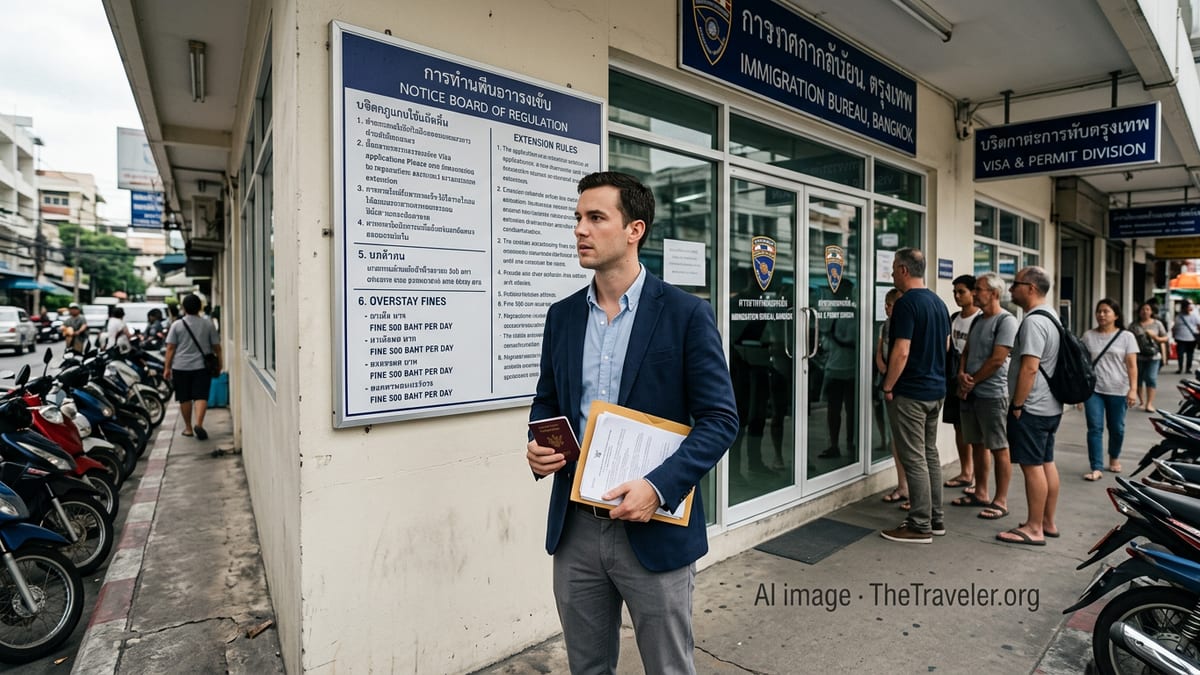
Misunderstanding Visa Validity, Permission to Stay and Extensions
A primary source of confusion for new arrivals is the distinction between visa validity, the permitted stay stamp, and any subsequent extensions. A single‑entry tourist visa, for example, may be valid for 90 days from issuance but typically confers only a 60‑day stay from the date of entry, which can usually be extended once in Thailand by approximately 30 days. Treating the visa validity date as the departure deadline leads some expats to unintentionally remain in Thailand after their stamped permission to stay has already expired.
Similar misunderstandings occur with non‑immigrant categories used for work, retirement, or family reasons. These visas often allow entry within several months, but the actual permission to stay is based on the entry stamp and any annual extensions issued by immigration inside Thailand. Assuming that the visa sticker alone guarantees a full year in the country, without checking the entry stamp and extension dates, is a recurrent error that can create hidden overstays.
Another recurrent mistake is failing to align extension dates with travel plans. When expats apply for long‑stay extensions close to their expiry date, they sometimes book international trips that fall just after their current permission to stay ends, assuming the extension will be processed in time. If documents are incomplete and the extension is delayed or refused, the person can unknowingly move into overstay status while still in the country, or discover the problem only when attempting to exit at the border.
For decision‑making purposes, anyone planning relocation to Thailand should treat the passport entry stamp and subsequent extension stamps as the operative controls on lawful presence. Visa stickers in the passport primarily regulate the right to apply for entry; they do not independently guarantee a full year of stay or full flexibility to come and go.
Overstaying and Miscalculating Day Limits
Overstaying remains one of the most common and consequential visa mistakes for foreigners in Thailand. As of recent regulations, the standard administrative fine is approximately 500 Thai baht per day of overstay, usually capped at 20,000 baht when the individual voluntarily presents at an airport to leave the country. However, this cap may not apply if the person is arrested inland or attempts to exit via certain land borders, in which case the per‑day fine can be applied without a strict maximum and additional penalties may follow.
Beyond fines, longer overstays can trigger entry bans. A structured ban regime applies, with shorter overstays leading to bans of roughly one year and longer or repeated overstays resulting in multi‑year exclusions. For instance, overstay detected at an immigration checkpoint of more than 90 days may lead to a one‑year entry ban, while multi‑year illegal presence can produce bans of up to 10 years. While specific thresholds can evolve, the direction of policy has consistently been toward harsher treatment of extended or deliberate overstay.
Another frequent problem involves cumulative day counting. Expats who rely on visa‑exempt entries or short tourist visas sometimes miscalculate the number of days actually spent in Thailand, particularly when crossing borders multiple times in a calendar year. Airline schedules that arrive close to midnight and border queues that delay stamping can also create ambiguity about whether a particular night counts as an extra day. Treating 30‑day or 60‑day permissions as approximations instead of fixed daily counts exposes travelers to inadvertent single‑day overstays, which nonetheless can still incur fines.
For individuals evaluating a longer‑term relocation, the operational implication is that Thailand expects strict compliance with day limits. Overstay, even by a small margin, is recorded in the immigration database and may be considered in future visa applications, including non‑immigrant categories. A relocation plan that relies on cycling short‑term permissions without careful date tracking carries elevated compliance risk.
Ignoring 90‑Day Reporting and Address Notification Duties
Foreigners who hold temporary long‑stay permission in Thailand are subject to a recurring 90‑day address reporting obligation. Under the Immigration Act, anyone staying in Thailand on a non‑immigrant basis for more than 90 consecutive days must confirm their current residential address with immigration every 90 days. This requirement applies to long‑term categories such as retirement, education, and work‑related stays, and it is separate from any visa extension or reentry rules.
The timing rules are precise. Current practice generally allows reporting during a window that starts 15 days before the 90‑day deadline and ends seven days after it. Reporting can be done in person, by authorized representative, by registered mail, or via online channels after an initial in‑person report. Many expats mistakenly assume that extending a visa or work authorization automatically satisfies 90‑day reporting, or that exiting and re‑entering slightly resets the clock without further action. In reality, leaving Thailand does reset the 90‑day count, but once back in the country the obligation starts again from the new entry date.
Failure to complete the 90‑day report on time can result in fines that typically range from around 2,000 to 5,000 baht, and late reporting discovered during an immigration check can be treated more seriously than voluntary late compliance at the counter. Moreover, unresolved 90‑day reporting lapses can complicate future extensions of stay or work permit processes, because immigration officers may decline to process an application until the reporting backlog and associated fines are cleared.
For relocation planning, the key mistake to avoid is treating Thailand as a country where long‑term foreign residents only interact with immigration once per year. In practice, an expat whose relocation visa strategy depends on annual extensions should also factor in the quarterly administrative obligation of 90‑day reporting and maintain personal systems or reminders to avoid inadvertent non‑compliance.
Misunderstanding TM30 and Landlord Reporting Responsibilities
Thailand operates a parallel reporting regime known as TM30, a notification of residence for foreigners. Under this system, property owners, hotel operators, and other accommodation providers must notify immigration when a foreign national comes to stay at their premises. While the legal duty primarily falls on the landlord or accommodation operator, expats routinely encounter practical consequences when TM30 obligations are not met, particularly during visa extensions and 90‑day reporting.
Common mistakes include assuming that TM30 is only a hotel process and does not apply to private rentals; presuming that a Thai landlord has already fulfilled the obligation; or not understanding that a change of address in Thailand may trigger a new TM30 notification requirement. In some cases, landlords decline to file TM30 at all, exposing themselves to potential fines of up to several thousand baht or more depending on enforcement practice. However, expats then discover at immigration that certain services, such as converting visas, extending non‑immigrant stays, or completing 90‑day reports, require a record of current TM30 compliance for their address.
Another misunderstanding concerns the interaction between TM30 and 90‑day reporting. Some expats attempt to update their residential address only when making the 90‑day report, even if they moved weeks earlier. Although practices can vary among local offices, the general expectation is that the accommodation provider files a TM30 within a short period of the foreigner’s arrival at a new address, often referenced as within 24 hours, while the foreigner then continues regular 90‑day reporting for as long as they lawfully remain in Thailand. Treating these filings as interchangeable can lead to data inconsistencies that immigration officers may require the applicant to resolve first, delaying other processes such as work permit applications or extensions.
For individuals evaluating longer‑term residence, TM30 compliance risks are material because they depend on a third party, usually the property owner. Before committing to a rental, expats should explicitly confirm that the landlord is willing and able to comply with TM30 reporting and should understand that failure to do so may not only expose the owner to fines but can indirectly hinder the tenant’s own immigration procedures.
Working Without Proper Authorization or Misusing Visa Categories
Another critical visa‑related mistake involves misunderstanding the relationship between right of residence and right to work. In Thailand, holding a non‑immigrant visa or long‑stay permission does not automatically authorize employment or income‑generating activity. Separate work authorization, typically in the form of a work permit or digital equivalent under the Foreigners Working Management framework, is usually required for most forms of employment or business activity carried out in Thailand.
Common errors include performing paid work, consulting, or managing a business on a tourist visa; using education or volunteer visas as de facto work permits; or assuming that remote work for a foreign employer is categorically permitted without restriction. While enforcement priorities can shift, Thai authorities have periodically conducted checks on workplaces and co‑working spaces, and foreigners found working on inappropriate visa types can face fines, cancellation of permission to stay, deportation, and future entry bans. Employers can also be fined for hiring foreigners without proper authorization.
Another frequent issue is misaligning the chosen visa category with the actual purpose of stay. For example, some expats enter initially on a tourist visa while informally working for a local company in anticipation of a later conversion to a work‑based non‑immigrant visa. If the conversion is delayed or refused, the person may have already breached the law by working without authorization. Similarly, using retirement visas while actively managing local businesses or providing services can draw unwanted scrutiny, particularly when combined with banking, tax, or social media evidence of ongoing economic activity in Thailand.
From a relocation planning perspective, any long‑term stay that will involve employment, freelance work, or active business management should be designed around a compliant combination of non‑immigrant visa category and work authorization. Treating Thai visas as generic long‑stay passes while engaging in economic activity is a structural compliance risk that can jeopardize the entire relocation.
Reentry Permit, Border Runs and Change‑of‑Status Challenges
A further class of mistakes occurs when expats travel in and out of Thailand while holding long‑stay extensions of non‑immigrant visas. Many extension stamps are single‑entry, meaning that if the holder leaves Thailand without first obtaining a reentry permit, the existing permission to stay is automatically canceled upon departure. The individual then re‑enters on whatever status is available at the border, often a short visa‑exempt stay, and discovers that the previous long‑stay extension is lost and must be rebuilt from scratch.
This risk is particularly high for foreigners based in Thailand who travel regionally for work or family reasons. Forgetting to apply for a reentry permit before departure effectively erases the long‑term visa strategy and may force the person back into a cycle of short‑term entries, each of which may have an upper annual limit or be subject to heightened questioning by border officials if used repeatedly. Reentry permits can usually be issued as single‑use or multiple‑use documents, but they must align with the underlying permission to stay and be obtained before leaving.
Another mistake is relying excessively on short‑notice border runs to maintain presence in Thailand instead of structuring a sustainable long‑term visa. While short exit‑and‑reentry trips can sometimes reset a tourist or visa‑exempt stay, Thai immigration has progressively tightened scrutiny of individuals who appear to reside in the country through repeated short‑term entries. Outcomes can include shortened permissions, denial of entry, or instructions to obtain an appropriate non‑immigrant visa at a consulate abroad before returning.
Change‑of‑status applications filed within Thailand also present risks when expats assume approval is automatic. For example, converting from a tourist visa to a non‑immigrant category for work or study usually requires meeting specific eligibility criteria, documentation from local sponsors, and minimum remaining validity on the current permission to stay. Misjudging processing times, incomplete documentation, or filing too close to expiry can all result in the person needing to leave Thailand and reapply from abroad, disrupting relocation timelines and employment start dates.
The Takeaway
Viewed collectively, the most common visa mistakes made by expats moving to Thailand share a consistent characteristic: underestimating the precision and interconnectedness of the country’s immigration rules. Overstays arise from small miscalculations of day counts. Long‑stay permissions are lost because reentry permits were not obtained before travel. Reporting duties are overlooked because they are perceived as optional rather than mandatory. Work is performed on the assumption that any long‑stay visa implicitly allows economic activity.
For individuals and employers evaluating relocation feasibility, a sustainable presence in Thailand depends less on discovering a single “best” visa and more on maintaining continuous compliance across multiple elements: permission to stay dates, reentry control, 90‑day and TM30 reporting, and appropriate work authorization. The financial penalties for non‑compliance are material but usually secondary to the potential long‑term impact of immigration records that show overstay, unauthorized work, or chronic reporting failures.
Relocation plans that anticipate these compliance requirements from the outset, allocate administrative time to meet them, and avoid reliance on improvised border runs or informal work arrangements are significantly more likely to result in stable residence in Thailand. Conversely, treating visa rules as flexible guidelines rather than binding conditions of stay can quickly undermine even well‑resourced relocation strategies.
FAQ
Q1. What is the most common visa mistake new expats make in Thailand?
One of the most frequent errors is confusing the visa validity period with the actual permission to stay stamped in the passport, then using the longer date as the basis for travel planning. This leads to inadvertent overstays when the entry stamp or extension expires earlier than the visa sticker itself.
Q2. How serious is a short overstay of just one or two days?
Even a one‑ or two‑day overstay is a technical violation that normally results in a fine at departure, often calculated at around 500 baht per excess day. While such short overstays usually do not trigger entry bans, they are recorded in immigration systems and may be viewed negatively if similar issues recur.
Q3. Does extending my visa automatically satisfy the 90‑day reporting requirement?
No. Visa extensions and 90‑day address reporting are separate obligations. Extending a non‑immigrant stay does not reset or cancel the requirement to report your address every 90 days, unless travel outside Thailand has reset the 90‑day count.
Q4. If my landlord refuses to submit a TM30, can it affect my visa processes?
Yes. Although the legal duty to file TM30 lies with the accommodation provider, immigration officers often expect to see up‑to‑date TM30 records before processing services such as 90‑day reports or extensions. A landlord’s non‑compliance can therefore delay or complicate your own immigration procedures.
Q5. Can I work remotely for a foreign employer while on a tourist or retirement visa?
Thai rules distinguish between right of stay and right to work, and the legal position on remote work is complex. Assuming that any economic activity is automatically allowed on a tourist or retirement visa can be risky, and expats should treat paid or business‑related activities cautiously unless covered by appropriate work authorization.
Q6. What happens if I leave Thailand without a reentry permit while on a long‑stay extension?
In most cases, leaving without a reentry permit cancels your existing permission to stay, so when you re‑enter you do so on a new, shorter‑term status such as a visa‑exempt entry. The previous long‑stay extension is effectively lost and must be re‑established.
Q7. Do frequent border runs remain a reliable way to live long term in Thailand?
Relying on back‑to‑back visa‑exempt entries or short tourist visas has become progressively less reliable. Immigration officers may shorten stays, question intentions, or refuse entry if they believe someone is effectively residing in Thailand without an appropriate long‑term visa.
Q8. How strictly is 90‑day reporting enforced for long‑term expats?
Enforcement intensity can vary by location, but the legal obligation is clear and fines for late reporting are widely applied. Immigration offices can also refuse to process other services until outstanding 90‑day reports are completed and related fines are paid.
Q9. Does moving to a new apartment require a new TM30 filing every time?
Yes. A change of residential address in Thailand typically requires a new TM30 notification from the property owner or manager. Not updating TM30 after a move can cause discrepancies in immigration records when you later complete 90‑day reporting or apply for extensions.
Q10. What is the safest general approach to avoid visa problems when relocating to Thailand?
The safest approach is to choose a visa category that accurately reflects your primary purpose of stay, track all permission‑to‑stay and reporting dates carefully, obtain reentry permits before travel, ensure TM30 compliance at each residence, and avoid any form of work until proper work authorization is in place.