

More news on this day
Germany’s leisure carrier Condor is preparing a major shake-up at Frankfurt Airport, confirming plans to move from its long-time base in Terminal 1 to the brand-new Terminal 3 in summer 2027, a strategic relocation that will reshape passenger flows and redefine how millions of holidaymakers begin their trips from Germany’s busiest hub.
From Lufthansa’s Shadow to a Standalone Hub
The decision to relocate Condor’s Frankfurt operations marks the clearest break yet from its historic dependence on former partner Lufthansa. For years, Condor passengers benefited from coordinated transfer flows and preferential handling at Terminal 1, where seamless connections onto Lufthansa’s European and long-haul network were part of the airline’s appeal.
Tensions escalated during and after the pandemic, when Lufthansa launched its own leisure subsidiary and gradually dismantled special arrangements that had once favored Condor passengers. Legal disputes followed, but the underlying commercial reality had already shifted: Condor accelerated the development of its own feeder network and increasingly focused on point-to-point holiday traffic rather than relying on Lufthansa for onward connections.
By the time Terminal 3 opens to passengers in April 2026, Condor’s transfer volumes with Lufthansa will already be a fraction of pre-crisis levels. The 2027 move is therefore less a sudden rupture and more a logical next step in Condor’s evolution into a fully independent leisure carrier with its own identity, its own network strategy and, soon, its own dedicated base in Frankfurt’s newest terminal complex.
For Lufthansa and its Star Alliance partners, the shift helps preserve Terminal 1 as a tightly integrated hub for higher-yield connecting traffic. For Condor, it offers the chance to step out of Lufthansa’s shadow and operate from an environment that can be tailored around leisure travelers rather than complex alliance-driven transfer flows.
What Terminal 3 Will Look and Feel Like for Condor Passengers
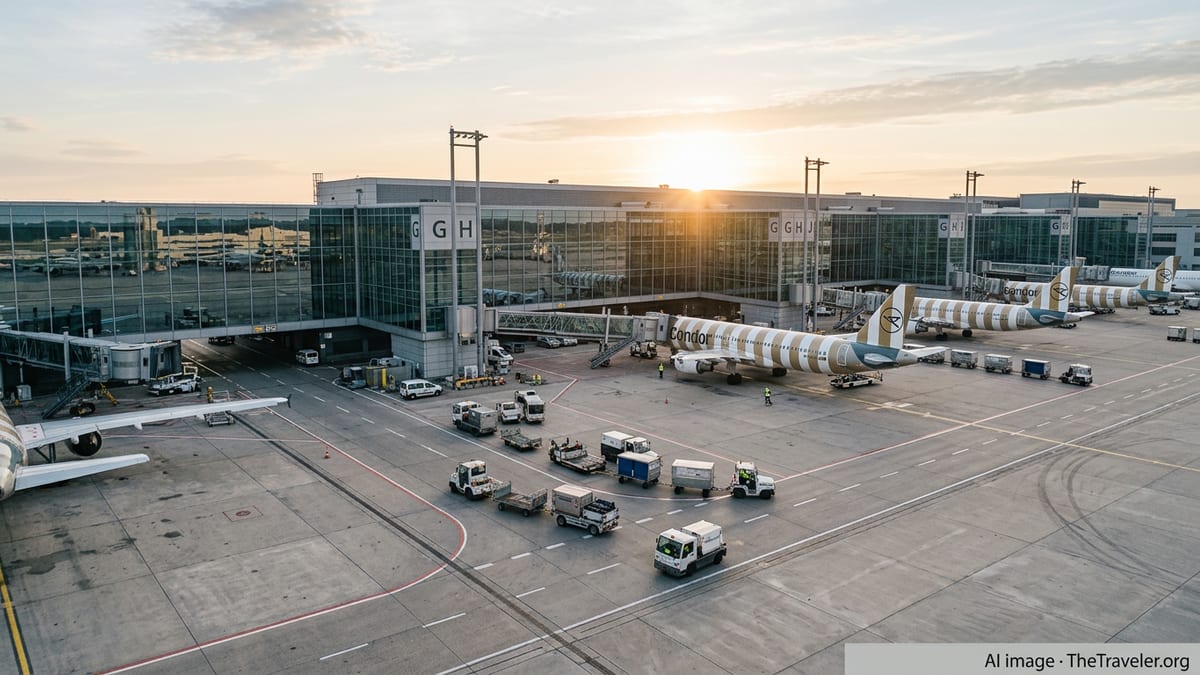
Frankfurt’s Terminal 3 is one of Europe’s biggest privately financed airport projects, a multibillion-euro investment designed to add capacity for up to 19 million passengers annually in its initial phase and eventually up to 25 million as additional modules come online. The complex, located in the southern section of the airport, features three piers labeled G, H and J, linked to the existing terminals by a new Sky Line people mover and extensive road and bus connections.
For Condor customers, the move promises a marked upgrade in the ground experience. The terminal has been designed around fast, largely digital processes, including extensive self check-in options, fast bag-drop facilities and 21 security lanes equipped with modern CT scanners that allow bags to be screened without unpacking laptops or liquids. The aim is to cut waiting times and make the start of a holiday feel calmer and more predictable, even at peak periods.
Inside, travelers will find 12,000 square meters of retail and dining space, with a mix of international brands and local concepts positioned along bright, high-ceilinged concourses. Fraport, the airport operator, has emphasized natural light, clear wayfinding and generous seating areas with power outlets, reflecting a broader trend across European hubs to make terminals feel more like contemporary public spaces than purely transit infrastructure.
While Condor’s exact layout within Terminal 3 has yet to be finalized, industry expectations point to a concentration of check-in counters, self-service islands and gates that cluster the airline’s short- and long-haul operations. That will allow the carrier to optimize boarding, turnaround times and staffing, and potentially introduce dedicated service areas for package holiday customers and premium cabin travelers.
How and When the Move Will Happen
Terminal 3 is due to open to commercial traffic in April 2026, with the first passenger flights operating shortly after the inauguration. Over the subsequent weeks, 57 airlines now based in Terminal 2 will move across in four waves, allowing the operator to test systems, baggage flows and transport links under real-world conditions while limiting the risk of large-scale disruption.
Condor, currently the airport’s second-largest customer with a fleet of around 60 aircraft, is scheduled to follow in a later phase, relocating from Terminal 1 to Terminal 3 in summer 2027 once the new facility has been running for more than a year. This timetable gives both the airline and the airport time to fine-tune processes, learn from the earlier airline moves and build out the Sky Line link and ground transport options to better handle Condor’s peak holiday waves.
Operationally, the transfer is likely to be staged over several days or weeks, with specific flights and destinations switching terminals according to a pre-announced plan. Passengers will be urged to pay close attention to their booking confirmations, boarding passes and pre-departure messages, as two Condor flights on the same route could depart from different terminals during the transition window.
Behind the scenes, the shift will require a complex migration of check-in systems, gate allocations, crew reporting points and aircraft stands. Training for airport and handling staff at Terminal 3 is already underway in preparation for the 2026 opening; Condor-specific procedures will be layered onto that foundation ahead of the 2027 move.
What It Means for Connections and Ground Transport
One of the most immediate impacts for travelers will be the change in connectivity. Today, Condor flights at Terminal 1 sit side by side with Lufthansa services, making self-organized connections relatively straightforward even without a formal through-ticket. Once Condor is based at Terminal 3, those quick cross-terminal dashes will no longer be possible in the same way.
Although the Sky Line people mover will link Terminal 3 with the rest of the airport campus, transfer times will increase and passengers who still choose to connect onto Lufthansa or other Star Alliance carriers at Terminal 1 will need to allow more time. Condor, however, has steadily built up its own network of short-haul feeders within Europe, and industry observers expect the airline to focus on connections within its own portfolio rather than relying on ad-hoc interlining at Frankfurt.
On the ground, passengers can expect new access patterns. Terminal 3 will be served by dedicated road links, parking facilities and bus connections to Frankfurt, Darmstadt and other cities in the Rhine-Main region. Long-distance bus operators are also expected to integrate the new terminal into their schedules, reflecting how airports increasingly function as multimodal hubs. For rail users, Frankfurt Airport’s existing regional and long-distance stations will remain concentrated near Terminals 1 and 2, making the Sky Line a key part of the last leg to Condor check-in.
For many holidaymakers, the trade-off will be clear: slightly longer transfers within the airport in exchange for a modern terminal experience with shorter queues, more space and a leisure-focused environment. As airlines across Europe jostle for position in the lucrative sun-and-sand market, Condor is betting that a smoother, more pleasant start to the journey from Frankfurt will help it stand out in a crowded field.
What Travelers Should Do Now
For trips departing before the summer 2027 switchover, Condor passengers will continue to use the familiar Terminal 1 infrastructure in Frankfurt. However, as Terminal 3 enters service for other airlines from April 2026, anyone planning complex itineraries through the airport should double-check which terminal each segment uses, as Frankfurt’s layout will become more segmented by airline group and alliance.
As the move date approaches, Condor and Frankfurt Airport are expected to roll out detailed passenger information campaigns, including updated terminal guidance on booking confirmations, mobile apps and airport signage. Travelers should pay particular attention to check-in cut-off times and recommended arrival windows, as those may be adjusted to reflect the new access routes and security set-up at Terminal 3.
Tour operators selling package holidays on Condor flights will also play a key role in communicating the change. In practical terms, this could range from revised airport transfer instructions in travel documents to on-the-spot guidance from reps at resorts and hotels, especially in markets where Frankfurt is a major gateway for long-haul leisure traffic.
For now, the main message for travelers is awareness. Frankfurt Airport is on the cusp of its biggest structural change in decades, and Condor’s high-profile move to Terminal 3 in 2027 is a central piece of that transformation. Passengers who stay informed, verify their terminal information before departure and allow a little extra time for wayfinding will be best placed to benefit from the modernized facilities and a reimagined start to their holidays.