

More news on this day
Europe’s cutthroat short-haul market is entering a new phase as Germany’s Condor Airlines accelerates its shift from traditional leisure specialist to full-spectrum competitor, positioning itself directly against low-cost giants Wizz Air, easyJet and Ryanair in a battle for dominance across the continent.
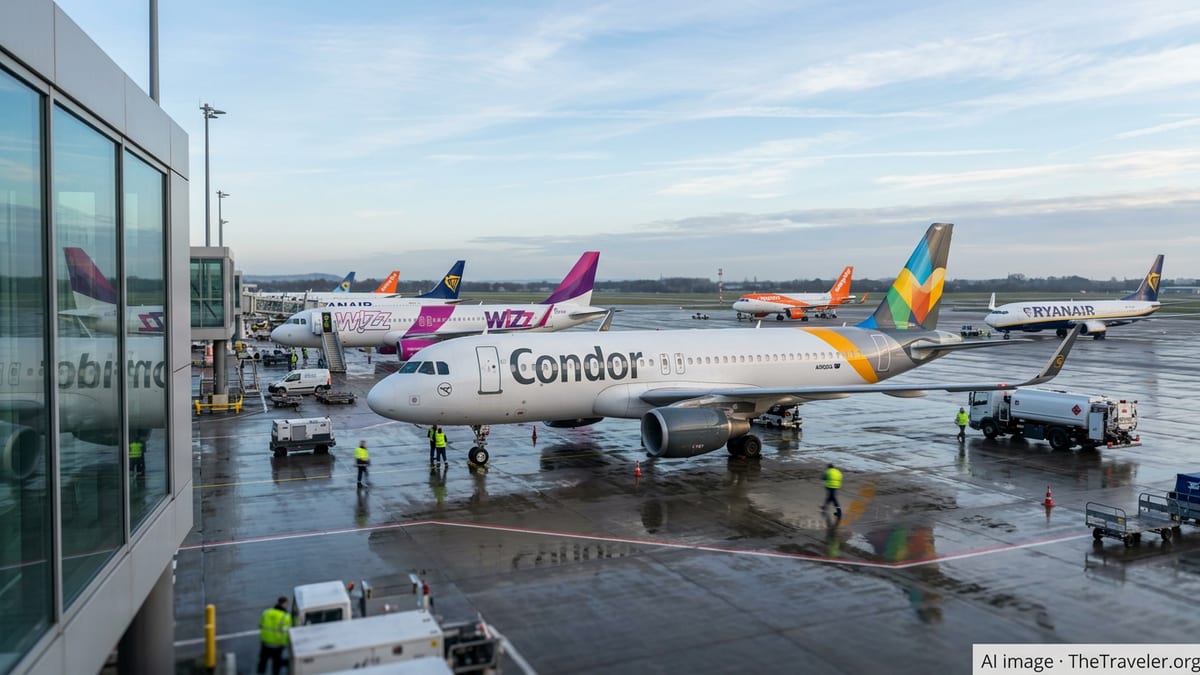
Condor Reinvents Itself as Germany’s Last Independent Challenger
Long seen as a classic package-holiday airline, Condor is rapidly recasting itself as a broader European player. The carrier has completed its transition to an all-Airbus fleet, retiring its final Boeing 757-300 in November 2025, a symbolic break with its charter-focused past and a move that aligns it more closely with the streamlined fleets of its low-cost rivals.
At the same time, Condor is pushing beyond pure beach traffic. It has started building a web of European city routes from Frankfurt, expanding into major metropolitan destinations such as Rome, Milan, Prague, Vienna and Zurich, while also adding domestic services inside Germany. The strategy signals that Condor is no longer content to leave year-round point-to-point city traffic to Ryanair, easyJet and Wizz Air.
German regulators have long noted Condor’s role as a critical leisure player, historically holding a mid-teens share of the German holiday travel market and acting as a consolidator for thousands of tour operators. Now, by bolstering its presence in cities and adding higher-frequency flying, Condor is edging toward the space occupied by Europe’s ultra-low-cost carriers, while still leaning on its strong tour operator relationships.
Condor also continues to invest in long haul. The airline has been adding Airbus A330-900neo widebodies, focusing on fuel efficiency and lower operating costs on routes to the Americas, Africa and Asia. Management has confirmed that it is studying the long-range Airbus A321XLR for future narrowbody expansion, an aircraft type that could allow Condor to serve thinner leisure and city routes at lower cost, potentially mirroring strategies already deployed by its rivals.
Ryanair, Wizz Air and easyJet Keep Turning Up the Heat
Condor’s evolution comes as Europe’s low-cost heavyweights continue to flood the market with capacity. Ryanair remains the continent’s largest airline by flights, operating more than 3,000 daily services in 2025 and maintaining traffic levels around 40 percent above pre-pandemic volumes. Its deep order book of Boeing 737 aircraft and relentless cost focus have allowed it to outgrow many legacy rivals and defend its leading position in southern and eastern Europe.
Wizz Air is also expanding aggressively from its core central and eastern European hubs. Industry data show that the carrier has been one of the fastest-growing airlines in the region, with double-digit capacity increases in several quarters and strong seat growth forecast into early 2026. The airline has boosted capacity at key airports such as London Luton, Budapest and Rome Fiumicino, and has refocused on its European heartland after winding down operations at its Abu Dhabi joint venture.
easyJet, meanwhile, remains a dominant force in the intra-European point-to-point market, anchored by its large presence at slot-constrained airports such as London Gatwick, Geneva and Amsterdam. Although analysts have recently flagged softer fares, rising costs and intense competition weighing on profitability, easyJet continues to grow capacity, adding around high-single-digit percentage increases in available seats and sharpening its focus on higher-yield leisure and city-break traffic.
Together, these three low-cost groups control much of the continent’s short-haul capacity, especially from secondary airports and holiday destinations. Condor’s push into city routes and year-round flying therefore drops it straight into their lane, particularly in markets such as Italy, Spain and central Europe where holiday and city-break demand increasingly overlap.
Germany Becomes a Crucial Battleground
Germany is shaping up as one of Europe’s most contested aviation markets. Following the collapse or retrenchment of several competitors over the past two decades, Condor has emerged as the country’s only sizable independent airline not backed by a major group. Studies commissioned by German authorities highlight that many European low-cost carriers have pared back domestic flying in Germany, creating space for Condor to step in even as they remain formidable rivals on cross-border leisure routes.
Ryanair and Wizz Air have both scaled back from some German airports in recent years, while easyJet has rebalanced its network away from weaker domestic routes. That has left Lufthansa and Eurowings dominant on much of the domestic feed, but it also presents an opening for Condor to offer direct services from German cities to sun destinations and nearby capitals without relying on alliance connections.
By launching new Frankfurt-based services to Rome, Milan, Prague and other cities, and by planning additional city destinations such as Barcelona, Budapest, London and Venice, Condor is seeking to bind Germany more tightly into its own network. This plays to its core customer base of German leisure travelers while nudging into the territory of low-cost rivals that have traditionally carried much of the outbound holiday traffic.
Yet the move also raises the stakes. Ryanair, Wizz Air and easyJet remain highly capable of redirecting aircraft capacity back into Germany if pricing and demand justify it. Any sustained attempt by Condor to hold or grow market share on popular European city and beach routes risks provoking a renewed capacity response from the ultra-low-cost carriers, potentially intensifying price competition at a time when yields are already under pressure.
Capacity Surge Meets Cost Pressures Across Europe
Across Europe, the capacity race is colliding with a tougher revenue environment. Air traffic data for 2025 show that low-cost carriers such as Ryanair and Wizz Air are operating substantially more flights than before the pandemic, while easyJet has largely recovered and in some cases exceeded its 2019 activity. Analysts warn that this surge in available seats, combined with consumer sensitivity to higher living costs, is straining fare levels on many routes.
Investment banks have recently sounded a cautious note on European airlines, pointing to weaker unit revenues and rising costs for fuel, labour and airport charges. In particular, they have highlighted the risk that sustained high single-digit or double-digit capacity growth from low-cost carriers could push short-haul yields lower, especially on routes where multiple players chase the same price-conscious travelers.
For Condor, which historically relied on relatively stable tour-operator contracts and package holiday bookings, competing more directly with the low-cost giants on standalone tickets adds a new layer of risk. Matching their headline fares while absorbing higher input costs will require continued focus on fleet efficiency, tight cost control and disciplined capacity planning across both leisure and city networks.
At the same time, the broader competitive pressure may accelerate consolidation or force airlines to differentiate more sharply. Legacy groups are leaning on premium cabins and long-haul connectivity, while ultra-low-cost carriers double down on bare-bones pricing. Condor is attempting a hybrid path, aiming to blend low unit costs and dense Airbus narrowbody cabins with a stronger brand presence, a long-haul leisure portfolio and deeper ties to the package travel sector.
The Battle for Europe’s Leisure Traveler Enters a New Phase
The intensifying competition is ultimately about who owns the European leisure customer. Ryanair, Wizz Air and easyJet have already reshaped travel habits, encouraging passengers to book flights independently, mix and match airports and chase flash sales. Their growing networks from regional and secondary airports continue to undercut traditional charter patterns, especially for short and medium-haul holidays.
Condor’s counter is to broaden its offering while holding on to its package holiday DNA. Its all-Airbus fleet, refreshed cabins and growing slate of city routes are designed to give travelers more reasons to stay within the Condor ecosystem year-round, rather than only during peak summer beach season. By offering both standalone tickets and integrated packages, the airline aims to capture passengers looking for a balance of price, reliability and service.
How far Condor can push into the territory of the low-cost titans without triggering a damaging price war remains an open question. Much will depend on how quickly it can scale its new European network, whether it proceeds with long-range narrowbodies such as the A321XLR, and how aggressively Ryanair, Wizz Air and easyJet defend their positions on key leisure corridors.
What is clear is that Europe’s aviation map is still shifting. With Condor stepping more firmly into the low-cost arena while preserving its role as Germany’s leading leisure specialist, passengers are likely to see even fiercer competition for their holiday budgets, more route choices and, at least in the near term, continued pressure on fares as airlines fight for ultimate domination of the continent’s skies.