

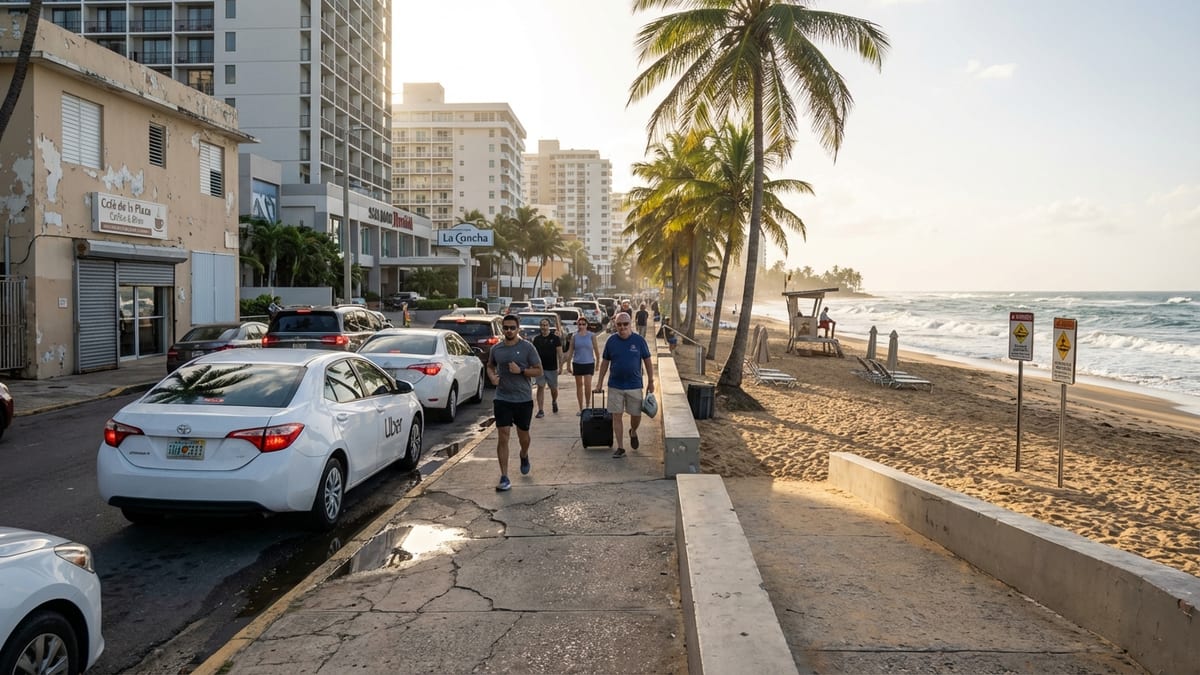
I had heard people talk about Condado as “the Miami Beach of San Juan,” a polished strip of sand, hotels and restaurants that promised a convenient base for exploring Puerto Rico’s capital. When I finally stayed there myself, I learned that description is both accurate and misleading.
Condado is comfortable, busy and efficient in many ways, but it also has rough edges, compromises and a few frustrations that you do not see on glossy hotel websites. If you are deciding whether to stay in Condado, here is what it actually felt like to base myself there, what worked, what annoyed me and what I would do differently next time.
First Impressions: Polished, Urban and A Little Anonymous
Arriving in Condado, I was struck by how urban it felt. The neighborhood is essentially a slender peninsula between the Atlantic Ocean and the Condado Lagoon, with Ashford Avenue running like a spine through high-rise hotels, condo towers, chain restaurants, casinos and a scattering of local spots. It felt more like a compact resort district in a U.S. city than some romantic Caribbean hideaway. I could see why many American visitors choose it: it felt familiar, relatively safe and easy to navigate from the first evening.
That ease came with a tradeoff. From my hotel balcony I could see the ocean, but I could also hear constant traffic from Ashford, honking horns and the whoosh of buses. At street level, the sidewalks were busy with tourists, joggers and Uber drivers pulling over wherever they pleased. At times I felt like I could have been in parts of Miami or Fort Lauderdale, just with more Spanish on the signs and a saltier breeze. If you are expecting a charming, historic Caribbean town, Condado will not give you that feeling; it is more of a functional, beach-adjacent city strip.
On the plus side, Condado felt welcoming from the start. Staff at hotels and restaurants slipped easily between Spanish and English, menus were bilingual and I never felt judged for asking clumsy questions. At the same time, there was an unmistakable sense that the area has been reshaped around tourism. Many of the businesses and even some apartment buildings are clearly oriented toward visitors and short-term rentals rather than long-term community, which changes the character of the neighborhood in ways I felt but only gradually understood.
The Beach Reality: Beautiful to Look At, Tricky to Use
Before going, I imagined Condado as a place where I would wander down from my hotel and float lazily in calm turquoise water every day. The real beach experience turned out to be more complicated. The main stretch of Condado Beach is undeniably beautiful: a wide, golden strip of sand framed by hotels and palm trees, with dramatic Atlantic surf pounding in. Early in the morning, walking along the waterline felt almost magical. But when I tried to swim, I quickly realized why locals and recent visitors keep warning about rip currents and drownings in the area.
Standing in the water, even on a seemingly normal-weather day, I could feel a tug that was stronger than I expected. Lifeguards were limited or absent on some stretches, and warning signs were small or easy to miss. After talking to a couple of San Juan residents on the beach, I learned that Condado’s open-ocean exposure makes it unpredictable, especially for weaker swimmers or kids. I am a decent swimmer and still found myself thinking more about safety than relaxation. It was not the carefree, float-in-the-waves spot I had pictured from hotel marketing photos.
I adapted by treating the main beach as a place to walk, sit and watch the waves rather than a place to really swim. For calm water, I started gravitating to nearby options like Escambrón Beach or the small protected cove by the Condado Plaza area. Those required a bit of walking or a quick ride, but they delivered the serene, swimmable conditions I had hoped for. Looking back, I wish I had known in advance that “beachfront” in Condado can mean beautiful views and loud surf, but not necessarily easy, safe swimming right outside your door.
There is also the Condado Lagoon on the bay side, a glassy body of water where people paddleboard and kayak. On paper it looked like the perfect alternative to rough ocean waves. In practice, I found it pleasant but a little less idyllic than Instagram suggests. Depending on recent rain and runoff, water quality warnings sometimes pop up, and on busy days the area can feel crowded with tour operators, rentals and groups of inexperienced paddlers. I still enjoyed a morning paddle there, but I would not call it pristine. If you picture a totally wild, untouched lagoon, that is not what you will find.
Safety, Noise and Nighttime Vibe
In terms of safety, Condado felt relatively secure compared with many urban beach districts I have visited. I walked around in the evenings on Ashford Avenue and the surrounding blocks and never felt personally threatened. There is a visible police presence tied to the broader San Juan tourist zones, and there are usually enough people around that you are not isolated. Still, I approached Condado as I would any city neighborhood: I stuck to well-lit streets, avoided wandering too far inland into unfamiliar areas late at night and used rideshares rather than walking long distances after midnight.
What I did not love was the combination of noise and occasional petty-hustle energy that comes with a nightlife district. On weekend nights, the strip can get loud, with music from bars, revving cars, people shouting on the sidewalk and the constant rumble of traffic. If you are a light sleeper and your lodging is close to Ashford, this can be a real issue. Even on higher floors, I heard late-night noise that made it hard to fall asleep before things died down. Next time, I would either pick a room facing away from the avenue or choose a building one or two blocks off the main drag.
Street harassment was less intense than in some other Latin American cities I have experienced, but it was not absent. I heard catcalls directed at women walking alone or in small groups, especially near bars and clubs late at night. It was mostly verbal and not aggressive in the sense of people physically blocking the path, but it was noticeable. If I were traveling with friends who are sensitive to this, I would set expectations that the vibe is more “high-energy beach city” than “quiet, low-key seaside town.” It was not dangerous, but it could be tiring if you deal with it repeatedly.
The nightlife itself is a mixed bag. There are plenty of bars, lounges and a couple of clubs that mostly cater to tourists and well-off locals. If you enjoy bar-hopping within walking distance of your hotel, Condado delivers. Drinks are not cheap, though, and some venues felt like interchangeable upscale hotel bars you could find in any major city. I ended up enjoying the more local-feeling spots and simple oceanfront kiosks more than the polished cocktail lounges. But if your idea of a good night is a casino, a steakhouse dinner and a DJ, Condado lines all of that up in one compact area.
Accommodation, Short-Term Rentals and Value for Money
Condado’s skyline is a patchwork of big-name hotels, boutique properties and steadily expanding short-term rentals. On one hand, this gives you a lot of choice. On the other, it drives up prices and shifts the neighborhood toward tourism. I stayed in a mid-range hotel that marketed itself heavily around its beachfront pool deck and “central Condado” location. The room was clean, the staff helpful, and the ocean view genuinely lovely at sunrise. But by the time I added in resort fees, taxes and food and drink on-site, the overall price felt closer to a major U.S. city than to what many people expect from the Caribbean.
If you are considering an apartment or short-term rental, the landscape is a bit more complex than it used to be. The municipality of San Juan now requires short-term rental hosts to obtain licenses and register their properties, and there is an ongoing push to bring thousands of units into compliance over the next couple of years. Many buildings in Condado have also tightened their own rules, some allowing vacation rentals and others banning them. As a guest, this means you really want to be sure the place you are booking is legitimate, properly permitted and accepted by the building, not a unit quietly operating in a gray area.
From a value perspective, Condado is not a budget-friendly base. Lodging, food and even basic groceries skew expensive compared with other parts of Puerto Rico. That said, the cost often buys you convenience. I could walk to the beach, grab an espresso, find an ATM, call an Uber and pick up sunscreen all within a few blocks. I did not spend money on rental cars or long taxi rides from a remote resort, which offsets some of the nightly rate. Whether that tradeoff feels worth it depends on your travel style and budget. I personally felt I was paying a premium for location rather than for exceptional quality.
If I go back, I would either lean into the hotel experience, choosing a property with truly outstanding amenities and committing to using them, or I would stay in a more modest place a block or two away from the water, accept a less glamorous setting and redirect the savings into experiences around the island. Straddling the middle with a mid-range oceanfront hotel ended up feeling like the least satisfying option in terms of perceived value.
Food, Coffee and Everyday Convenience
One of Condado’s best features for me was how easy it made everyday travel logistics. Within a short walking radius, I found bakeries, coffee shops, pharmacies, small grocery stores, casual eateries and higher-end restaurants. On mornings when I needed to get moving early, being able to grab a decent coffee and a quick breakfast without planning ahead was a real plus. I never felt “stranded” at a resort where my only realistic dining option was the hotel restaurant.
The food itself was varied but uneven. I had some excellent meals: fresh seafood, modern Puerto Rican dishes and surprisingly good international options. Yet I also ran into tourist-trap pricing and forgettable plates that could have been served anywhere. On Ashford Avenue, especially right in front of the largest hotels, some restaurants seemed to rely on constant foot traffic rather than repeat customers, and the food quality reflected that. I learned to step a block or two off the main strip, or head toward Santurce, to find better flavor and a bit more local character at similar or slightly lower prices.
For coffee, there are a few strong options in and around Condado, but it is not the neighborhood that made me fall in love with Puerto Rican coffee culture. Those moments came more in Santurce and Old San Juan, where small cafes felt woven into community life rather than appended to a tourist corridor. In Condado, even the good coffee spots often felt like amenities, not institutions. Still, for a base of operations, having easy access to caffeine, snacks and basic services was one of the reasons I did not regret choosing Condado.
Grocery shopping was functional but pricey. The small markets and convenience stores carried what I needed: water, fruit, snacks, sunscreen, simple breakfast items. But costs added up quickly, especially for imported goods and alcohol. If you plan to self-cater a lot from a rental kitchen in Condado, expect to pay closer to mainland U.S. urban prices than bargain island rates. For me, this reinforced the sense that Condado is not the place to stretch a tight budget; it is the place to pay more for the comfort of having everything within easy reach.
Getting Around: Walkability, Rideshares and Public Transport
As a home base for exploring San Juan, Condado worked well in some ways and less well in others. Within the neighborhood itself, walkability is one of its strengths. I could walk from one end of the main Condado strip to the other in under half an hour, passing the beach, lagoon, shops and restaurants along the way. The sidewalks are generally present but not always in perfect condition: uneven in places, crowded in others, occasionally squeezed by construction. If you have mobility challenges, the combination of narrow walkways, curb cuts and busy crossings might feel frustrating.
Connecting to other parts of San Juan was straightforward with rideshares. Uber was readily available at most hours during my stay, and prices, while not dirt-cheap, were reasonable for the convenience. Getting to Old San Juan usually took around 10 to 20 minutes depending on traffic. The ride to the airport was similarly short and simple. For nightlife, I appreciated being able to take a quick Uber into Santurce’s La Placita area for a more local scene and then retreat to the relative orderliness of Condado afterward.
Public transportation was technically an option but not one I relied on. There are bus routes connecting Condado to Old San Juan and other areas, but schedules and reliability were not clear enough to make it my primary mode of transport, especially at night. If you are comfortable navigating local buses and have a flexible schedule, you can save money and travel like a resident. If you are on a short trip and want to minimize logistical friction, rideshares and walking will probably be your main tools.
For broader island exploration, Condado is decent but not perfect. Rental car agencies are accessible, but driving out of the city from Condado means negotiating dense traffic and one-way streets. Day trips to places like El Yunque or the beaches of the northeast coast are very doable from here, but if your primary goal is to explore rural Puerto Rico, staying in Condado might feel like an unnecessary daily detour. In that scenario, I would spend fewer nights in Condado and more closer to the areas I wanted to explore.
Culture, Character and The Question of “Authenticity”
One of my lingering questions before going was whether Condado would feel like “real Puerto Rico” or just a tourist enclave. After staying there, my honest answer is that it feels like both, in tensions that you can sense if you look for them. On the surface, the international hotels, condos and chain restaurants create a bubble that can feel detached from the island’s deeper history and everyday life. If you never leave Ashford Avenue and the beachfront, you could spend several days eating, drinking and sunning yourself without learning much about Puerto Rican culture beyond what is packaged for visitors.
At the same time, the neighborhood is not a sealed resort compound. People live here full-time. There are local schools, small businesses, churches and everyday routines happening in parallel with the tourism economy. When I stepped inland a few blocks, I saw kids in school uniforms, neighborhood bakeries serving regulars and older residents chatting on balconies. It reminded me that Condado is not a theme park built from scratch; it is a community under pressure from tourism and real estate forces that have changed who can afford to live there.
For me, Condado worked best as a practical base camp rather than the main stage of my cultural experience. The moments that stayed with me from the trip came mostly from Old San Juan, Santurce, day trips into the interior and conversations with people outside the hotel zone. Condado offered a comfortable place to wake up, plan my day and sleep, but it was rarely the destination in itself. I do not say that to dismiss the area; some travelers genuinely love its energy. But if your primary goal is cultural immersion, you will need to be intentional about leaving Condado regularly rather than expecting it to deliver that on its own.
I also felt the impact of short-term rentals and tourism in subtle ways: the ratio of visitors to locals in some streets, the “for rent” and “for sale” signs on older buildings, the friction between late-night noise and residential life. These are not issues unique to Condado; many urban beach districts face them. Still, as a guest, I could not entirely ignore the sense that my presence, along with thousands of others, was part of a strain on the housing market and community fabric. It made me more conscious about how I spent money and how I behaved in shared spaces.
The Takeaway: Who Condado Is Good For, And What I Would Do Differently
So, is Condado a good place to stay in San Juan? My answer is: yes, for some travelers and under certain expectations. Condado is a strong choice if you value convenience, walkability, relative safety and easy access to both beach scenery and city amenities. It suits first-time visitors who are a bit nervous about navigating a new destination, groups who want nightlife without having to organize complex transportation and travelers who like the comfort of familiar hotel brands and services.
It is a less ideal base if you are on a tight budget, if you crave peace and quiet, or if your main goal is deep cultural immersion. The main beach is better for looking at than swimming in, the prices are high by Puerto Rican standards, and the neighborhood’s character leans more cosmopolitan-touristy than distinctly local. If you arrive expecting a charming colonial town on the sand, you will likely be disappointed. If you arrive expecting a compact, urban beach district where you trade authenticity and serenity for convenience, you will probably find Condado delivers more or less what you signed up for.
Personally, if I return to San Juan, I would not base my entire stay in Condado again. Instead, I would split my time: a couple of nights in Condado at the beginning or end of the trip for the easy airport access and restaurant options, and the rest in Old San Juan or another neighborhood with more historic character and calmer evenings. I would also be more intentional about choosing a property slightly back from the main avenue and researching beach safety and swimmable spots ahead of time rather than assuming all “beachfront” stays offer the same experience.
That said, I do not regret staying in Condado. It gave me exactly what I needed at that moment: a straightforward, low-friction landing place where I could shake off the flight, orient myself and explore the city without getting bogged down in logistics. If you go with realistic expectations, build your cultural experiences mostly outside the neighborhood, and budget for higher prices, Condado can still be a very practical and enjoyable place to stay in San Juan.
FAQ
Q1: Is Condado safe to walk around at night?
It felt relatively safe to me when I stuck to the main streets like Ashford Avenue and stayed in well-lit, busy areas. I treated it like any city neighborhood: I avoided wandering into quiet side streets late at night, did not flash valuables and used rideshares for longer distances after dark.
Q2: Can you swim safely at Condado Beach?
The main stretch of Condado Beach is beautiful but has strong currents and can be dangerous, especially for inexperienced swimmers or children. I was more comfortable using it for walking and sunbathing and going to more sheltered spots like Escambrón or protected coves nearby when I wanted calm water.
Q3: Is Condado a good area for families with kids?
It can work for families because of the walkable access to services, but you need to be cautious about where kids swim and be prepared for noise and traffic. I would choose a hotel with a good pool and easy access to sheltered beaches rather than relying on the open-ocean section right in front of many properties.
Q4: How expensive is it to stay in Condado?
I found Condado to be one of the more expensive areas in San Juan. Hotel rates, restaurant prices and even groceries at small markets felt closer to a major U.S. city than to a budget beach destination. You pay a premium for location and convenience more than for luxury in every case.
Q5: Is Condado a good base for exploring Old San Juan?
Yes, it works well as a base for visiting Old San Juan. I used rideshares to go back and forth, which took around 10 to 20 minutes depending on traffic. You will not get the same historic charm in Condado, but it is easy to access the old city from there.
Q6: What is the nightlife like in Condado?
The nightlife is lively and a bit polished: bars, hotel lounges, some clubs and casinos. It is convenient if you want to go out without traveling far, but it can be noisy and somewhat generic. I enjoyed mixing a night or two in Condado with evenings in other areas like Santurce for more local flavor.
Q7: Are short-term rentals (like apartments) a good option in Condado?
They can be, but regulations have tightened, and some buildings do not allow them. If I booked a rental again, I would check that it is properly permitted and accepted by the building, and I would read reviews carefully to avoid surprises around noise, building rules or last-minute cancellations.
Q8: Is Condado walkable if I do not rent a car?
Within the neighborhood, yes. I walked to the beach, restaurants, pharmacies and small shops easily. For trips beyond Condado, I relied mainly on rideshares instead of renting a car. If you plan to explore the island extensively, though, you might still want a car for at least part of your stay.
Q9: Does Condado feel like “real Puerto Rico”?
It feels like one particular slice of Puerto Rico: an urban, tourist-oriented beach district with locals and visitors living side by side. If you stay only in Condado, you will miss a lot of the island’s deeper culture and history. I treated it as a convenient base and made sure to spend plenty of time in Old San Juan, Santurce and beyond.
Q10: Who would I recommend Condado to as a place to stay?
I would recommend Condado to first-time visitors who want a simple, familiar-feeling base; to people who value walkability and nightlife; and to those who prefer staying in areas with lots of services close by. I would be more cautious recommending it to budget travelers, very light sleepers, or anyone whose top priority is quiet, swimmable beaches right in front of their hotel.