

More news on this day
Copenhagen Airport is experiencing severe operational disruption, with widespread delays and cancellations leaving thousands of passengers stranded and scrambling for alternatives across Scandinavia and the wider European network.
Get the latest news straight to your inbox!
Major Disruptions Hit a Key Northern European Hub
Copenhagen Airport, one of Northern Europe’s busiest hubs, has been facing a wave of significant flight disruptions, with reports indicating long delays, rolling cancellations and aircraft being diverted to nearby airports. Publicly available flight tracking data shows that departures and arrivals have been reduced or heavily delayed across a range of carriers, particularly on short haul routes around Scandinavia and continental Europe.
The disruption follows a period in which aviation analysts have warned that European hubs remain vulnerable to sudden shocks, from weather and staffing shortages to security events and airspace restrictions. Recent industry analysis points to a pattern of volatility in 2025 and 2026, with operational bottlenecks quickly cascading into large scale cancellations at major airports, including those in Denmark.
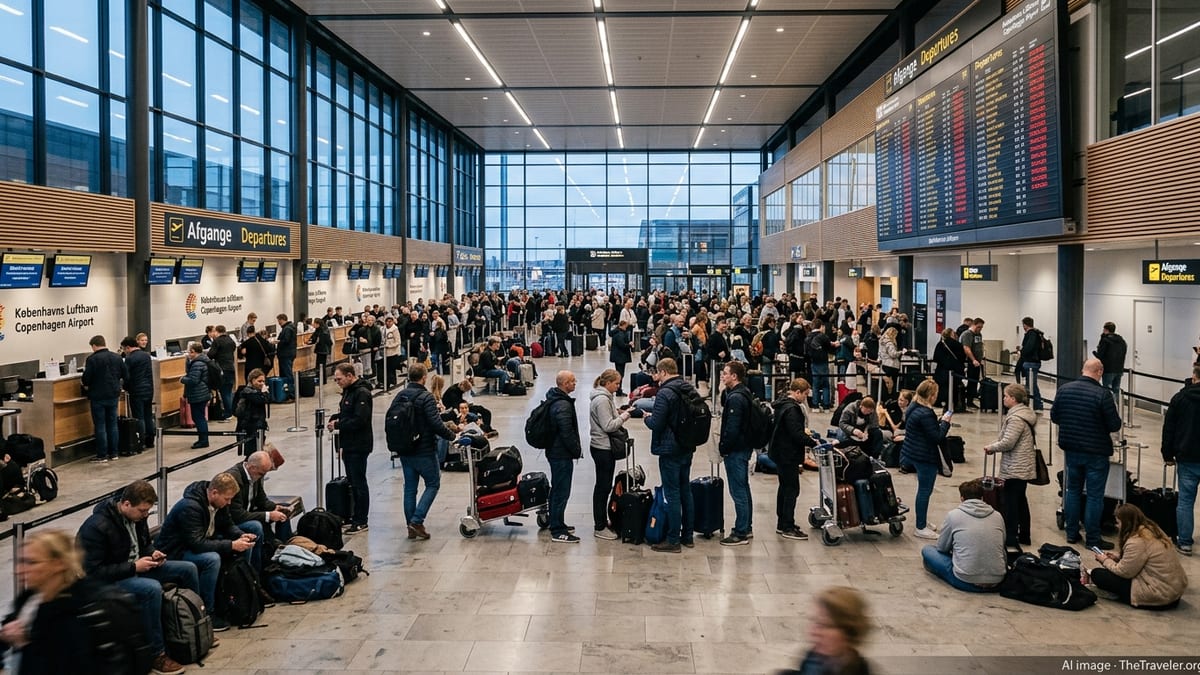
Travelers at Copenhagen have reported extensive queues, overcrowded departure halls and limited information about when normal operations will resume. Social media posts and local coverage describe passengers sleeping on terminal floors, families separated across different flights and long lines at airline service desks as people seek rebooking options or basic care such as food and accommodation.
The knock on effects are being felt far beyond Denmark. As Copenhagen functions as a vital transfer point between Scandinavia, the rest of Europe and long haul routes to North America and Asia, disruption at this single airport is rippling through airline schedules across the region, affecting passengers who never intended to set foot in Denmark.
Causes Tied to Wider Strains on Europe’s Aviation System
While the precise mix of causes behind the latest Copenhagen disruption is still emerging, publicly available information points to a combination of structural and short term pressures. Across Europe, airlines and airports have been contending with capacity constraints, ongoing staff shortages in ground handling and air traffic control, as well as periodic technical or security incidents that force sudden slowdowns.
Industry briefings highlight that cancellations and delays at major hubs can spike sharply from month to month, driven by factors such as infrastructure works that limit gate and runway capacity, technology outages and airspace restrictions. Analysts have also drawn attention to the growing impact of security related events in recent years, including drone sightings that have previously halted takeoffs and landings at major European airports, among them Copenhagen.
In parallel, airlines are navigating high operating costs and tighter schedules, leaving limited slack to absorb disruption. When a hub like Copenhagen experiences even a short period of reduced capacity, the result can be a rapid build up of stranded aircraft and displaced passengers. Once rotations are out of sync, recovery can take many hours or even several days, especially during busy travel periods.
The broader European network is adding further complexity. Weather related events elsewhere, air traffic control restrictions over congested regions and geopolitical tensions affecting certain air corridors are all contributing to route changes and longer flight times. These elements, when combined, make it more difficult for carriers to quickly restore regular service once an airport falls behind schedule.
Stranded Passengers Face Long Queues and Limited Options
For travelers on the ground at Copenhagen, the operational jargon translates into a very immediate set of problems. Reports from the terminal describe long lines at security and check in, with passengers urged via public announcements and online updates to arrive much earlier than usual. In some cases, travelers who did so still found themselves stuck for hours as departure boards filled with rolling delay messages.
Those whose flights have been outright cancelled are often being rebooked onto later services or rerouted through other European hubs. With capacity elsewhere also tight, some passengers are being offered itineraries that arrive a day or more later than originally planned, or are advised to make their own alternative arrangements by rail or bus where possible.
Accommodation has emerged as another flashpoint. Under European passenger rights rules, airlines are generally expected to provide meals and hotel rooms in cases of long delays or overnight cancellations when the disruption is within their control. However, during large scale events, hotel capacity around a major hub can quickly be exhausted, leaving travelers to compete for remaining rooms or spend the night in the terminal.
Families with young children, older travelers and those with tight onward connections appear to be among the hardest hit. Accounts shared publicly describe missed cruises and tours, disrupted business meetings and students struggling to reach the start of academic terms or exams. For many, the experience is not just inconvenient but financially and emotionally draining.
Passenger Rights and What Travelers Can Do Now
The turmoil at Copenhagen is once again putting a spotlight on passenger protections within the European Union. Under existing rules, travelers departing from EU airports, or flying into the bloc on EU based carriers, may be entitled to assistance, rerouting and in some circumstances financial compensation when flights are significantly delayed or cancelled.
Current regulations set out thresholds for long delays and cancellations, differentiating between extraordinary circumstances and disruptions that are deemed within airline control. In addition to compensation, airlines are expected to provide so called care and assistance, including meals, refreshments and hotel stays where necessary, along with options for rerouting at the earliest opportunity or a refund of the unused ticket portion.
Consumer organizations advise affected passengers to keep all receipts for out of pocket expenses, document the delay or cancellation and retain boarding passes or booking confirmations. Travelers are also encouraged to submit claims directly through airline channels and, if necessary, escalate to national enforcement bodies when they believe the rules have not been properly applied.
At the same time, ongoing discussions in European institutions about modernizing air passenger rights have underscored how large scale disruption events, such as those now unfolding in Copenhagen, can leave significant gaps between the protections on paper and the practical experience of stranded travelers. The current situation is likely to fuel renewed debate about how to ensure airlines and airports are better prepared to handle future crises.
Network Recovery and Outlook for the Coming Days
As airlines and airport operators work to clear backlogs at Copenhagen, the focus has shifted to how quickly normal operations can be restored and what travelers should expect in the near term. Experience from previous disruption episodes at major European hubs suggests that even once the immediate trigger is resolved, knock on effects can linger for several days as aircraft and crews are repositioned.
Published schedules indicate that carriers are trimming some services in the short term to create space for recovery, while prioritizing key trunk routes within Scandinavia and to major European capitals. Some long haul flights are operating with altered timings or aircraft types as airlines seek to reconnect passengers who have missed earlier departures.
Travelers scheduled to pass through Copenhagen in the coming days are being urged, through airline channels and public travel advisories, to monitor flight status frequently, allow extra time at the airport and consider flexible routing where possible. Same day rebooking options may remain limited on busy routes, particularly during peak morning and late afternoon waves.
For the wider industry, the events at Copenhagen serve as another reminder that Europe’s air travel system, though far busier than during the pandemic years, still operates with tight margins when unexpected shocks occur. As infrastructure projects, staffing realities and security concerns continue to intersect, passengers may need to brace for further episodes of sudden disruption at key hubs, even as airlines and airports work to strengthen resilience.