

Relocating a family with two children to Thailand can significantly reduce day-to-day expenses compared with many Western countries, but actual costs vary widely by city, schooling choices and lifestyle expectations. This briefing summarizes current evidence on typical monthly spending for a family of four, with a focus on the major expenditure categories that drive the cost of living in Thailand in 2025–2026.
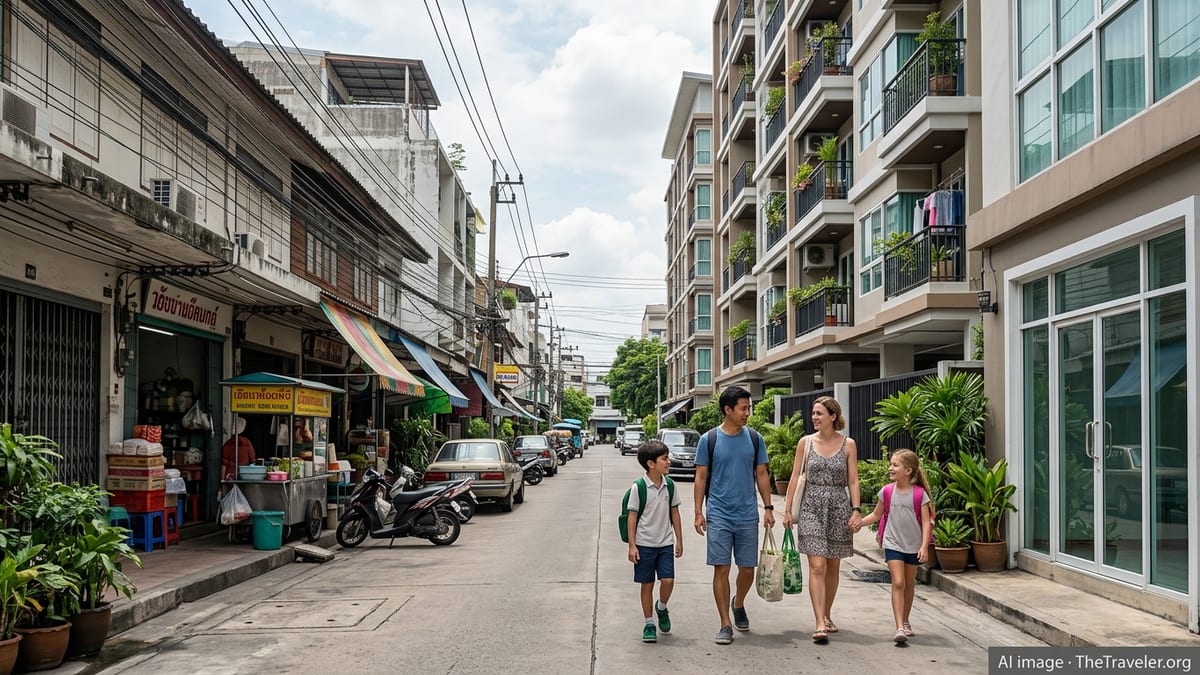
Overview of Family Living Costs in Thailand
Thailand remains a relatively low to mid-cost destination in global terms, with private consumption per person substantially below Western averages. However, families with two children face specific cost drivers that can push monthly spending far above local norms, particularly in Bangkok and other major urban centers. Recent cost-of-living syntheses and expatriate budget surveys suggest that an overseas family of four should expect a monthly budget in roughly the 80,000 to 150,000 Thai baht (THB) range, depending mainly on location, desired housing quality and education choices for the children.
Estimates tailored to expatriate households indicate that a comfortable lifestyle for a family of four including rent commonly starts around 100,000 THB per month in central Bangkok, while families living in secondary cities such as Chiang Mai, Khon Kaen or Hua Hin can often maintain similar living standards on 30 to 40 percent less. At the upper end, high-income households with premium schooling, frequent use of imported goods and large accommodation may spend 150,000 to 200,000 THB monthly or more.
The gap between local household spending and expatriate-family budgets is notable. Average Thai per-capita consumption remains far below these figures, but foreign families typically pay international-level prices for rent in newer condominiums, imported food, private transport and selective services. For relocation planning, multinational employers and mobile professionals should therefore reference expatriate-focused ranges rather than national averages when modeling the cost of living in Thailand for a family with two children.
Typical Monthly Budget Ranges by City Type
Location is the single strongest determinant of family living costs. Bangkok is consistently the most expensive major city, followed by popular coastal and island destinations. Northern and northeastern provincial cities tend to be significantly cheaper for comparable local goods and services, although high-end imports and international school fees are less sensitive to geography.
Synthesizing multiple recent budget guides and price aggregators, indicative monthly cost-of-living ranges for a family of four (two adults, two school-age children) including rent can be framed as follows for 2025–2026:
| Location type | Lean but comfortable lifestyle | Mid-range expatriate lifestyle |
| Central Bangkok | 90,000–110,000 THB | 120,000–160,000 THB |
| Bangkok suburbs / large regional cities (Chiang Mai, Khon Kaen, Udon Thani) | 70,000–95,000 THB | 90,000–130,000 THB |
| Smaller provincial towns (limited international schooling, simpler housing) | 55,000–80,000 THB | 80,000–110,000 THB |
These ranges assume children attend at least mid-quality local private or bilingual schools, the family rents a modern two or three-bedroom apartment or house, eats a mix of local and some imported foods, and uses a combination of public or app-based transport with limited private car use. Choosing premium international schools, living in high-end condominium developments, or replicating a Western consumption pattern of imported goods quickly moves a family toward or above the upper end of each band.
At the other extreme, some families in regional cities report managing on significantly less than 60,000 THB per month by using public schools, renting older properties outside city centers and relying primarily on local markets for food. However, this level of spending typically requires substantial adaptation to local norms and may not align with expectations of transferees on corporate assignments.
Major Expenditure Categories for a Family of Four
The main drivers of monthly living costs for a family with two children in Thailand are rent, food and groceries, education-related outlays, and transport. Secondary but still material items include utilities, communications, domestic help and incidental child-related expenses such as activities and clothing.
For a mid-range expatriate household in Bangkok, a reasonable working distribution of monthly expenditure might allocate approximately 30 to 40 percent of the budget to rent, 15 to 25 percent to food and groceries, 15 to 25 percent to education and childcare, 5 to 10 percent to utilities and telecommunications, and the remaining share to transport, leisure and miscellaneous child-related costs. In secondary cities, both rent and transport often represent a smaller share, while food and schooling can have similar proportional weights but at lower absolute levels.
The following simplified table outlines indicative monthly cost ranges for key categories for a mid-range family of four in 2025–2026, illustrating central Bangkok versus a large regional city such as Chiang Mai:
| Category | Bangkok (THB) | Regional city (THB) |
| Rent (2–3 bedroom) | 35,000–70,000 | 20,000–40,000 |
| Food & groceries | 20,000–35,000 | 15,000–25,000 |
| Utilities & internet | 3,500–6,000 | 3,000–5,000 |
| Transport | 5,000–12,000 | 3,000–8,000 |
| Education & childcare | 20,000–60,000+ | 10,000–40,000+ |
| Other (clothing, activities, incidentals) | 10,000–20,000 | 7,000–15,000 |
These ranges are indicative rather than prescriptive and mask substantial variation between budget-focused and premium options. They do, however, provide a realistic starting point for corporate mobility teams and relocating families when constructing Thailand-specific cost-of-living models.
Housing and Utilities as Cost Anchors
Although this briefing does not analyze the housing market in detail, rent and utilities form the foundation of the family cost structure and must be understood to contextualize the broader cost of living. In Bangkok, recent expatriate-focused data suggest that a modern two-bedroom condominium suitable for a small family in a central or near-central district frequently rents in the 30,000 to 50,000 THB per month range, while three-bedroom units or properties in highly sought-after areas can run from 50,000 to 80,000 THB or more.
In large regional cities such as Chiang Mai, Khon Kaen or Nakhon Ratchasima, similar quality apartments or townhouses often fall closer to 18,000 to 35,000 THB for two or three bedrooms, with larger detached houses available from roughly 25,000 to 45,000 THB depending on location and amenities. Smaller provincial towns may offer substantially cheaper options, but supply of modern family-oriented housing is more limited and often requires local-language market knowledge.
Monthly utilities for a family of four in a modern apartment with regular air-conditioning usage generally range from around 2,500 to 4,500 THB for electricity and water combined, with higher bills during the hottest months for larger condominiums. High-speed fixed broadband commonly costs in the vicinity of 600 to 1,000 THB per month, while mobile phone plans for two adults may add a further 800 to 1,500 THB depending on data requirements. These amounts are meaningful but typically remain a modest share of the overall family budget relative to rent and schooling.
Food, Groceries and Everyday Consumption
Food expenditure for a family with two children in Thailand depends heavily on the balance between local products and imported items, as well as the mix of home cooking versus restaurant dining. Local markets and mid-range supermarkets offer Thai staples at relatively low prices, while imported cheeses, cereals, snacks and meats can cost as much or more than in Western cities.
Evidence from recent expatriate budget case studies in Bangkok shows monthly grocery spending for families of four ranging broadly from 15,000 to 30,000 THB, with some high-income households reporting 35,000 THB or more where imported products make up a large share of the basket. Families that cook primarily Thai-style meals using local ingredients and purchase limited imported goods tend to cluster at the lower end of this range, especially in regional cities where local markets are dominant.
Eating out remains comparatively affordable, especially at Thai restaurants and street-food vendors, where basic meals typically cost well under 150 THB per person. A family that eats a significant share of meals outside the home, including some higher-end or Western-style venues, might allocate an additional 5,000 to 10,000 THB per month for dining out, while a more home-focused pattern might keep this closer to 3,000 to 6,000 THB. For budgeting purposes, families combining local groceries with occasional imported products and moderate restaurant use should anticipate overall monthly food-related spending in the 20,000 to 35,000 THB range in Bangkok and 15,000 to 25,000 THB in major regional cities.
Education, Childcare and Child-Related Costs
Education decisions create significant divergence in the cost of living for families with two children in Thailand. Public schooling is either free or very low cost for Thai nationals, but foreign children often require documentation and may not always be accommodated in public schools in practice. As a result, many expatriate families choose between Thai private schools, bilingual schools and international schools, each with distinctly different fee levels.
Tuition at fully international schools in Bangkok is typically priced in foreign currencies and can match or exceed fees in developed-country capitals. Annual tuition for primary-level international programs often falls within the equivalent of several hundred thousand THB per child, before application fees, uniforms and transport, implying monthlyized education costs that can easily exceed 40,000 THB per child. For two children, this can dominate the family budget and push total monthly spending far beyond the mid-range cost-of-living figures cited earlier.
By contrast, mid-tier bilingual or Thai private schools may charge significantly lower fees, bringing monthly education expenses into a more manageable band for many families. Depending on location and school type, monthlyized costs for two children at such institutions might range from approximately 10,000 to 40,000 THB combined, including periodic additional charges. In regional cities, these figures are often lower than in Bangkok, although the range of schools offering extensive foreign-language curricula may be narrower.
Additional child-related costs such as tutoring, extracurricular activities, sports, music lessons and school transportation can add a further 3,000 to 10,000 THB per month or more, depending on expectations. Families should also budget for occasional large but irregular spending on school trips, equipment, uniforms and technology devices, which may not be reflected in simple monthly cost-of-living indices.
Transport and Mobility Costs
Transport spending for a family with two children in Thailand varies by city and by willingness to use public or app-based services. Bangkok has a relatively well-developed mass-transit network in central districts, while many regional cities remain highly car-dependent.
Families living near Bangkok mass-transit corridors who rely heavily on trains, buses and ride-hailing services may spend in the region of 4,000 to 8,000 THB per month on transport, including school commutes and weekend trips. Adding a private car introduces fixed costs such as finance payments, insurance, parking and maintenance, as well as fuel, which collectively can push monthly transport outlays for a family toward or above the 8,000 to 12,000 THB range, especially if two vehicles are involved or long commutes are routine.
In regional cities, many families choose to own at least one car or pickup truck because public transport options are limited and distances between residential areas, schools and workplaces can be substantial. While fuel and insurance may be somewhat lower than in Bangkok due to shorter average commutes and cheaper parking, vehicle ownership still represents a meaningful recurring cost. For relocation budgeting, allocating 3,000 to 8,000 THB per month for transport in regional cities, depending on car usage and school location, is a prudent baseline.
The Takeaway
Thailand can offer a materially lower cost of living than many Western economies for a family with two children, but actual spending is highly sensitive to location, housing standards and education choices. A realistic working range for a foreign family of four in 2025–2026 is broadly 80,000 to 150,000 THB per month, including rent, with central Bangkok typically occupying the upper part of this band and regional cities the lower part. Families integrating extensively into local consumption patterns and schooling may achieve lower budgets, while those choosing premium international services can exceed these levels considerably.
For decision-makers in global mobility and for families evaluating relocation, the key analytical conclusion is that Thailand’s cost advantage is meaningful but not automatic. Rent, schooling, imported food and private transport can quickly erode headline affordability if expectations are set according to home-country norms rather than local options. Thorough scenario planning that tests different combinations of city, school type, housing quality and lifestyle intensity is therefore recommended to determine whether a move to Thailand is financially attractive for a specific family profile.
FAQ
Q1. What is a realistic monthly budget for a family of four in Bangkok?
For a mid-range expatriate lifestyle in central Bangkok, a realistic monthly budget for a family with two children is typically between 110,000 and 150,000 THB, including rent, education, food, utilities and transport.
Q2. How much less does it cost to live in a city like Chiang Mai compared with Bangkok?
Large regional cities such as Chiang Mai are often 20 to 40 percent cheaper overall than central Bangkok for a similar standard of living, mainly because rents and some services are lower, though imported goods and international schooling remain costly.
Q3. Can a foreign family of four live in Thailand on 60,000 THB per month?
Living on 60,000 THB per month is possible in smaller cities or provincial areas if the family chooses modest housing, relies on local food and avoids expensive private schooling, but this budget usually requires significant adaptation to local norms.
Q4. How much should be budgeted for rent for a family with two children?
A modern two or three-bedroom apartment or house suitable for a family of four generally costs around 35,000 to 70,000 THB per month in central Bangkok and roughly 20,000 to 40,000 THB in major regional cities.
Q5. What do families typically spend each month on food and groceries?
Most expatriate families of four in Bangkok report monthly food and grocery spending in the 20,000 to 35,000 THB range, while those in regional cities often fall between 15,000 and 25,000 THB, depending on use of imported products and frequency of dining out.
Q6. How large a cost factor is schooling in the overall family budget?
Schooling can be the single largest cost component. International schools can easily add the equivalent of 40,000 THB or more per child per month when averaged over the year, whereas Thai private or bilingual schools are generally far less expensive.
Q7. Are utilities and internet a significant part of the cost of living?
Utilities and internet are noticeable but not dominant. A family of four in a modern apartment typically spends 2,500 to 4,500 THB on electricity and water plus about 600 to 1,000 THB on fixed broadband each month, with modest additional mobile charges.
Q8. How much should be allocated for transport costs each month?
In Bangkok, families relying mostly on public transport and ride-hailing might spend 4,000 to 8,000 THB per month, while car-owning households often see transport costs rise to 8,000 to 12,000 THB. In regional cities, a car-focused pattern commonly falls between 3,000 and 8,000 THB.
Q9. Does Thailand still offer a clear cost advantage versus Western countries for families?
Thailand generally remains cheaper than major Western cities for equivalent everyday consumption, particularly for food and local services, but high-end rent and international schooling can narrow the gap, especially for families seeking premium options.
Q10. How should employers structure cost-of-living allowances for staff relocating with children?
Employers should model separate scenarios based on city, housing standard and schooling choice, and then benchmark against realistic family budgets in the 80,000 to 150,000 THB per month range, adjusting allowances to ensure that rent and education needs are adequately covered.