

More news on this day
A growing number of couples are deliberately booking separate seats on flights, a practice dubbed “seat divorce” that reframes time in the air as a chance to reset individually rather than an enforced block of togetherness.
Get the latest news straight to your inbox!
From Sleep Divorce to Seat Divorce in the Sky
The concept of couples spending planned time apart is not new. Relationship experts and travel analysts have tracked a rise in “sleep divorce,” where partners choose separate beds or bedrooms to prioritize rest. Hotel and travel reports in recent years have highlighted that a substantial share of travelers prefer separate sleeping arrangements from their partners when away from home, often for better rest and improved mood the next day.
That same mindset is now migrating to the aircraft cabin. Instead of fighting algorithms, families, and frequent flyers for two seats side by side, some couples are leaning into separation by design, selecting seats across the aisle, a row apart, or even in different sections of the plane. Travel commentary and social media threads describe these choices less as a sign of relationship strain and more as a practical strategy for comfort, rest, and autonomy.
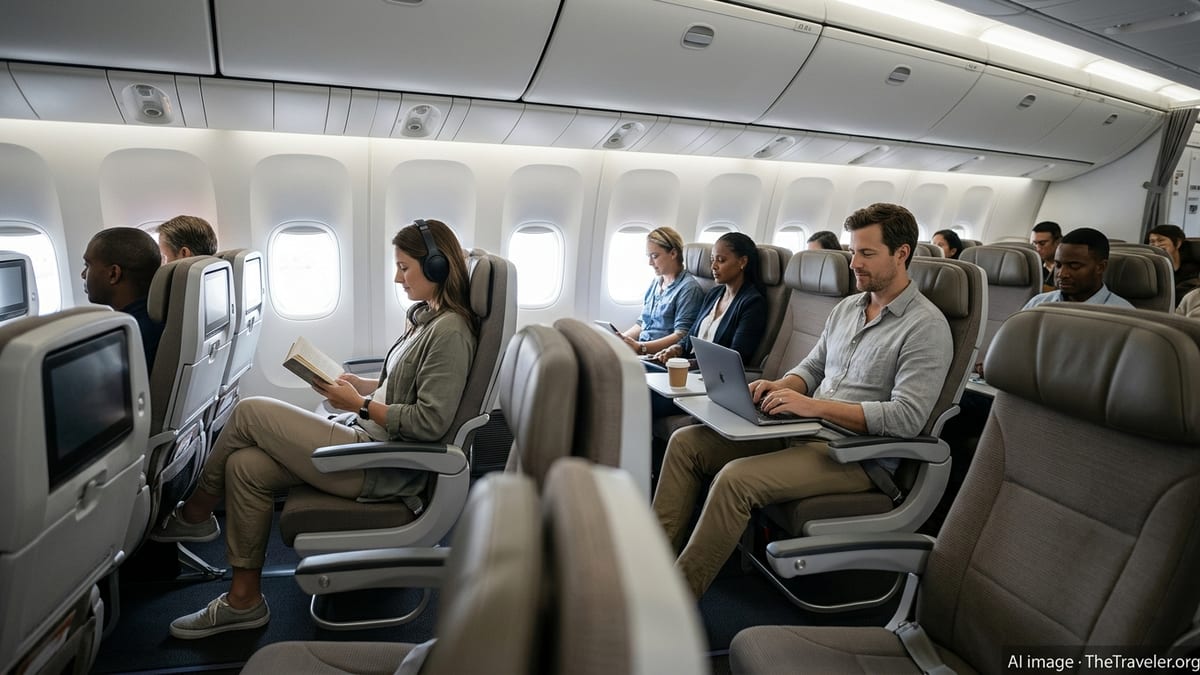
Online travel communities show couples swapping tips on how to sit near, but not on top of, one another in economy cabins. For some, that means opposite aisle seats, which provide easy access to overhead bins and lavatories without needing to coordinate every stretch or bathroom break. For others, it means one partner choosing a window seat to sleep while the other takes an aisle seat several rows away to work or watch movies.
Observers note that this shift is unfolding alongside a broader reevaluation of what quality time means on vacation. Instead of viewing every moment as an opportunity for shared experiences, more couples frame the flight itself as a transition period where separate routines can support a better trip once they land.
Algorithms, Fees, and the Push Away From Shared Seats
Seat divorce is also being shaped by the economics and technology of modern air travel. Dynamic seat maps, basic economy restrictions, and growing seat-selection fees have made it harder for couples to sit together without paying extra. Consumer advocates and travelers have complained for years that airlines routinely scatter families and companions throughout cabins unless they pay to pre-select seats.
In response to public pressure, regulators have focused on keeping parents and young children together, with the United States Department of Transportation proposing rules that would require airlines to provide adjacent seating for families with young kids at no extra cost. At the same time, individual carriers have promoted new tools that automatically place children next to an accompanying adult where possible. These changes, however, do not address couples traveling without children, who are frequently told that sitting together will require a fee or an upgrade.
Faced with these trade-offs, some partners are deciding that paying solely to sit shoulder to shoulder is not worth the cost. Rather than battling automated systems that prioritize family adjacency or elite-status passengers, they accept separate seats and reframe the outcome as a benefit. The choice can feel especially rational on short-haul or daytime flights, where conversation may be less of a priority than getting work done or catching up on sleep.
Data from travel deal and seat-selection analyses also highlight how limited adjacent seating has become on popular routes, particularly close to departure dates. With airlines segmenting cabins into multiple fare buckets and monetizing preferred seats, couples booking late may find that sitting apart is the only no-fee option. For cost-conscious travelers, turning that limitation into an intentional “seat divorce” strategy can reduce frustration.
Redefining Romance at 35,000 Feet
Rather than undermining romance, advocates of seat divorce argue that it can support healthier dynamics mid-flight. Travel essays and first-hand accounts describe couples who feel less pressure to entertain one another for hours in cramped conditions, and more freedom to follow their own in-flight rhythms. One partner might dive into a long novel with noise-cancelling headphones, while the other streams a favorite show or chats briefly with a neighboring passenger.
Some couples still coordinate their seating to preserve a sense of connection without constant interaction. That might mean booking two aisle seats across from each other, allowing quick eye contact and occasional conversation while avoiding the elbow battles and shared armrests that come with adjacent economy seats. Others choose to reunite periodically in the galley or during a walk down the aisle, treating these moments as brief check-ins before returning to their own space.
Relationship counselors quoted in lifestyle coverage have noted that intentional time apart can reduce friction, especially during stressful travel days. Long security lines, tight connections, and delays can strain even strong partnerships. By giving each partner a defined zone of personal space on the aircraft, couples may sidestep minor irritations that can escalate when they are confined to one row for hours.
For some travelers, separate seats also remove social pressure around seat swapping. With rising frustration over requests to move so friends or families can sit together, couples who plan for seat divorce in advance avoid asking strangers to trade or relying on last-minute favors from gate agents.
Wellness, Productivity, and Personal Space at Altitude
Health and wellness narratives around air travel increasingly emphasize sleep, hydration, and movement. In that context, seat divorce can be seen as a form of in-flight self-care. Each partner can choose the seat that best fits their body and priorities: a window for uninterrupted rest, an aisle for stretching and frequent walks, or a bulkhead or exit row for extra legroom when available.
For couples who frequently combine business and leisure travel, separate seats can also support productivity. Reports on changing workplace habits show that many travelers now treat flights as mobile offices, using onboard Wi-Fi and laptop-friendly tray tables to work uninterrupted. A partner who needs to focus on presentations or emails may prefer not to feel obliged to chat or share screens during the journey.
Mental space matters as well. Travel psychologists have pointed out that transitions between home, work, and vacation can be emotionally charged. Having several hours of quiet reflection in the air can help individuals decompress from work or jet-lagged schedules before re-engaging as a couple at their destination. Rather than interpreting silence or separation as distance, some partners now view it as an investment in arriving more relaxed and present.
These choices align with broader trends in travel where personalization outruns tradition. Just as some couples book separate activities on the ground before meeting for dinner or a sunset walk, seat divorce treats the journey as another space where individual needs matter.
Practical Strategies for Couples Considering Seat Divorce
For couples curious about experimenting with seat divorce, travel analysts and frequent flyers highlight several practical considerations. Booking earlier typically increases the chances of picking seats that are close but not adjacent, such as two aisle seats across from each other or two windows one row apart. On fuller flights, it may be easier to secure one desirable seat and accept that the second will be further away.
Travel experts advise reading airline seat maps carefully, as some carriers automatically group passengers on the same reservation together whenever possible. In those cases, it may require manual changes in the seat-selection screen to ensure a deliberate separation. On low-cost carriers that monetize nearly every seat assignment, couples may find that choosing two different fee-based seats costs no more than paying for two adjoining places.
Communication between partners remains important even when the goal is time apart. Discussing expectations in advance about whether to chat briefly before takeoff, meet in the aisle during the flight, or reconnect at the gate can prevent misunderstandings. Many couples who try seat divorce report that aligning on the plan ahead of time helps the experience feel like a shared strategy rather than a rejection.
As aircraft cabins grow more crowded and personal space feels scarcer, seat divorce offers one more way couples are adapting. By reframing where intimacy happens and where solitude is acceptable, partners are discovering that a little distance at cruising altitude can sometimes bring them closer together on arrival.