

More news on this day
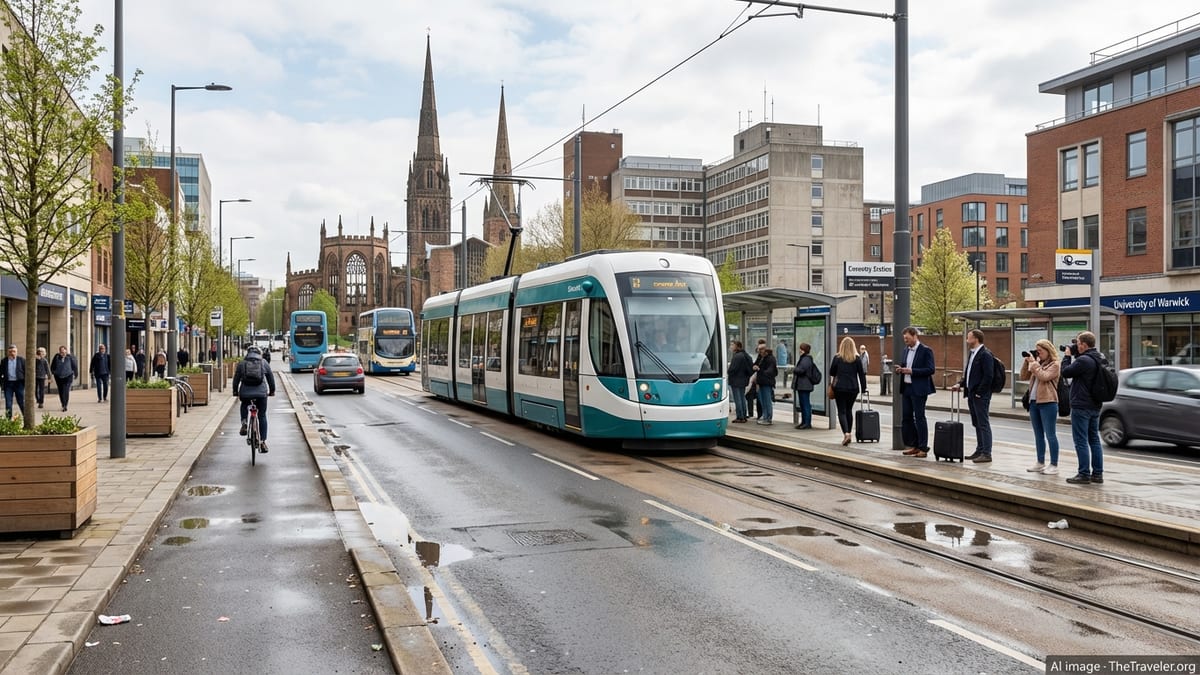
Coventry’s pioneering Very Light Rail system is moving from concept to concrete track, with city leaders and industry partners betting that the ultra-light, low-cost tram network will reshape how residents and visitors move around the city and help drive a surge in tourism by 2030.
A New Model for Affordable Urban Rail
Coventry’s Very Light Rail, often described as a tram system for smaller and medium-sized cities, is designed around a simple but disruptive proposition: deliver a modern rail-based network at less than half the cost and in roughly half the time of conventional light rail schemes. Using battery-powered vehicles and a specially engineered shallow precast track slab, the system avoids the deep excavations and utility diversions that have pushed up costs and timescales on many traditional tram projects across the United Kingdom.
City officials say the target installation cost of around £10 million per kilometre, combined with eight-week build times for key sections, positions Coventry as a testbed for a new generation of urban rail. The technology has been developed through a long-running research partnership involving Coventry City Council, Warwick Manufacturing Group and specialist suppliers, with the West Midlands Combined Authority seeing the project as a regional export opportunity for towns that have previously ruled out tram systems as unaffordable.
The combination of lower capital costs, reduced construction disruption and all-electric operation without overhead wires is central to Coventry’s claim that Very Light Rail could be scaled quickly through the late 2020s. By 2030, local planners expect the system to form the backbone of an integrated low-carbon transport offer that supports the city’s regeneration and tourism strategies.
From Demonstrator Track to 800-Metre Pilot Route
The project’s momentum has accelerated since 2025, when a 220-metre on-street demonstrator track was installed along Greyfriars Road and Queen Victoria Road in the heart of Coventry. Constructed by Colas Rail UK in just eight weeks, the single-track section embedded in a live traffic corridor has provided crucial proof that the novel thin-slab track can be laid quickly while maintaining access, with no full road closures and minimal diversions.
Public ride events and technical showcases on the demonstrator during 2025 drew thousands of residents, engineers and transport specialists, offering early feedback on ride quality, noise, and integration with city traffic signals. The trial has also been watched closely by utility companies, who have been able to observe how pipes and cables remain accessible beneath the precast slabs, a key reassurance for long-term maintenance and emergency works.
Following that successful city-centre test, Coventry City Council approved a much larger phase two pilot. In early 2026, Colas Rail’s urban division began work on an 800-metre twin-track section linking Coventry Railway Station with Coventry University Technology Park. The route, scheduled to operate in mixed traffic and to be substantially complete by 2027, is seen as the final demonstration step before decisions on a full commercial line are taken.
This pilot corridor will allow integrated testing of vehicle control, passenger operations, and tram-priority signalling in a busy urban setting. Stakeholders say that by the end of the decade the lessons learned on construction methods, costs and service reliability will underpin business cases for a wider network designed to be operational in stages through to 2030 and beyond.
Building a 12-Kilometre Network and a Visitor-Friendly City
Beyond the pilots, Coventry’s long-term ambition is a 12-kilometre Very Light Rail network that knits together major attractions, employment zones and transport hubs. Concept plans envisage a spine linking the main railway station, the city centre retail core, Pool Meadow bus station, the University Hospital, Coventry University, and emerging employment sites including the West Midlands Investment Zone at Coventry Airport and Ansty Park.
For visitors, the proposed alignments would effectively create a hop-on, hop-off urban circulator, allowing tourists arriving by intercity train to step straight onto a frequent tram-like service reaching the cathedral quarter, cultural venues, sports arenas, and outlying heritage sites with minimal interchange. Local officials argue that this kind of legible, high-quality public transport is now a basic expectation for international city-break travellers and conference organisers when choosing destinations.
Tourism analysts note that Coventry’s year as UK City of Culture in 2021 raised its profile, but also highlighted constraints in moving large numbers of people efficiently between venues. The council is positioning Very Light Rail as a direct response, aiming by 2030 to present the city as compact, car-light and easy to navigate, with integrated ticketing and clear wayfinding between the rail system, buses and active travel routes.
Crucially, the proposed network is being planned alongside public realm upgrades, including widened pavements, new public squares and improved cycling infrastructure along and across the corridors. Officials argue that Very Light Rail is as much an urban design and placemaking tool as a transport scheme, with the potential to lift the experience for residents and tourists alike.
Economic, Environmental and Tourism Payoffs
Supporters of Coventry’s approach say the economic case for Very Light Rail rests not only on cheaper construction, but on the wider regeneration it can catalyse. Early modelling for the proposed network suggests that connecting the railway station, innovation campuses, hospital and new business parks with a fast, visible rail system could significantly expand the city’s effective labour market and attract higher-value investment by 2030.
For the visitor economy, improved connectivity is expected to lengthen stays and increase per-capita spending. The ability for tourists to access attractions without a car, particularly from intercity rail services, is seen as critical to attracting more weekend city-break visitors and international delegates to conferences at the university and nearby exhibition venues.
Environmental benefits are also central to the narrative. Battery-powered vehicles, regenerative braking, and the absence of overhead wires all contribute to a cleaner streetscape and lower operational emissions. By capturing a greater share of trips that would otherwise be made by private car or taxi, Very Light Rail is intended to support Coventry’s air quality and climate targets while reducing congestion on radial roads used by visitors heading to events and sports fixtures.
Local leaders argue that if the system proves its promised cost and disruption advantages, it could become an exportable template. Other UK and European cities assessing how to cut transport emissions affordably may look to Coventry’s experience, bolstering the city’s reputation as a hub of low-carbon innovation and, indirectly, as a destination for industrial tourism and professional study visits.
Risks, Timelines and the Road to 2030
Despite the optimism, significant challenges remain before Coventry can claim a fully operational Very Light Rail network by 2030. Detailed business cases for each phase must still secure funding in a competitive national environment, with inflationary pressures and supply chain constraints continuing to affect major infrastructure projects across the country.
Technical work is ongoing to validate long-term performance of the precast slab track under continuous operation, including structural health monitoring and trials of how quickly utilities beneath the slabs can be accessed and reinstated. Ensuring reliable performance in all-weather conditions and fine-tuning vehicle integration with complex city-centre junctions will be vital before moving from demonstrations to a full public timetable.
There are also policy questions around fare levels, integration with regional rail and bus ticketing, and the extent to which routes can be made partially or fully autonomous over time. Coventry’s ambition to offer a future driverless hop-on, hop-off service would require further regulatory approvals and robust safety systems, though planners see that as a realistic prospect in the 2030s once the core network is established.
For now, the focus is on delivering the 800-metre pilot link on time and on budget, then locking in the first commercial line that can be extended across the city. If the programme maintains momentum through the late 2020s, officials believe that by 2030 visitors will experience Coventry very differently: as a city where a slim, quiet, wire-free tram gliding past heritage sites and new innovation districts is no longer a demonstration of the future, but an everyday part of urban life.