

More news on this day
Drivers on the M1 in Hertfordshire faced hours of disruption on Sunday after a collision near Harpenden forced the closure of multiple lanes, grinding northbound traffic to a standstill and rippling delays across one of the UK’s busiest intercity routes.
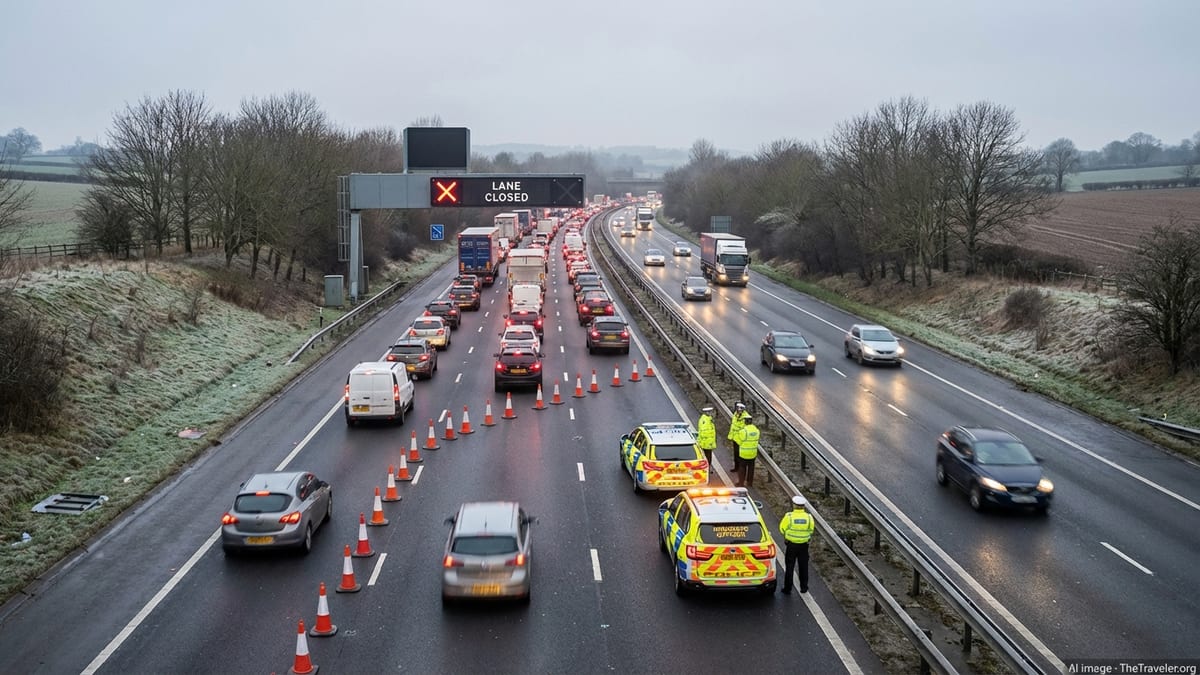
Collision Near Harpenden Closes Lanes on Key Commuter Artery
The latest incident unfolded on the M1 northbound between junctions 9 and 10, a stretch that serves Harpenden and links the commuter towns of Hertfordshire with Luton, Bedfordshire and onward routes to the Midlands. A road traffic collision shortly before midday prompted National Highways to close two of the five lanes on the northbound carriageway, immediately throttling capacity on a section already strained by weekend getaway traffic.
Traffic monitoring services reported the crash as “active” late on Sunday morning, with the event not expected to clear until early afternoon. Initial assessments pointed to significant debris and a complex recovery operation, requiring lanes 4 and 5 to remain shut while emergency services worked at the scene and highways officers inspected barriers and the road surface.
Although early indications suggested only limited formal delays in travel time, the lane closures quickly led to heavy, slow-moving queues. Cars, vans and heavy goods vehicles found themselves inching forward for long stretches, with drivers describing the motorway as “stop–start at best” and, at times, completely static north of junction 9.
The crash came less than 24 hours after a separate collision on the southbound entry slip at junction 5 in Hertfordshire, underscoring just how vulnerable this corridor has become to disruption when even a single access point or lane is taken out of use.
Hours of Congestion, Missed Plans and Mounting Frustration
As the collision response continued into the middle of the day, motorists heading towards Luton, Bedford and beyond saw their journeys extended well beyond what navigation apps had predicted at the start of the morning. What should have been a straightforward 20- to 30-minute hop between Watford and Luton Airport for some travellers stretched toward an hour or more as traffic built behind the lane closures.
Families returning from half-term breaks, match-going football fans and airport-bound passengers all reported disruption. Some drivers chose to leave the M1 altogether at junction 9 and attempt local routes through Harpenden and surrounding villages, only to find that those roads were quickly overwhelmed by diverted motorway traffic, with junction roundabouts and high streets snarled by unfamiliar through-traffic.
Taxi drivers and ride-hailing operators serving London Luton Airport warned passengers to build in extra time for drop-offs and pick-ups, highlighting that any knock-on congestion at key junctions can translate directly into missed flights and expensive rebookings. With the M1 forming the primary motorway spine into the airport from the south, even partial closures on adjacent sections can send journey times sharply higher.
On board the gridlocked motorway, frustration mounted as drivers crawled past illuminated matrix signs warning of a collision ahead and advising “slow” and “lane closures.” With limited live information beyond short variable-message updates, many travellers were left relying on radio bulletins and phone alerts to gauge how long the chaos might last.
Emergency Response and the Push to Reopen the M1
Emergency services were dispatched quickly to the scene of the Harpenden-area crash, with police, ambulance crews and National Highways traffic officers all involved in the operation. The priority in the early phase focused on assessing casualties, securing damaged vehicles and ensuring the safety of responders working just inches from passing traffic.
Once the most pressing medical and safety concerns were addressed, teams turned their attention to recovery and clean-up. That included lifting or towing stricken vehicles from the outer lanes, removing debris from the carriageway and checking whether any impact had compromised the central reservation or roadside barriers. Only once engineers are satisfied that the infrastructure is intact can lanes safely be handed back to motorists.
National Highways indicated that it expected traffic conditions to return to normal between midday and early afternoon, suggesting that the incident, while serious enough to require multi-lane closures, might be cleared within a few hours rather than dragging into the evening peak. Even so, the organisation urged drivers to allow extra time, follow local diversions where signed and heed instructions from on-road officers.
On nearby stretches of the strategic road network, including the A421 linking Bedford to the M1, separate collisions over the weekend further complicated travel planning. For many road users, the Harpenden crash felt like the latest in a string of setbacks on a network operating close to its limits.
Harpenden and Hertfordshire Bear the Brunt of Repeated Disruption
The area around Harpenden has long been shaped by its proximity to the M1. The motorway provides vital connectivity for commuters heading into London, logistics operations serving the Home Counties and long-distance travellers bound for the Midlands and the North. However, that reliance means local communities often shoulder the burden when serious incidents strike.
Harpenden’s local roads, most of them single carriageway and not designed as primary diversion routes, can quickly become saturated when drivers seek shortcuts away from congestion on the motorway. On Sunday, as the crash unfolded, surrounding B-roads and rural lanes saw a notable increase in through-traffic, with reports of lengthy tailbacks at key junctions and roundabouts feeding the M1.
Residents have repeatedly raised concerns that every major incident on the motorway leads to a familiar pattern: rat-running through residential streets, blocked access for buses and delays for those simply trying to undertake short local journeys. When a crash occurs close to a key junction, that pressure intensifies as motorists scramble to rejoin or escape the motorway at the same pinch points.
In the wider Hertfordshire context, this weekend’s disruption followed a series of recent incidents and works both on the M1 itself and on feeder routes, including infrastructure issues that prompted temporary lane closures further north in Bedfordshire. The cumulative effect has been a sense among regular users that the corridor is never far from its next bout of severe congestion.
A Corridor Under Pressure from Traffic Volumes and Incidents
The M1 is one of the UK’s principal north–south arteries, carrying a high mix of commuter, freight and leisure traffic. Around Harpenden, the motorway narrows from its most heavily engineered urban sections closer to London into a corridor that must balance long-distance flows with local access to a string of Hertfordshire towns.
On Sundays, volumes can be especially volatile, combining returning weekend traffic, airport trips and freight movements timed to avoid weekday peak restrictions. In such conditions, a single collision involving several lanes can rapidly push the network past its tipping point, leaving traffic officers struggling to keep queues at manageable lengths while ensuring the safety of those on scene.
Recent weeks have also seen a backdrop of planned maintenance and infrastructure works up and down the M1, from Derbyshire to Leicestershire and Bedfordshire. While these scheduled closures are typically planned overnight or during off-peak hours, they highlight the maintenance burden of ageing motorway infrastructure and the shrinking margin for error on roads that carry far more vehicles than originally envisioned.
Safety campaigners argue that recurring collisions and disruption points to a need for renewed investment in junction layouts, incident detection technology and clearer real-time communication with drivers. Others counter that driver behaviour, including tailgating, speeding and distraction, remains the dominant factor in many serious crashes, regardless of road design.
Advice for Motorists and Travellers on the M1 Spine
With the latest Harpenden incident illustrating how quickly things can go wrong, travel experts are urging drivers who depend on the M1 to build more resilience into their plans. For those heading to time-critical destinations such as airports, sporting events or cruise departures, that means adding a generous buffer to journey times, especially at weekends and during school holidays.
Motorists are also encouraged to check live travel information before departure and, crucially, to continue monitoring updates while on the move via in-car systems or passenger-held devices. Situations like Sunday’s collision can evolve rapidly, with lanes reopening earlier than feared or, conversely, closures being extended if damage is worse than first thought.
Where safe diversions exist, taking an alternative route early can help avoid the worst of the queues. However, authorities caution against blindly following satnav instructions down narrow rural lanes that may be unsuitable for heavy traffic, warning that such detours can create fresh safety issues and secondary congestion hot spots.
For local residents, the advice is to factor potential motorway knock-on effects into everyday routines. Whether planning supermarket runs, school activities or visits to nearby towns, leaving a wider time window and staying informed about incidents on the M1 can help ease at least some of the frustration when chaos erupts nearby.
Calls for Longer-Term Solutions to Keep Traffic Moving
The latest disruption near Harpenden has reignited debate about the long-term resilience of the UK’s motorway network. Business groups, logistics operators and regular commuters all warn that frequent lane closures and hours-long traffic jams carry a real economic cost, from delayed deliveries to lost working hours and the broader dampening effect on mobility.
One recurring theme is the need for quicker incident clearance, potentially supported by more dedicated on-call recovery teams and enhanced technology for detecting and responding to crashes. Another is the question of whether speed limits, lane control and enforcement need to be intensified on known pinch points to reduce the risk of multi-vehicle collisions in the first place.
For communities along the M1 corridor, including Harpenden and neighbouring towns, there is also growing interest in improved public transport alternatives that could reduce the reliance on car travel for regional journeys. Better rail connections, more frequent coach services and park-and-ride options have all been touted as part of a broader strategy to take pressure off the motorway.
While no single measure can eliminate the risk of sudden, severe disruption, the crash near Harpenden serves as another stark reminder of how quickly a single incident can cascade into hours of chaos along one of Britain’s most critical travel arteries.