

More news on this day
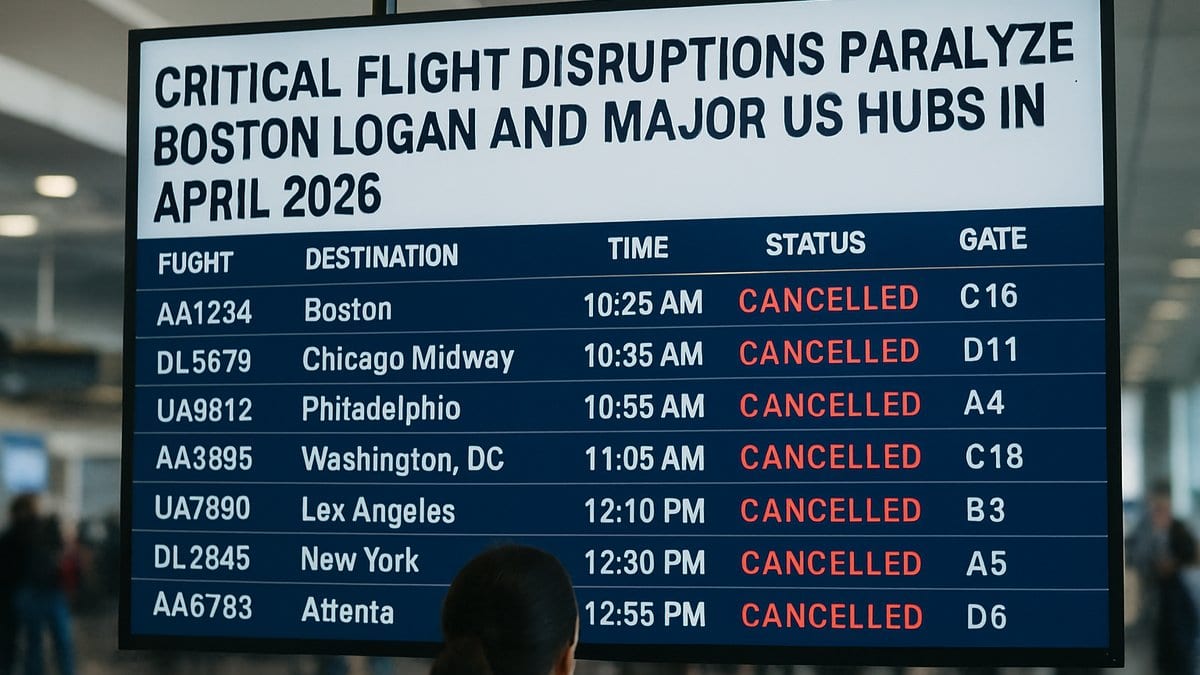
Early April 2026 is turning into a punishing stretch for air travelers as Boston Logan International Airport and several major US hubs confront cascading delays and cancellations tied to severe weather, new safety restrictions and lingering fallout from recent ground stops.
Get the latest news straight to your inbox!
Stormy End to March Cascades Into April Disruptions
Reports on national aviation performance at the turn of the month indicate that a potent line of late March thunderstorms and heavy rain has created a difficult starting point for April travel. The same systems that battered parts of the Midwest and Mid-Atlantic have continued to influence flight operations, with low clouds, turbulence and lightning risk forcing repeated adjustments to schedules.
Publicly available flight tracking data shows that thousands of US flights were delayed or canceled between March 31 and April 2, as storm bands swept across multiple time zones and intersected several busy air corridors. The knock-on effect has been particularly visible at hubs responsible for feeding traffic into the Northeast, where aircraft and crews have struggled to return to their planned rotations.
In this environment, any additional strain on the system has quickly amplified into wider disruption. Even on days when local conditions appeared manageable at certain airports, arriving flights were already running hours behind schedule, limiting the ability of carriers to recover by the start of April’s first weekend.
Travel coverage focused on the early spring period notes that such compound events are increasingly common, as a mix of volatile weather, tight aircraft utilization and high demand leaves little spare capacity when storms stall over key regions.
Boston Logan Becomes a Bottleneck for Northeast Travel
Boston Logan has emerged as one of the most heavily affected focal points in this latest round of disruption. Coverage focused on New England travel reports waves of delays and cancellations as aircraft inbound from storm-affected cities arrive late or not at all, compressing departure banks and limiting options for rebooking.
Airport status tools monitored on April 3 and April 4 show fluctuating arrival and departure rates at Logan, with periods where traffic is held to manage spacing in poor conditions. Even short disruptions in flow have translated into lengthy waits at gates as crews time out, aircraft await deicing or fueling, and connecting passengers miss onward flights.
Boston’s role as both a transatlantic gateway and a busy domestic hub has further complicated the picture. When weather or operational issues ripple through mid-continent hubs or the Washington area, flights that would ordinarily continue on to New England often arrive out of position. Published analyses of recent disruptions point to a pattern in which Logan becomes a bottleneck for the broader Northeast network, especially at the start and end of the day.
Local travelers have taken to social platforms to describe extended lines, crowded concourses and gate changes, although some accounts also note that the experience can vary significantly by time of day and terminal. For many, the key challenge has been uncertainty as rolling delays turn into cancellations with limited advance notice.
Ground Stops and Safety Rules Ripple Through Major Hubs
Compounding the storms and network congestion, recent operational restrictions at major hubs have added another layer of complexity. Published coverage of a late March ground stop affecting Washington-area airports describes an incident that led the Federal Aviation Administration to temporarily halt departures for specific carriers at Reagan National and Dulles International. The stoppage was relatively short, but its impact reached far beyond the mid-Atlantic.
Because those airports function as key hubs for large US airlines, the pause in departures disrupted complex sequences of aircraft and crew assignments. Flights that would have continued northward or connected through other hubs were delayed or canceled, leaving aircraft out of position just as April travel began to ramp up. Subsequent schedules into Boston and other Northeast destinations were still absorbing that shock into the first days of the month.
At the same time, new and updated safety directives have been quietly altering the operating environment for carriers. Industry and government notices issued in recent weeks highlight tighter requirements related to certain aircraft inspections, weather-related spacing on congested arrival paths and procedures during low-visibility operations. While often invisible to passengers, these rules can lower the maximum number of arrivals or departures allowed per hour during marginal conditions, effectively throttling capacity when demand is high.
Analysts following aviation performance in 2026 have emphasized that ground stops, temporary restrictions and infrastructure constraints at one or two hubs frequently cascade through the network, even if individual events appear localized. For travelers, that has meant disruption at airports far from the original trigger, including Boston Logan and other major coastal gateways.
Nationwide Weather and Infrastructure Strains Intensify the Crunch
The paralysis unfolding at Boston Logan and other hubs in early April is not occurring in isolation. Travel reports from Houston, Rochester and Minneapolis over the past several days describe significant slowdowns linked to severe thunderstorms, freezing rain and late-season wintry mixes. Each of these regional events has contributed its own batch of delays and cancellations, further tightening an already stressed system.
In Houston, spring storms and ongoing construction projects at a major international airport have triggered lengthy ground delays and forced airlines to reroute or consolidate flights on short notice. Rochester, a smaller but strategically important station for connections into the Northeast, has seen repeated service disruptions as airlines navigate rapid shifts between snow, sleet and heavy rain. The Upper Midwest has confronted similar challenges, with deicing queues and runway treatment requirements slowing operations during passing squalls.
When these regional bottlenecks line up with storms affecting Chicago, Denver or other central hubs, the result is a national pattern in which schedule reliability deteriorates almost everywhere at once. Expert commentary on 2026 delay trends points to an increasingly interconnected system in which there is little buffer capacity to absorb overlapping weather events, infrastructure projects and safety-driven restrictions.
For passengers looking at departure boards, the result can appear as a patchwork of explanations ranging from “weather” and “air traffic control” to “late arriving aircraft” and “crew availability.” Behind that patchwork sits a common thread of constrained resources and a fragile equilibrium between planned timetables and real-time conditions.
What Travelers Can Expect in the Coming Days
With forecasts pointing to additional unsettled weather across parts of the Midwest and Northeast in the short term, travel observers expect the disruption at Boston Logan and other hubs to persist at least through the first full weekend of April. Recovery timelines often extend several days beyond the last major storm cell, as airlines work through backlogs of displaced passengers and reposition aircraft to their intended routes.
Public guidance from airlines and travel experts continues to stress the importance of flexibility. Same-day rebooking, voluntary travel waivers and the option to connect through alternative hubs are all being referenced as tools for navigating the current environment. Passengers with nonessential trips are being encouraged, where possible, to shift travel to off-peak days or times, when schedules are slightly less compressed.
For those who must travel, widely shared best practices include building extra time into connections, monitoring airline apps and flight tracking tools frequently, and preparing for potential overnight disruptions with contingency plans for accommodation. At Boston Logan in particular, early-morning and late-evening flights may face heightened risk of disruption as the system attempts to reset from the prior day’s delays.
Looking slightly further ahead into April, industry analysis suggests that bouts of significant disruption are likely to remain a feature of the season, even as winter weather gradually gives way to convective storm patterns. The experience at Boston Logan and other hubs in early April 2026 offers a vivid illustration of how quickly critical flight disruptions can paralyze key nodes in the US air travel network when multiple stressors converge at once.