

More news on this day
European river cruising is enjoying renewed momentum, and Spain is fast becoming one of its most dynamic gateways as CroisiEurope strengthens air access to key cruise hubs and expands packages tailored to international travelers.
Get the latest news straight to your inbox!
Spain Emerges as a Strategic River Cruise Gateway
Spain’s wider cruise sector is entering a record-setting phase, creating favorable conditions for river cruise operators looking to expand. Recent port data show Spanish ports handled more than 14 million cruise passengers in 2025, a new annual high that underscores the country’s growing role in European cruise tourism.
While much of that traffic is still ocean-based, the uplift is spilling over into river and coastal itineraries, particularly in Andalusia and along the Iberian Atlantic fringe. Industry outlooks on the European cruise market highlight Spain among the countries driving projected growth through the next decade, as operators diversify beyond traditional hubs in Germany and France.
River cruising remains a relatively small segment in Spain compared with established Rhine and Danube routes, but demand indicators are strong. Market analyses point to sustained interest in culture-focused, small-ship experiences, with Spain’s historic cities and warmer climate positioning it as a natural complement to central European river corridors.
Analysts also note that Spain’s broader tourism recovery, which saw the country welcome close to 100 million international visitors in 2025, is bolstering confidence among cruise brands. As airlines rebuild capacity and new connections come online, the country’s airports are becoming key arrival points not only for Mediterranean sailings but also for river itineraries that begin or end in Iberian ports.
CroisiEurope Ties Flight Options to River and Coastal Routes
CroisiEurope, one of Europe’s largest river cruise specialists, has been steadily building out air-inclusive options aligned with its network of river, coastal, and canal sailings. Publicly available information on the line’s distribution strategy shows a focus on simplifying travel by packaging flights, transfers, and cruises under a single booking, particularly for long-haul markets.
The company has a track record of partnering with airlines to bundle air and cruise, including programs historically marketed in North America that offered flights and airport transfers directly alongside river itineraries. Recent trade coverage indicates that CroisiEurope is extending this model through collaborations with tour operators and vacation companies, allowing travelers to combine European flights with cruises on rivers such as the Douro, Rhine, and Danube.
In the Spanish market, the emphasis now is on streamlining access to embarkation hubs that serve Iberian and Western Mediterranean programs. These include itineraries that connect Spain with Portugal on the Douro as well as coastal and small-ship journeys calling at Spanish ports. Travel industry reports show that new partnerships with air-focused tour operators are aimed at making it easier for guests to align flight schedules with sailing departures, reducing the complexity of do-it-yourself connections.
For international travelers, particularly from North America and Latin America, integrated air-and-cruise packaging is emerging as a key selling point. Instead of booking flights, hotels, and transfers separately, passengers can increasingly opt for bundles that route them via major Spanish or neighboring hubs and deliver them directly to their ship, often with pre-arranged ground transport.
Key Spanish Hubs and Featured River Itineraries
Although Spain is better known for its ocean terminals in Barcelona and the Canary Islands, it is also a gateway to river cruising on the Iberian Peninsula. The standout example is the Douro, where many itineraries weave between Portugal and western Spain, linking Porto with historic inland cities such as Salamanca. CroisiEurope and other operators feature these routes as culture-rich journeys focused on wine regions, medieval towns, and UNESCO-listed landscapes.
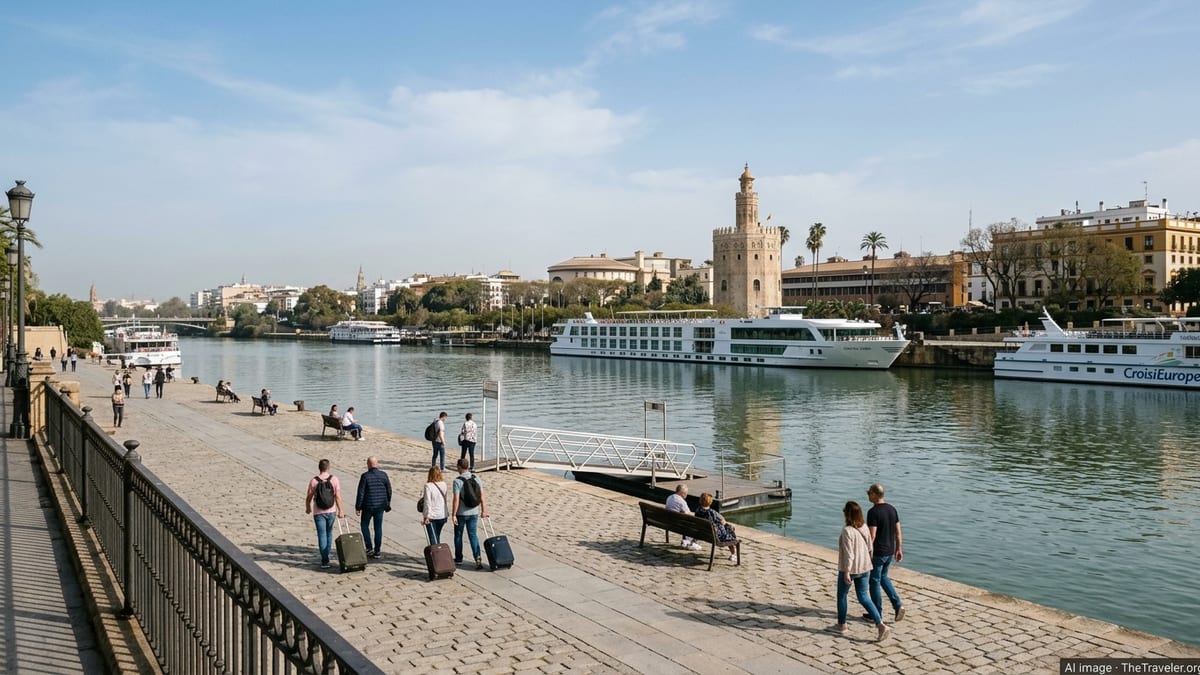
Southern Spain is another focal point as operators position small ships and river vessels close to Andalusian highlights. Travel brochures and cruise programs reference itineraries that use ports near Seville to access the Guadalquivir, creating hybrid experiences that combine river segments with coastal navigation to the Atlantic. These routes often include overland excursions to Moorish palaces, whitewashed villages, and flamenco districts, aiming squarely at travelers seeking immersive cultural content.
Barcelona, while primarily an ocean-cruise hub, also plays an indirect role as an aviation gateway for river cruises elsewhere in Europe. Flight schedules allow travelers to route through Barcelona or Madrid and then connect onward to embarkation cities along the Rhine, Danube, or Rhône. Industry observers note that this network effect is increasingly important as cruise lines encourage guests to see Spain as part of a broader multi-country river voyage.
As CroisiEurope promotes air-connected cruise packages, Spanish cities figure prominently in pre- and post-cruise extensions. Guests are encouraged to add nights in Barcelona, Madrid, Seville, or Lisbon before boarding river vessels, transforming a week on the water into a longer Iberian holiday that blends urban stays with slow travel along rivers and coasts.
Growing Demand, Overtourism Concerns, and Sustainability
The rapid expansion of cruise tourism in Spain has coincided with renewed debate about the sector’s impact. News reports on tourism protests in 2024 and 2025 highlighted concerns over overtourism in major Spanish destinations, with residents calling for a more balanced model that protects housing, public space, and local services. Although river vessels are smaller than large ocean ships, the broader cruise boom places additional scrutiny on all segments of the industry.
At the European level, regulators and industry bodies have been pushing for cleaner and more efficient inland waterway fleets. Recent inland navigation reports note that a growing proportion of river cruise vessels now use hybrid propulsion, shore power, and upgraded emissions systems. These developments are particularly relevant on major rivers such as the Rhine and Danube, but similar standards are expected to influence vessels operating around the Iberian Peninsula.
CroisiEurope has promoted its use of modern, shallow-draft ships and smaller passenger capacities as a way to access less-crowded ports and waterways, including in Spain and Portugal. Public information on the company’s fleet suggests that newer ships are designed to meet evolving environmental requirements across European rivers, which may help river cruising position itself as a lower-impact alternative to mass-market ocean itineraries in sensitive destinations.
Spain’s policymakers and port authorities, meanwhile, are working to align cruise growth with local expectations. Industry coverage of trade events dedicated to cruising in Madrid indicates that river and small-ship operators are increasingly involved in discussions about itinerary planning, capacity management, and the use of new technologies, including artificial intelligence, to better distribute visitor flows.
What Travelers Need to Know Before Booking
For travelers considering a river cruise that starts, ends, or connects via Spain, the expansion of air access means more options and potentially smoother journeys. Many of CroisiEurope’s air-inclusive offers route passengers through major European hubs with onward connections to Spain or Portugal, and then on to river embarkation cities. Booking through a tour operator or vacation company associated with the line can simplify logistics, particularly when flight delays or schedule changes occur.
Travel advisers recommend paying close attention to which airports are included in a given package and how transfers are arranged between the terminal and the ship. In some cases, guests may overnight in a Spanish city before boarding, while in others, transfers are timed to same-day embarkation. River cruise lines typically advise arriving at least a day early when traveling long-haul, and bundled air-and-cruise products are increasingly designed with this buffer in mind.
Travelers should also consider seasonal factors. Spring and autumn departures on Iberian and European rivers are gaining popularity, offering milder temperatures and fewer crowds in major cities. Market reports suggest that shoulder-season itineraries are an important growth segment, particularly for Spanish-speaking travelers and North Americans seeking quieter travel periods.
Finally, sustainability considerations are becoming part of the booking decision. As more river vessels adopt cleaner technologies and ports in Spain and across Europe upgrade shore power facilities, travelers are showing greater interest in environmental credentials. Reviewing information on ship size, passenger capacity, and emissions initiatives can help guests choose itineraries that align with their expectations for responsible travel while still taking advantage of Spain’s improving air links to Europe’s storied rivers.