

More news on this day
From the German-Polish frontier to the Alpine passes between Italy, Austria and Slovenia, European motorists in 2026 are increasingly turning their road trips into fuel runs, crossing borders to save tens of euros every time they fill up their tanks.
Get the latest news straight to your inbox!
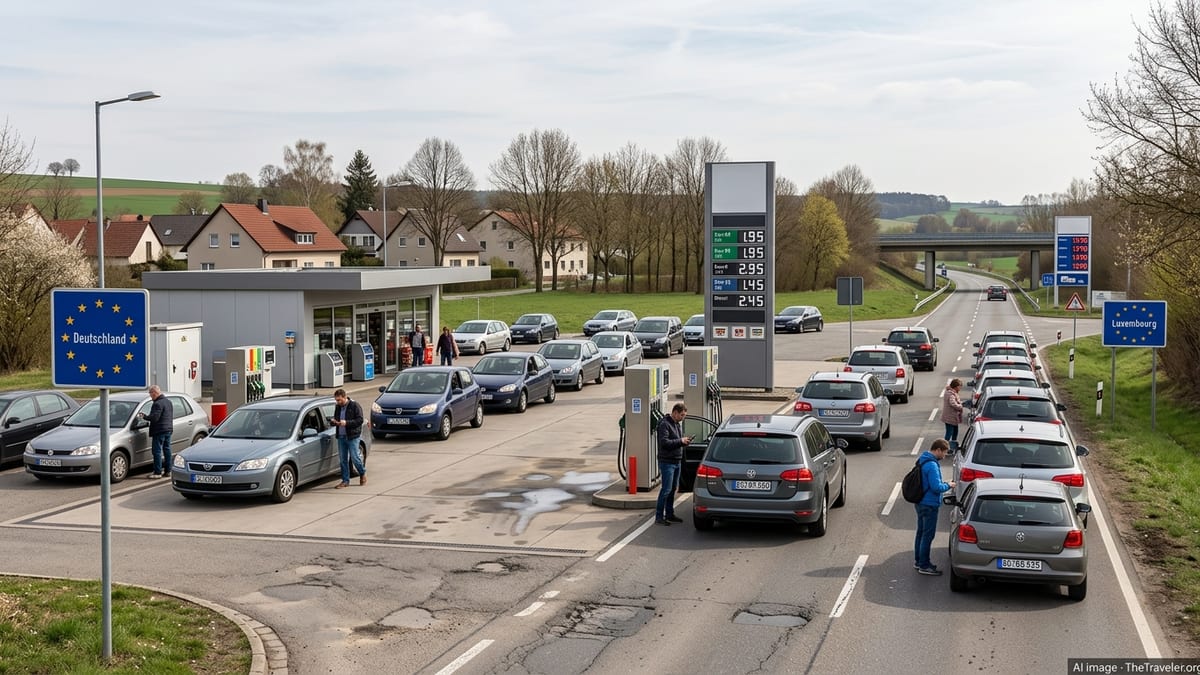
Image by Travel and Tour World – Tourism, Airline, Destination, MICE, Gobal Travel Market, Hotel news that you will find only over here.
Price Shocks Revive a Long-Standing Border Phenomenon
Sharp increases in retail petrol and diesel prices across much of Europe since late February 2026 have pushed cross-border “fuel tourism” back into the spotlight. Publicly available pricing data indicate that pump prices in large economies such as Germany have climbed toward or above 2 euros per litre, widening longstanding gaps with lower-tax neighbours and making a short detour across a frontier financially worthwhile for many drivers.
Reports from regional media in Central Europe describe a marked rise in cross-border traffic to stations in Czechia, Poland, Austria and Luxembourg, where prices remain noticeably below German levels. For households facing higher costs of living and for small businesses heavily reliant on vehicles, the potential to save 20 to 30 euros on a single 50-litre refill has become a significant incentive to plan journeys around cheaper pumps.
The pattern is not confined to one corridor. Similar dynamics are visible from Scandinavia to the Balkans, as disparities in taxes, subsidies and regulatory caps on fuel prices continue to create incentives for motorists to cross into neighbouring jurisdictions whenever geography and time make it practical.
Industry and policy analyses point out that only a fraction of the retail price at the pump reflects the underlying cost of fuel itself. Differences in national excise duties and value added tax explain much of the variation between countries, leaving governments’ fiscal choices at the centre of Europe’s renewed fuel tourism map.
Hotspots from the Baltic to the Balkans
In Central Europe, recent coverage has highlighted a so‑called “petrol carousel” along Germany’s eastern borders. Lower prices in western Poland and Czechia have drawn German motorists in large numbers, with some Polish outlets noting local irritation as foreign-registered cars queue for cheaper fuel and, in places, contribute to temporary shortages.
Farther south, Bulgaria has emerged as a draw for drivers from Romania and Greece, where domestic prices have climbed more steeply. Accounts from border regions such as Ruse and the Kulata crossing describe busy forecourts catering to visitors who often combine refuelling with other cross-border purchases. Lower underlying import costs and comparatively lighter fuel taxation keep Bulgarian prices below many of its neighbours, sustaining the flow of visitors.
In the Benelux region, fuel tourism has been a feature of life for years, but recent data underline its economic impact. Sector statistics in the Netherlands show that petrol and diesel sales fell in 2025 compared with the previous year, with analysts attributing part of the decline to Dutch drivers filling up across the border in Belgium and Germany where excise levels are often lower.
Even at Europe’s northern fringe, price differentials continue to shape driving behaviour. Anecdotal accounts from border communities describe Swedish stations attracting Norwegian motorists whenever the combination of pump prices, exchange rates and discounts tilt in Sweden’s favour, particularly during periods of elevated taxes and carbon charges on the Norwegian side.
Slovenia, Italy and Austria Illustrate Policy Tensions
The northern Adriatic and Alpine border region has become one of the clearest illustrations of how national price controls and tax policy can redirect regional fuel flows. In Slovenia, government regulation currently keeps retail petrol and diesel prices among the lowest in the European Union, with caps adjusted roughly every two weeks. Local and regional media report that this has drawn in drivers from Italy and Austria, in some cases leading to unusually high demand at stations close to the frontier.
At the same time, Italy has its own long tradition of using regional tax subsidies to influence refuelling patterns. In the border region of Friuli Venezia Giulia, publicly available guidance indicates that residents can still benefit from discounts that partially offset higher national excise levels, making some Italian stations competitive for petrol even as Slovenia remains more attractive for diesel. This creates a patchwork in which the best place to fill up can change over just a few kilometres.
Austria’s role in the regional fuel landscape has shifted as well. Analyses of 2024 and 2025 price data show that Austrian pump prices rose noticeably at the start of 2025, narrowing some of the historical advantage its drivers enjoyed but still leaving certain cross-border differentials in place. For motorists in southern Austria, Slovenia’s regulated prices remain an appealing option, particularly for high-mileage drivers and commercial operators able to refuel large tanks just across the border.
Economists studying the region note that such policy-driven price gaps can have measurable effects on traffic volumes at specific crossings, as well as on the turnover of small independent stations that either lose domestic customers to nearby countries or gain new business from foreign drivers seeking cheaper fuel.
Hungary and Slovenia Use Price Caps as Crowds Grow
Recent developments in Hungary and Slovenia highlight how regulatory interventions can intensify cross-border fuel tourism. In early March 2026, Hungary announced a fresh cap on petrol and diesel prices, setting maximum levels per litre for domestic vehicles. The decision followed a surge in international oil prices and renewed concerns about inflation, and it echoed an earlier cap introduced in 2021 that had previously made Hungary one of the cheapest places in the region to fill up.
Historical assessments of Hungary’s previous cap period describe how significantly below-market prices drew in buyers from neighbouring states and contributed to localised fuel shortages, especially when refinery maintenance constrained supply. The new measures explicitly limit capped prices to vehicles with Hungarian registration, reflecting an attempt to prevent a repeat of earlier episodes when foreign motorists were able to benefit directly from the subsidy.
In Slovenia, authorities have not only maintained regulated pump prices but have also responded to recent demand surges by drawing down strategic oil reserves. Coverage in regional outlets notes that some service stations near the Austrian border experienced temporary stockouts following a spike in cross-border demand linked to Slovenia’s comparatively low prices. Officials have reacted by setting purchase limits and reallocating supplies to busier locations.
These cases underscore the delicate balance governments attempt to strike between shielding domestic consumers from sudden price spikes and avoiding distortions that encourage arbitrage, strain logistics and complicate relations with neighbouring countries facing higher market-based prices.
How Road Trippers Are Planning Around Price Gaps in 2026
For individual travellers, the resurgence of cross-border fuel tourism has become part of broader trip planning across the continent in 2026. Travel advice sites and motoring clubs now routinely publish comparative price tables by country, encouraging drivers to check the latest figures before setting out and to consider where along their route it makes financial sense to refuel.
Examples drawn from these comparisons are striking. Data for 2025 show average petrol prices in Germany well above those in neighbouring Poland and Czechia, while Slovenia’s capped prices remain below those in Austria and Italy. For a family car or campervan with a large tank, waiting to cross a border before refuelling can translate into savings that offset motorway tolls, vignette fees or accommodation costs during a multi-day trip.
However, analysts caution that price gaps can be volatile, particularly in the current environment of geopolitical tension and fluctuating crude oil costs. Taxes can be adjusted at short notice, and temporary subsidies or price caps can be introduced or withdrawn within weeks. As a result, road trippers who plan around cheaper fuel across borders are increasingly advised to rely on up-to-date, official price bulletins and to remain flexible if conditions change.
Despite this uncertainty, the underlying drivers of Europe’s fuel tourism trend show little sign of disappearing. As long as national governments set their own tax rates and policy responses to energy price swings, motorists will continue to scan price boards on the far side of borders and to weave these differences into the fabric of their journeys across the continent.