

More news on this day
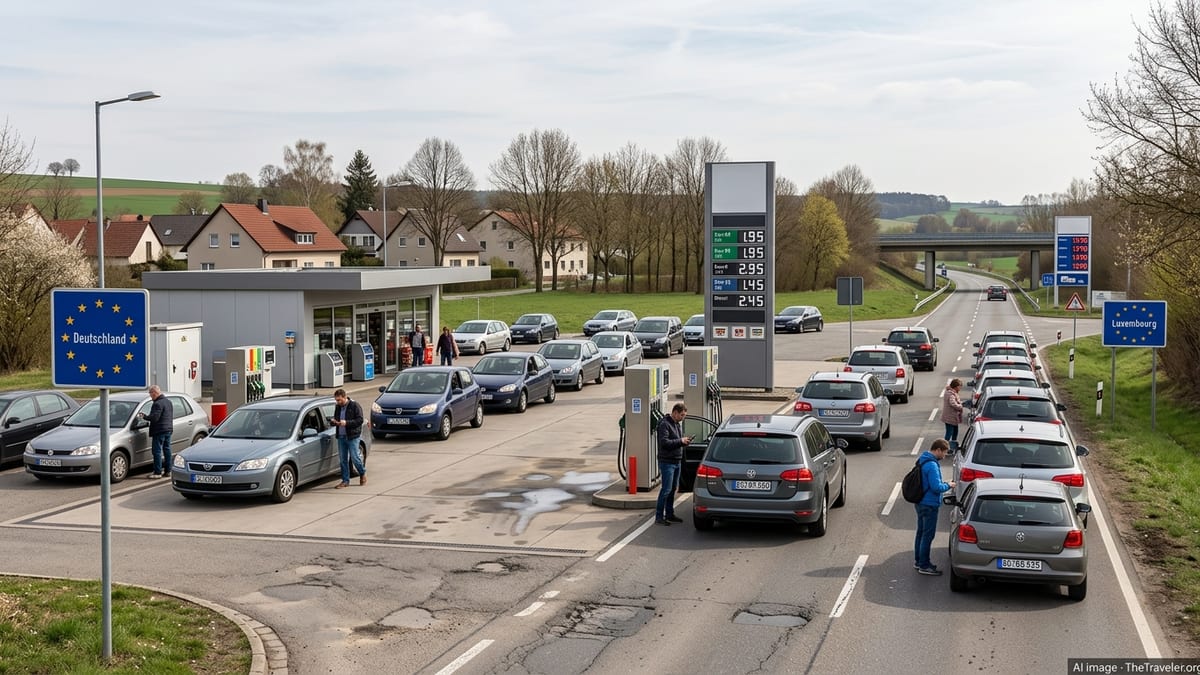
From the Alps to the Pyrenees, European road trippers are increasingly plotting routes not just around scenery, but around petrol and diesel price gaps that can shave double-digit euros off every fill-up.
Get the latest news straight to your inbox!
Price Gaps Widen as Fuel Costs Climb
Fresh data for early March 2026 show wide differences in petrol and diesel prices across the European Union, creating strong incentives for motorists to refuel in cheaper jurisdictions. Tracking by specialist platforms based on the European Commission’s Oil Bulletin indicates average Euro 95 petrol at about 1.57 euros per litre across the bloc, but with national prices ranging from around 1.27 euros in the cheapest countries to above 2 euros in the most expensive markets.
Bulgaria, Cyprus, Malta and Poland currently sit at the lower end of the petrol price table, while Germany, Denmark, Finland and the Netherlands occupy the upper tier for both petrol and diesel. In practical terms, that can mean a difference of 30 to 40 euro cents per litre between neighbouring states. For a 50-litre tank, drivers who cross a border before filling up can save 15 euros or more, a meaningful sum for commuters and holidaymakers watching household budgets.
Those gaps have widened further since late February, when the conflict in Iran pushed wholesale oil prices higher and rippled through European forecourts. According to recent business coverage, Germany has seen petrol prices climb by almost 5 percent in just a few weeks, noticeably more than the EU average, while France, Austria and Luxembourg have recorded more modest increases. Against that backdrop, differences of even a few cents per litre are enough to trigger what analysts describe as “fuel tourism” along internal EU borders.
For road trippers mapping spring and summer journeys, these divergences are no longer a niche concern for professional drivers. Publicly available price comparisons suggest that a family driving several thousand kilometres across the continent can save the equivalent of a night in a mid-range hotel simply by timing refuelling stops in lower-cost countries.
Luxembourg, Slovenia and Spain Emerge as Hotspots
Some long-standing fuel tourism hotspots are seeing renewed attention in 2026. Luxembourg remains one of the most prominent examples, with government figures for 2025 showing that cross-border workers could save up to 15 euros per tank compared with refuelling in Germany, Belgium or France. Low excise duties and a system of maximum pump prices have historically kept Luxembourg’s forecourts busy with foreign-plated vehicles seeking cheaper fuel.
Further south, Slovenia has become a focal point after the government extended fuel price regulation and maintained caps on margins at petrol stations, including those along motorways. Regional energy reports describe Slovenia’s regulated prices as among the lowest in Central Europe, especially for diesel, encouraging motorists from neighbouring Austria and Italy to cross the border to fill up. In March 2026, local media coverage highlighted increased demand from Austrian drivers and temporary shortages of some products at busy stations.
On the Iberian Peninsula, a different dynamic is at work. While Spain sits in the middle of the European price league, recent fluctuations have left pump prices noticeably below those in France and above those in Portugal for some fuel types. This has sustained cross-border refuelling flows on both the French-Spanish and Spanish-Portuguese frontiers, adding to long-established patterns of motorists pairing shopping trips with cheaper fuel stops.
These hotspots illustrate how national tax policies, regulatory choices and subsidy schemes translate into highly localised travel behaviours. Even modest differences in tax rates or margin caps can, when compounded by global market swings, make a border village service station significantly more attractive than one just a few kilometres away on the other side.
Border Regions Feel the Surge in Traffic
The most immediate impact of fuel tourism is felt in border regions, where service stations, retailers and local authorities must cope with rapid swings in demand. Recent coverage of the French-German and French-Swiss borders points to notable surges in cross-border traffic since February as Germany’s diesel prices have moved above the two-euro mark while averages in France have remained lower.
Similar pressures have been reported in parts of Slovenia, where capped prices have encouraged foreign motorists to plan specific refuelling trips. Local news outlets have described queues at some stations and instances where diesel pumps were temporarily emptied following waves of visitors from Austria. While such episodes are typically short-lived, they underline how sensitive cross-border flows can be to relatively small price changes.
Retailers close to borders can benefit from increased turnover when motorists combine fuel stops with grocery shopping or other purchases. However, business groups in higher-price countries have raised concerns that sustained fuel tourism may divert spending away from domestic forecourts and convenience stores. In some regions, commentators note that smaller filling stations further inland struggle to compete when drivers are willing to travel an extra 30 or 40 kilometres to cross into a cheaper market.
Road management is another emerging issue. Transport specialists say heavier car and light van traffic on secondary roads leading to border crossings can add to congestion at peak times, particularly during holiday periods. This is especially visible where cheap-fuel corridors coincide with popular tourist routes through mountain passes or coastal regions.
Apps, Data and Hyper-Planned Road Trips
The growth of digital tools is amplifying the trend. Route-planning apps, fuel price comparison sites and in-car navigation systems increasingly integrate real-time or weekly updated forecourt prices. Publicly available platforms built on EU oil bulletin data allow drivers to compare national averages and, in some cases, locate individual stations advertising lower prices along their planned path.
Travel booking services and toll vignette retailers also highlight fuel price differentials in their advisory content, encouraging customers to refuel in specific countries before entering higher-cost markets. One 2026 overview aimed at long-distance drivers in Central Europe suggests that pre-planning refuelling and toll purchases together can produce “real savings” on multi-country itineraries, particularly for those driving larger, less fuel-efficient vehicles.
For holidaymakers, this has turned the once-simple refuelling stop into part of a broader optimisation exercise. Social media discussions show drivers trading tips on where to cross a border to combine lower fuel prices with cheaper motorway vignettes or rest stops. The result is a form of micro-arbitrage, where private motorists behave more like professional hauliers, calculating the most cost-effective places to top up.
Industry observers note that as digital tools become more sophisticated, they can respond rapidly to geopolitical or market shocks. The most recent spike in prices following tensions in the Middle East, for example, was quickly reflected in updated indices and maps, allowing consumers to adjust plans within days rather than weeks.
Policy Debate: Tax Revenues, Climate Goals and Fairness
The rise of fuel tourism is feeding into wider policy debates about taxation, climate targets and equity between member states. Comparative analyses from Eurostat and other institutions show that taxes and levies can account for a large share of final fuel prices in many EU countries, with northern and western states generally imposing higher excise duties than some central and eastern neighbours.
In Luxembourg, international economic surveys have long highlighted that relatively low fuel taxes encourage residents of neighbouring countries to refuel there, effectively exporting part of the tax base from higher-duty jurisdictions. Recent policy discussions in Brussels and national capitals have revisited whether such disparities distort the internal market or simply reflect the fiscal autonomy of member states.
Environmental groups argue that fuel tourism can undermine climate policy by incentivising extra kilometres driven purely to access cheaper fuel, while also weakening the price signal that higher carbon taxes are meant to send. Business associations and motoring clubs, on the other hand, often present cross-border refuelling as a rational consumer response to uneven taxation and regulatory measures.
With fuel prices likely to remain volatile through 2026, analysts expect the phenomenon of cross-border fuel tourism to persist, particularly in regions where regulated prices or tax freezes temporarily break the link between global crude benchmarks and local pump prices. For Europe’s most dedicated road trippers, the cheapest litre may continue to lie just across the next border.