

More news on this day
Rapidly unfolding security tensions and airspace closures around the Arabian Gulf are triggering a wave of cruise cancellations at key ports in Dubai, Doha and Muscat, disrupting winter travel plans and clouding growth prospects for one of the world’s fastest-rising cruise regions.
Get the latest news straight to your inbox!
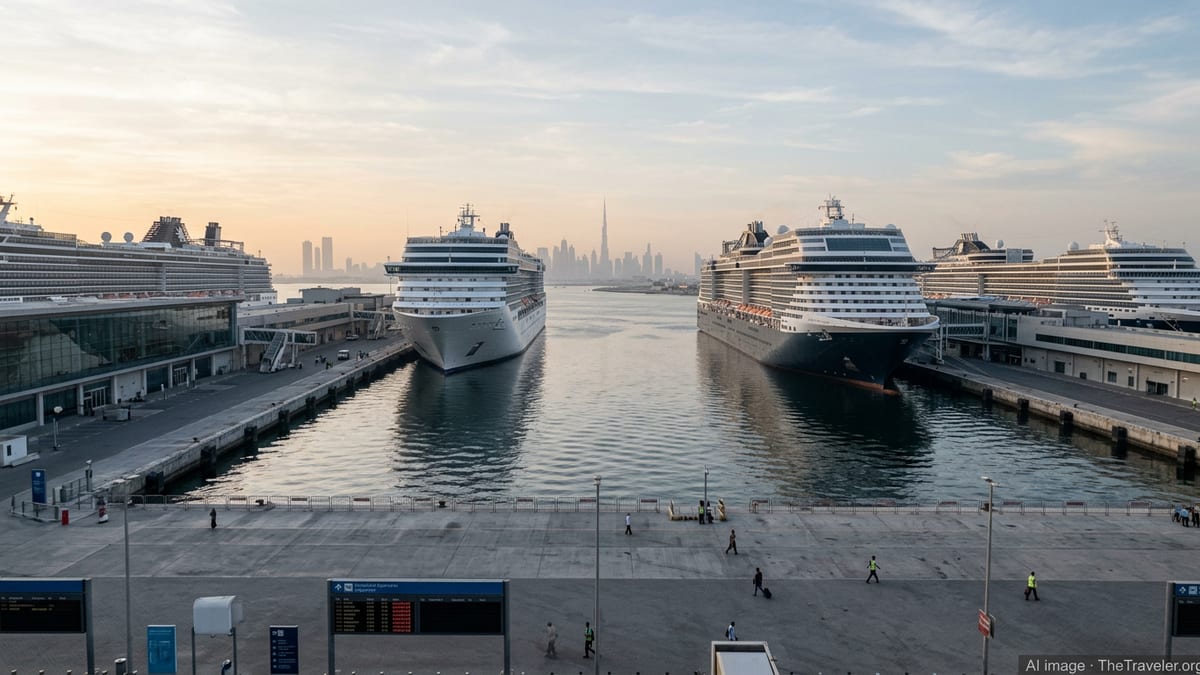
Ships Stuck, Sailings Scrapped Across the Arabian Gulf
In early March 2026, at least six major cruise ships remained stuck in ports across the United Arab Emirates and Qatar after departures were halted amid the evolving regional crisis. Publicly available reports describe vessels from MSC Cruises, TUI Cruises, Celestyal and Saudi-backed Aroya Cruises held in Dubai, Abu Dhabi and Doha while operators reassessed safety, route viability and passenger repatriation options.
Coverage of the disruption indicates that MSC Euribia, Celestyal Journey, Celestyal Discovery and TUI’s Mein Schiff 4 and Mein Schiff 5 are among the most affected ships. Some had been poised to shift from Gulf itineraries to early spring European programs, but schedules were abruptly broken when sea-lane restrictions and airspace shutdowns made onward voyages uncertain or impossible.
Travel and cruise industry outlets report that operators have reacted by cancelling upcoming sailings, cutting European deployment segments and arranging emergency travel for thousands of guests. In several cases, cruise lines have ended seasons early and focused on getting passengers home rather than attempting to complete published itineraries.
Why Dubai, Doha and Muscat Are Suddenly Vulnerable
The immediate backdrop to the disruption is a broader maritime security crisis stretching from the Red Sea to the Strait of Hormuz. Since late 2023, attacks and threats against commercial shipping in the Red Sea and Gulf of Aden have already pushed many cruise lines to drop Suez Canal and Middle East transit itineraries. By early 2026, heightened tensions had spilled over into the narrow chokepoint that connects the Arabian Gulf to the open ocean.
Regional advisories show that, while there has been no formal international closure of the Strait of Hormuz, heightened risk assessments, insurance constraints and company-level directives have led many commercial operators, including cruise lines, to avoid the passage. At the same time, airspace closures and widespread flight cancellations across Gulf states have sharply reduced options for repositioning ships and moving passengers.
For ports such as Dubai’s Port Rashid and Mina Hamad in Doha, this combination creates a double bind. Cruise vessels can arrive and disembark guests, but onward sailings may be unsafe or commercially unviable, while limited airlift makes it difficult to fly passengers onward or home. Muscat and other Omani ports face similar uncertainty whenever risk levels rise near the Strait or along traditional approach routes.
Major Lines Cut Middle East Seasons and Redeploy Ships
Even before the latest escalation, several major brands had already reduced their exposure to Gulf and wider Middle East cruising. According to industry coverage, AIDA Cruises confirmed the cancellation of its entire 2025 to 2026 Middle East season, withdrawing AIDAprima from planned winter operations between Dubai, Abu Dhabi and Oman and redeploying the vessel to Northern Europe and Atlantic itineraries.
Costa Cruises has taken similar steps, scrapping a 2025 to 2026 Costa Toscana winter program that would have been based from Dubai with cruises across the United Arab Emirates and Oman. Documentation outlining Costa’s updated deployment shows the ship retained in the Mediterranean instead, with new itineraries linking Italian, Spanish, French and Moroccan ports during the same period.
More recently, Resorts World Cruises curtailed its foray into the Gulf. Travel notices issued in January 2025 confirmed the early cancellation of Resorts World One’s Dubai departures from late February that year, cutting short a season that had been promoted as a new short-break option from Port Rashid. Collectively, these decisions illustrate a broader pattern of lines retreating from the region, long before the latest crisis left ships stranded.
Tourism Impact on Gulf Gateways and Shore Destinations
The cruise pause is particularly sensitive for Dubai, Doha and Muscat, all of which have invested heavily in terminals, marketing and shore-excursion infrastructure to capture winter sun and city-break traffic. Over the last decade, these ports positioned themselves as turnaround and transit hubs connecting European source markets with Arabian desert experiences, modern skylines and heritage coastal towns.
Economic studies and regional tourism plans have highlighted the role of cruise traffic in supporting local tour operators, transport providers, retailers and hospitality businesses. Each cancelled call removes thousands of potential visitors from city centers, souks and beaches during prime months, with knock-on effects for seasonal employment and small enterprises that rely on coach tours and day trips.
The latest cancellations also disrupt long-haul world cruises and grand voyages that previously stitched together Gulf ports with the Mediterranean and Asia via the Red Sea. With those through-routes now diverted around the Cape of Good Hope or reimagined entirely, Dubai, Doha and Muscat risk losing not only homeport traffic but also high-spend transit visitors who typically join curated excursions and premium experiences.
What Cruise Travelers Should Expect and How to Plan Ahead
For travelers holding bookings that include Dubai, Doha or Muscat in late 2025 and into 2026, reports from cruise and travel outlets point to an environment of ongoing change. Some itineraries are being cancelled outright, others are being reworked to substitute different ports, and a number of lines appear to be reducing future Gulf capacity in favor of more stable regions such as the Mediterranean, Northern Europe and the Caribbean.
Passengers whose voyages are affected can usually expect a mix of refunds, cruise credits or rebooking options, depending on the line and the timing of the disruption. However, recent events show that rapid changes to airspace and port conditions can complicate repatriation, leaving guests on board longer than intended or requiring complex multi-leg journeys home once flights become available.
Travel planners suggest paying close attention to official cruise line updates, monitoring airline schedules for the wider region and being prepared for last-minute alterations to embarkation and disembarkation points. For those still keen to explore the Arabian Gulf by sea, smaller operators and regional lines may continue limited operations if conditions permit, but the broader pattern signals a more cautious approach from major global brands until security and air connectivity across the region stabilize.