

More news on this day
Major European cruise brands MSC Cruises, TUI Cruises and Celestyal are pressing ahead with expanded Arabian Gulf programs for the 2026–27 season, signaling confidence in the region’s long-term tourism potential despite a turbulent period of itinerary disruptions and security-related cancellations.
Get the latest news straight to your inbox!
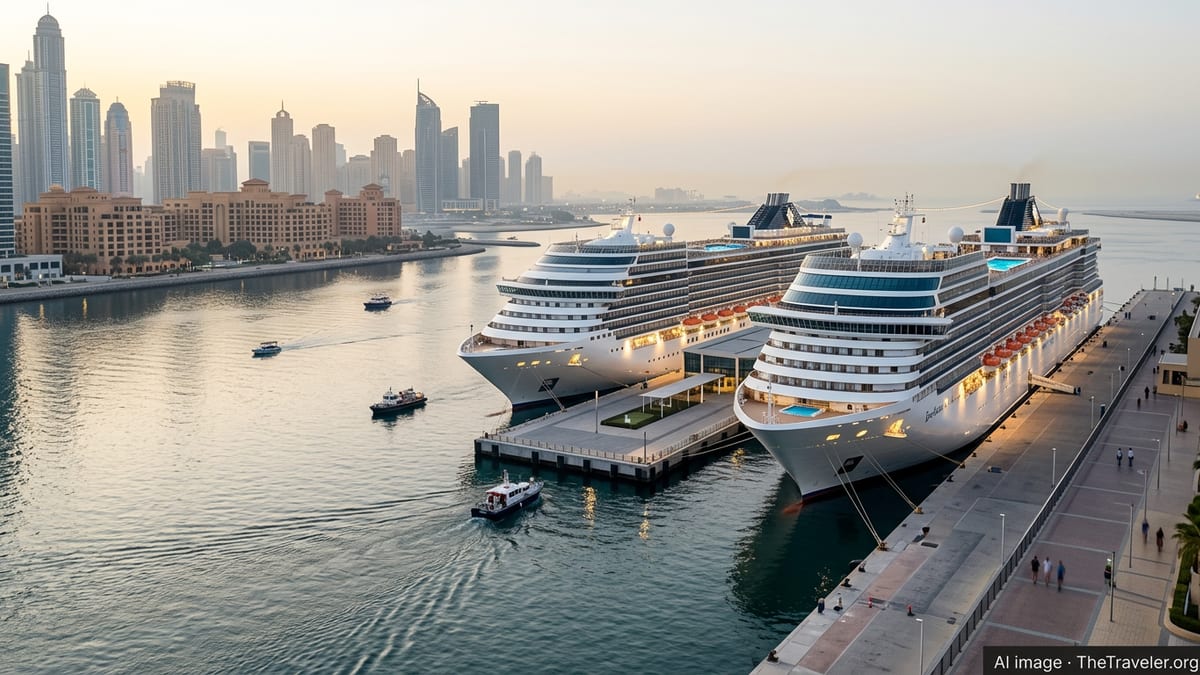
Gulf Cruise Ambitions Hold Steady After Disruptions
The Arabian Gulf has emerged as one of the most hotly contested growth markets in global cruising, with Dubai, Abu Dhabi and Doha competing to attract winter homeport business from European lines. Recent months have seen a patchwork of cancellations and reroutings as operators responded to regional security concerns and shifting demand patterns, yet deployment plans for 2026–27 show that the long-term trajectory remains pointed upward.
Publicly available information shows MSC Cruises, TUI Cruises and Celestyal all maintaining or expanding capacity in the Gulf across the middle of the decade, even as they fine-tune routes that previously depended on the Red Sea as a repositioning corridor. Cruise industry coverage indicates that operators are now favoring more contained, Gulf-centric itineraries and selective repositioning voyages, designed to keep ships close to well-developed ports and air hubs.
Analysts tracking the sector note that this recalibration has not translated into a retreat from the Gulf itself. Instead, ship schedules for late 2026 and early 2027 increasingly highlight seven-night and shorter regional cruises, opening the market to both European fly-cruise guests and a growing base of source markets in the Gulf states.
Celestyal Locks In Multi-Year Arabian Gulf Presence
Among the most visible bets on the region comes from Celestyal, which has pivoted from a primarily Eastern Mediterranean focus to a dual-ship deployment in the Arabian Gulf. Trade publications report that Celestyal Journey and Celestyal Discovery are being positioned as year-on-year winter regulars, with schedules stretching from late 2025 through at least 2027.
For the winters covering 2025–26 and 2026–27, Celestyal’s publicly distributed brochures outline a mix of three-, four- and seven-night itineraries built around Doha, Abu Dhabi and Dubai. Branded sailings such as “Desert Days” and “Iconic Arabia” are set to call at Sir Bani Yas Island, Bahrain, Khasab and Ras Al Khaimah, offering both marquee city stays and lesser-known ports. Capacity has been increased compared with Celestyal’s first Gulf season, with additional departures added after early bookings outpaced expectations.
The line has also introduced extended repositioning voyages linking Athens to the Gulf, which have been revised at times in response to Red Sea security advisories. Even with those adjustments, booking channels for 2026 and 2027 continue to feature a substantial slate of Gulf departures, underlining Celestyal’s intent to establish a permanent seasonal footprint.
TUI Rebuilds Strategy After Gulf and Red Sea Cancellations
TUI Cruises has faced some of the highest-profile disruptions affecting the region. Coverage in cruise and travel media during 2024 and early 2025 detailed the cancellation of several Red Sea repositioning cruises for Mein Schiff ships, citing security risks along key choke points. More recently, reports in March 2026 highlighted a halt to Arabian Gulf operations for Mein Schiff 4 and Mein Schiff 5, resulting in the loss of multiple departures from Dubai and Doha and prompting concern among regional tourism stakeholders.
Despite this, planning documents and industry commentary suggest that TUI has not abandoned the Gulf as a medium-term market. Instead, the brand appears to be recalibrating how and when it deploys capacity, with a stronger emphasis on point-to-point fly-cruise programs that avoid vulnerable transit zones. The 2025–26 winter schedule, for example, still includes seven-night Gulf itineraries from Dubai and Doha for selected ships, even as other voyages were withdrawn.
For the 2026–27 season, sector observers expect TUI to return with a more conservative but still meaningful presence, aligning cruise calls with peak hospitality demand in the United Arab Emirates and Qatar. This would mirror moves by rival lines to prioritize stable, air-accessible hubs while keeping options open to restore longer repositioning routes if security and insurance conditions improve.
MSC Cruises Balances Global Growth With Targeted Gulf Returns
MSC Cruises, already one of the largest players in the Middle East cruise market, continues to walk a tightrope between rapid global expansion and periodic itinerary changes. The company has announced a broad winter 2026–27 program featuring multiple ships in North America and the Caribbean, while Middle East deployments are being updated on a rolling basis in response to conditions in the Red Sea and around the Strait of Hormuz.
Industry reports indicate that marquee vessels such as the LNG-powered MSC World Europa and newer ships in the same class are expected to rotate between the Western Mediterranean and the Gulf over successive winters, including late 2026 and 2027. Earlier security incidents prompted temporary reductions in Gulf sailings and the adjustment of some shoulder-season voyages, but the line’s forward planning still highlights Dubai and other Gulf ports as key turnaround bases.
Travel trade coverage also points to the resilience of Gulf fly-cruise demand in MSC’s source markets, particularly in Europe, where guests are increasingly accustomed to combining city stays with week-long cruises. This demand profile supports the deployment of larger ships, even in a climate where individual cruises may be canceled, consolidated or re-routed closer to departure.
Security, Air Connectivity and Port Investment Underpin 2026–27 Outlook
The outlook for the 2026–27 Arabian Gulf cruise season ultimately hinges on three intertwined factors: regional security, international airlift and ongoing port investment. Recent crises affecting maritime routes into the Gulf have underscored the vulnerability of long repositioning voyages, but they have also highlighted the comparative strength of fly-cruise models that rely on modern airports in Dubai, Abu Dhabi and Doha.
Gulf tourism authorities have spent years expanding cruise terminals, streamlining immigration processes and integrating cruise operations with city tourism infrastructure. These investments are now being tested as lines adjust deployment strategies without wanting to forfeit hard-won market share. Publicly available port plans show continued upgrades to berths and terminals into the late 2020s, timed to accommodate larger newbuilds entering the fleets of MSC, TUI and Celestyal’s competitors.
For travelers, the near-term picture is one of abundant choice paired with a need for flexibility. The 2026–27 season is shaping up to feature a wide range of new and returning Gulf itineraries across all three brands, even as recent cancellations serve as a reminder that routes can change quickly. Industry observers suggest that the willingness of MSC, TUI and Celestyal to keep assigning ships to the region, despite short-term setbacks, is a strong signal that the Arabian Gulf will remain a cornerstone of winter cruising for years to come.