

More news on this day
Escalating conflict stretching from the Red Sea to the Strait of Hormuz is stranding cruise passengers across multiple continents, as cruise lines cancel sailings, divert ships around Africa and race to repatriate guests amid sweeping airspace closures and maritime security alerts.
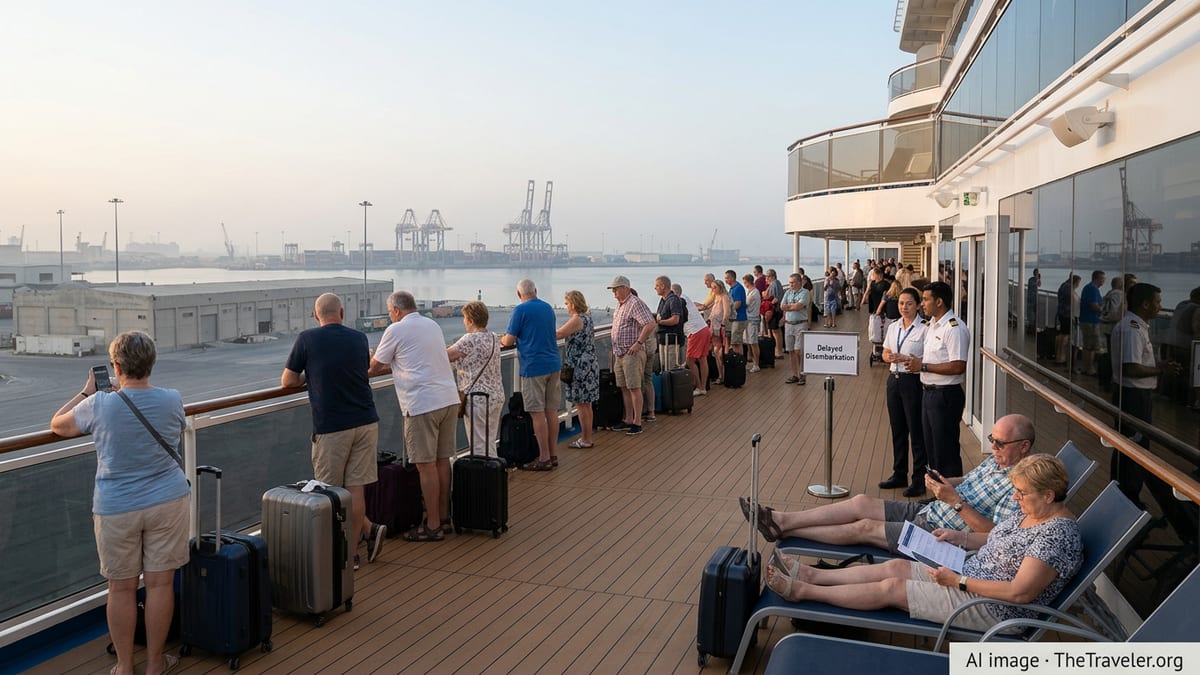
Cruise Itineraries Upended by Rapidly Shifting Conflict
The latest surge in hostilities involving Iran, Israel and Western allies has upended carefully planned cruise schedules that rely on Middle East choke points, particularly the Red Sea, Suez Canal and Strait of Hormuz. In recent days, war-related airspace closures and heightened naval warnings have compounded an already fragile security picture in waters that connect Europe with Asia and the Indian Ocean.
While container ships and tankers were the first to divert, the fallout is now hitting the cruise sector hard. Industry analysts say hundreds of thousands of travelers passing through regional hubs and sea lanes have been affected, as cruise operators suspend calls to Egypt, Jordan and Gulf ports or abandon whole seasons in the region. Many ships that would normally reposition via Suez between winter and summer programs are instead being rerouted on much longer voyages around the Cape of Good Hope.
The disruption builds on two years of intermittent tension in the Red Sea, where attacks on commercial shipping have already pushed up insurance costs and led global lines to treat the corridor as a high-risk zone. The latest Iran war and renewed threats against maritime traffic have now tipped the balance decisively against operating passenger vessels in the region in the short term.
Passengers Stuck on Board and in Transit Hubs
For travelers, the crisis is unfolding in two ways: some are stuck on board ships that can no longer follow their published itineraries, while others are stranded mid-journey in airports and hotels as the flights they relied on to join or leave cruises are canceled at short notice.
In the Gulf, limited evacuation flights out of major hubs such as Dubai and Abu Dhabi have begun operating, but the vast majority of regular commercial services remain suspended or heavily curtailed. That has left guests whose voyages were due to begin or end in the region struggling to secure alternative connections, particularly those on complex multi-country itineraries or back-to-back cruises.
Travel advisors report clients marooned in European turnaround ports after learning that their onward repositioning cruises through Suez have been canceled just days before departure. Others who had booked Middle East segments on longer world cruises have been told their ships will now bypass the region entirely, turning what were once bucket-list voyages into unplanned detours around Africa or extended stays in alternate ports.
On board, cruise directors are reworking daily programs on the fly as captains adjust course to avoid conflict-affected areas. Some ships have added extra sea days or unscheduled calls in Mediterranean, Canary Islands or East African ports to replace lost calls in Egypt, Israel and the Gulf, but passengers expecting marquee stops such as Luxor, Petra or Dubai are being told those experiences will have to wait for a calmer time.
Cruise Lines Cancel Middle East Seasons and Red Sea Crossings
Several major cruise brands had already pared back their Red Sea and Middle East presence due to sustained insecurity and attacks on commercial vessels. The latest escalation has accelerated those decisions and extended them further into 2026, effectively wiping out an entire regional cruise season for some operators.
European line AIDA has canceled its 2025 to 2026 Middle East program and redeployed AIDAprima to Northern Europe, the Baltic and Canary Islands, citing an inability to guarantee safe passage through the Red Sea, Suez Canal and Persian Gulf. Guests booked on the affected voyages have been offered rebookings, refunds and future cruise credits, but many are still out of pocket for independently arranged flights and pre- or post-cruise stays.
Other brands, including MSC Cruises, TUI Cruises and several Carnival Corporation lines, have quietly scrapped or reworked repositioning voyages that would have crossed the Red Sea in late 2025 and early 2026. Rather than transiting Suez, ships are now scheduled to sail the much longer route around southern Africa, a change that adds thousands of nautical miles and significantly higher fuel and operating costs.
At the premium and luxury end of the market, world cruises have been heavily rewritten. Ships that once promised grand circuits linking the Mediterranean, Middle East and Asia are dropping entire regions from their maps, substituting additional calls in Africa or the Atlantic in place of ports such as Jeddah, Muscat and Dubai. For passengers who chose specific segments to experience the Suez Canal or historic Red Sea ports, the changes are a major blow.
Egypt and Nile Cruises Hit as Operators Suspend Sailings
The turmoil is also rippling inland, particularly in Egypt, where river and coastal cruises are closely tied to international air links and perceptions of regional stability. River operators focused on Nile itineraries have begun suspending departures into late March 2026 after successive days of war-related headlines and a broad State Department warning urging travelers to leave several Middle Eastern countries amid mounting security risks.
Travel advisors say Egypt sailings, already sensitive to news cycles, saw a wave of cancellations as clients reconsidered plans to combine Nile cruises with time in neighboring countries such as Jordan, Lebanon or the Gulf states. Some operators are now quietly blocking further 2026 capacity in the region until they can assess the trajectory of the conflict and the likelihood of airspace and border closures easing.
The short booking window typical for many cruise products in the Eastern Mediterranean and Red Sea is compounding the uncertainty. Operators report that even when itineraries remain technically on sale, new demand has plunged as travelers gravitate instead toward what are perceived as safer alternatives in Northern Europe, Alaska and the Caribbean. That shift risks sidelining destinations along the Red Sea and eastern Mediterranean coasts that depend heavily on cruise arrivals for tourism income.
Local guides, small-boat operators and hospitality businesses in port cities such as Safaga, Sharm el-Sheikh and Aqaba are bracing for a season of near-empty docks. Some had only just begun to recover from the shocks of the pandemic and earlier conflicts, and now face another prolonged and unpredictable downturn.
Repatriation Efforts, Refunds and the Long Road to Recovery
Behind the scenes, cruise operations teams are locked in a complex logistical puzzle: how to get passengers home, how to reposition vessels safely, and how to rebuild credible itineraries in a fast-moving conflict. With flights across large swaths of the Middle East still curtailed, many passengers are being routed through secondary airports in Europe, North Africa or South Asia, sometimes with long overland segments replacing now-impossible short flights.
Lines are leaning on charter flights, emergency airlift arrangements and travel insurance partners to move guests and crew. Agents describe a round-the-clock effort to rebook clients, often juggling multiple cruise and airline policies as well as differing national travel advisories. For some travelers, particularly those on complex extended voyages, getting home has turned into a multi-day odyssey involving unexpected hotel stays and indirect routes.
Financially, the crisis adds new pressure to an industry still rebuilding balance sheets after the pandemic. Many operators are issuing full refunds and future cruise credits for canceled Middle East segments, while also absorbing the higher costs of rerouting ships and chartering flights. Analysts say that in the near term, lines may respond by trimming shoulder-season capacity, raising prices on high-demand itineraries elsewhere, or delaying new deployments in politically volatile regions.
Looking ahead, cruise executives and destination officials alike acknowledge that restoring traveler confidence in Middle East cruising will depend on more than just an official ceasefire. Insurance costs, naval threat assessments, and the reliability of regional airspace will all factor into when and how passenger ships return. Until then, the image of gleaming cruise liners altering course to avoid a war zone has become a stark symbol of how deeply the conflict is reshaping global travel routes.